Chapter 19: Future of Prompting and Continuous Learning
Emerging Trends and Long-Term Success Strategies
Learning Objectives
After completing this chapter, you will be able to:
- Identify emerging trends in AI and prompting
- Anticipate how prompting practices may evolve
- Develop a continuous learning strategy
- Build for adaptability
- Stay current with the evolving field
The Evolving Landscape
Where We’ve Been, Where We’re Going
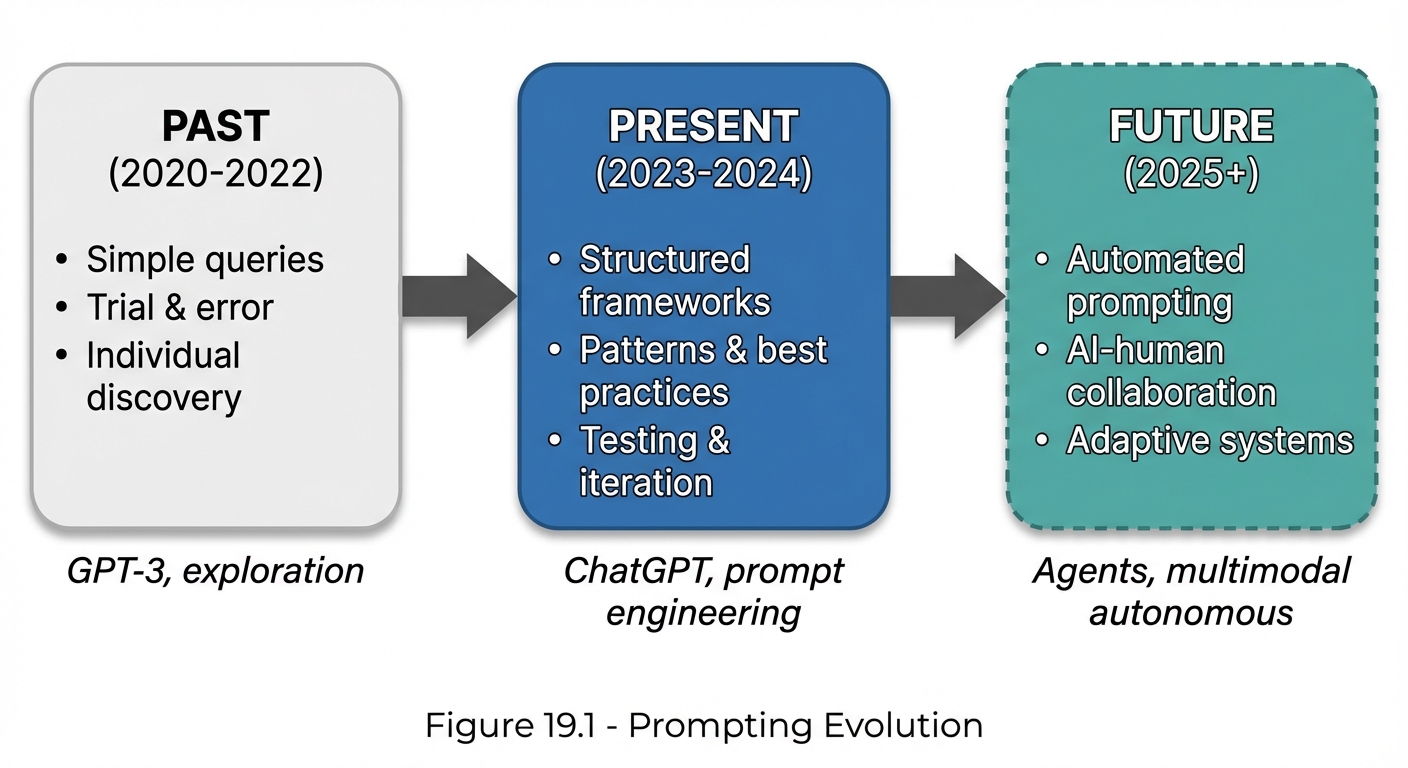 Figure 19.1: The evolution of prompting—from simple queries and trial-and-error to structured frameworks and toward automated, agentic systems.
Key Trends Shaping the Future
| Trend | Description | Impact on Prompting |
|---|---|---|
| Multimodal AI | Text + images + audio + video | Prompts will specify multiple modalities |
| AI Agents | Autonomous task execution | Prompts become objectives, not instructions |
| Longer Context | 1M+ token windows | More complex, context-rich prompting |
| Better Reasoning | Improved logical capabilities | Less need for explicit reasoning prompts |
| Tool Use | AI using external tools | Prompts define tool permissions and goals |
| Personalization | Models that adapt to users | Prompts become more implicit |
Emerging Prompt Paradigms
From Instructions to Objectives
Current: Tell AI exactly what to do step-by-step
CURRENT PARADIGM:
"First, search for X. Then, analyze the results.
Next, compare with Y. Finally, write a summary."
Future: Define objectives and let AI determine approach
EMERGING PARADIGM:
"Objective: Understand how X compares to Y
Success criteria: Accurate comparison, key differences highlighted
Tools available: Search, analysis, visualization
Constraints: Maximum 30 minutes of research"
From Single-Turn to Agentic
CURRENT: Human → Prompt → AI → Response → Human reviews

FUTURE:  Human → Objective → Agent → [Multiple steps,
         tool use, self-correction] → Result → Human verifies
From Text to Multimodal
CURRENT:
"Describe what a modern kitchen should look like"

FUTURE:
"Here's a photo of my kitchen [image]. Suggest 3 improvements
that would modernize it while keeping my existing appliances.
Show me visual mockups of each suggestion."
Skills That Will Remain Relevant
Enduring Principles
Despite technological changes, core prompting skills will remain valuable:
Transferable Skills
| Current Skill | Future Application |
|---|---|
| Context engineering | Defining agent environments |
| Instruction design | Setting agent objectives |
| Output specification | Defining success criteria |
| Quality evaluation | Verifying agent outputs |
| Testing methodology | Agent behavior validation |
| Security awareness | Agent permission management |
Continuous Learning Strategy
The Learning Framework
Staying Current
1. Follow Key Sources
AI company blogs, research papers (arXiv), practitioner communities (Reddit, Discord), industry newsletters, and updated editions of this handbook.
2. Allocate Learning Time
| Frequency | Activity |
|---|---|
| Weekly | Mon: Read AI news (30 min), Wed: Experiment with techniques (30 min), Fri: Reflect and document (30 min) |
| Monthly | Deep dive into one topic, update prompt library, share learnings |
3. Practice Deliberately
Identify skill gap → Find resources → Practice in controlled settings → Get feedback → Refine and repeat.
Building Adaptability
Adaptable Prompt Practices
| Principle | Description |
|---|---|
| Focus on Principles | Learn WHY techniques work, not just WHAT to type |
| Build Modular Libraries | Create components that can be recombined as needs change |
| Abstract Patterns | Identify patterns that transcend specific models or versions |
| Document Reasoning | Record why prompts work so you can adapt when things change |
| Test Across Models | Verify techniques work across different AI systems |
Future-Proof Skills
| Skill | Why It’s Future-Proof |
|---|---|
| Critical thinking | Always need to evaluate AI outputs |
| Clear communication | Foundation of any interaction |
| Problem decomposition | Complex problems need breaking down |
| Ethical reasoning | AI ethics will only grow in importance |
| Adaptability itself | Change is the only constant |
Long-Term Success Factors
Success Beyond Technical Skills
Career Development Path
| Track | Progression |
|---|---|
| Individual Contributor | Prompt User → Prompt Specialist → Prompt Engineer → Senior Prompt Engineer |
| Leadership | Team Lead → Manager → Director → VP/Chief AI Officer |
Community and Contribution
Learning from Others
Join communities: Reddit (r/ChatGPT, r/MachineLearning), Discord servers, LinkedIn AI groups, local meetups.
Participate actively: Ask questions, share discoveries, help newcomers, provide feedback.
Giving Back
| Category | Activities |
|---|---|
| Share Knowledge | Write blog posts, create tutorials, answer questions, mentor beginners |
| Build Resources | Open-source prompt libraries, testing frameworks, documentation, best practice guides |
| Advance the Field | Publish research, develop new techniques, create tools, present at conferences |
The Continuous Improvement Mindset
Principles for Ongoing Growth
| Principle | Description |
|---|---|
| Embrace Change | AI is evolving rapidly—expect and welcome change |
| Stay Humble | Today’s expertise may be outdated tomorrow—keep learning |
| Share Openly | The field advances faster when knowledge is shared |
| Experiment Boldly | Try new things—many won’t work, some will be breakthroughs |
| Reflect Regularly | Periodically assess your skills and update your approach |
| Build on Fundamentals | Strong foundations enable adaptation to new developments |
| Maintain Balance | Technical skills matter, but so do ethics and wisdom |
Your Personal AI Learning Journey
| Phase | Focus Areas |
|---|---|
| Current State (Quarterly) | Skill level, key strengths, areas for growth, recent learnings |
| Goals (Annually) | Technical goals, professional goals, learning goals, contribution goals |
| Actions (Monthly) | Learning activities, experiments to try, content to create, community engagement |
| Reflection (Quarterly) | What worked well, what to change, unexpected discoveries, revised priorities |
Final Thoughts
The Journey Continues
This handbook has provided a comprehensive foundation in structured prompting. But the journey doesn’t end here—it’s just beginning. AI is evolving rapidly, and the practitioners who thrive will be those who:
- Build strong foundations in core principles
- Stay curious about new developments
- Practice deliberately and consistently
- Share knowledge with others
- Adapt flexibly as the field evolves
- Act ethically in all AI interactions
Your Role in the Future
You’re not just learning to use AI—you’re helping to shape how humanity interacts with these powerful tools. The practices you adopt, the standards you uphold, and the knowledge you share all contribute to this emerging field.
Use these powers wisely.
Key Takeaways
- The field is evolving from instructions to objectives, single-turn to agents
- Core skills remain valuable—clarity, evaluation, ethics transcend specific techniques
- Continuous learning is essential in a rapidly changing field
- Adaptability comes from understanding principles, not just patterns
- Community engagement accelerates growth and contribution
- The journey continues—this handbook is a beginning, not an end
Summary
The future of prompting will look different from today, but the fundamental skills—clear communication, critical thinking, quality evaluation, ethical judgment—will remain essential. By committing to continuous learning, staying connected with the community, and maintaining adaptability, you can thrive regardless of how the technology evolves. The structured prompting skills you’ve developed through this handbook provide a strong foundation for whatever comes next.
Review Questions
- What emerging trends are shaping the future of AI prompting?
- Which prompting skills are likely to remain relevant long-term?
- What does a continuous learning strategy include?
- How can you contribute to the prompting community?
- What mindset principles support ongoing growth?
Final Exercise
Exercise 19.1: Your Learning Plan
Create a personal learning plan for the next 12 months:
- Assess your current state (skills, strengths, gaps)
- Set specific goals for each quarter
- Plan monthly learning activities
- Identify communities to join
- Define how you’ll contribute back
- Schedule quarterly reviews
Exercise 19.2: Future Vision
Write a brief vision statement (200-300 words):
- How do you see yourself using AI in 2 years?
- What skills do you want to have developed?
- What impact do you want to have made?
- What will you do differently starting today?
Chapter Navigation
| Previous | Up | Home |
|---|---|---|
| ← Chapter 18: Best Practices | Part VI: Implementation Guide | Return to Home |
Congratulations!
You’ve completed the Structured Prompting Handbook. You now have a comprehensive foundation in the art and science of effective AI prompting.
Your next steps:
- Review the chapters most relevant to your immediate needs
- Start applying techniques to real tasks today
- Begin building your personal prompt library
- Share what you learn with others
The future is being built by people like you who take the time to learn, practice, and improve. Go forth and prompt with purpose!
Thank you for reading. May your prompts be clear, your contexts be rich, and your outputs be exceptional.