Chapter 12: Prompt Quality Dimensions
Understanding What Makes Prompts and Responses Effective
Learning Objectives
After completing this chapter, you will be able to:
- Define the 5 Quality Dimensions for prompt evaluation
- Assess prompts and responses against each dimension
- Identify common quality issues
- Apply quality checklists systematically
- Prioritize quality improvements
The 5 Quality Dimensions Framework
Overview
The 5 Quality Dimensions provide a comprehensive framework for evaluating the effectiveness of AI prompts and their resulting outputs:
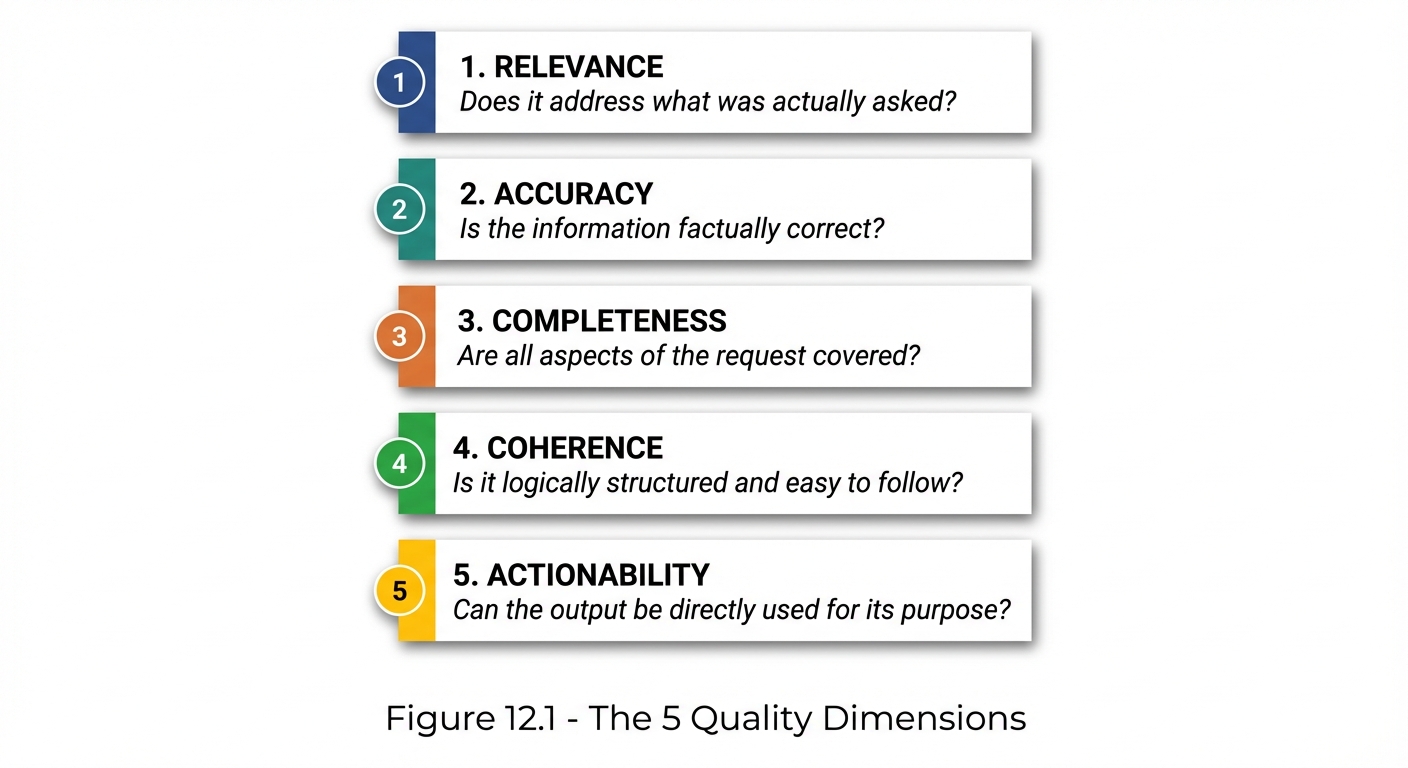 Figure 12.1: The 5 Quality Dimensions framework for comprehensive prompt and response evaluation.
Summary Table
| Dimension | Definition | Key Question |
|---|---|---|
| Relevance | Alignment with request | “Did it answer what I asked?” |
| Accuracy | Factual correctness | “Is the information correct?” |
| Completeness | Full coverage | “Did it address everything?” |
| Coherence | Logical structure | “Does it make sense?” |
| Actionability | Practical utility | “Can I use this directly?” |
Dimension 1: Relevance
Definition
Relevance measures how well the response addresses the actual request. A relevant response directly answers the question asked, not a related or tangential question.
Relevance Indicators
| Score | Description | Example |
|---|---|---|
| 5 | Perfectly on-topic, addresses exact request | Asked about X, got comprehensive answer about X |
| 4 | Mostly relevant, minor tangents | Addressed X with some useful but unrequested Y |
| 3 | Partially relevant, significant drift | Answered X but spent equal time on Y |
| 2 | Marginally relevant, mostly off-topic | Touched on X but mainly discussed Y |
| 1 | Not relevant, wrong question answered | Asked about X, got answer about Z |
Common Relevance Issues
| Issue | Cause | Solution |
|---|---|---|
| Wrong interpretation | Ambiguous prompt | Clarify the specific question |
| Scope creep | No boundaries specified | Define what’s in/out of scope |
| Over-generalization | Context missing | Add specific context |
| Topic drift | Weak instruction | Anchor to specific task |
Improving Relevance
❌ LOW RELEVANCE PROMPT:
"Tell me about Python"
[Could go anywhere—history, features, comparisons, tutorials...]

✅ HIGH RELEVANCE PROMPT:
"Explain Python's list comprehension syntax with 3 examples
showing filtering, transformation, and nested loops."
[Specific topic, specific format, specific number]
Dimension 2: Accuracy
Definition
Accuracy measures the factual correctness of the information provided. An accurate response contains no errors, false claims, or misleading information.
Accuracy Indicators
| Score | Description | Example |
|---|---|---|
| 5 | All facts verified, fully accurate | Technical details all correct |
| 4 | Minor inaccuracies, non-critical | Small error that doesn’t affect usefulness |
| 3 | Some inaccuracies, partially reliable | Mix of correct and incorrect information |
| 2 | Significant inaccuracies, unreliable | Major errors that could cause problems |
| 1 | Fundamentally wrong, misleading | Core information is false |
Accuracy Risk Factors
HIGH RISK (More likely to be inaccurate):
• Specific numbers, dates, statistics
• Recent events (after training cutoff)
• Technical specifications
• Legal/medical/financial advice
• Niche domain knowledge

LOWER RISK (More likely to be accurate):
• General concepts
• Well-established facts
• Logical reasoning
• Common patterns
• Widely-known information
Improving Accuracy
Request Verification:
"Provide the answer, then list your sources or indicate
which parts you're most/least confident about."
Constrain to Known Information:
"Only include information you're confident is accurate.
If uncertain, say 'I'm not certain about X' rather than guessing."
Request Caveats:
"For any technical specifications, note if they may have
changed since your training data."
Dimension 3: Completeness
Definition
Completeness measures whether all aspects of the request have been addressed. A complete response covers every part of the question without significant omissions.
Completeness Indicators
| Score | Description | Example |
|---|---|---|
| 5 | All points addressed thoroughly | Every question answered in full |
| 4 | Most points covered, minor gaps | 90% coverage, small omission |
| 3 | Partial coverage, notable gaps | Answered 2 of 4 parts |
| 2 | Significant omissions | Major aspects missing |
| 1 | Barely addressed | Only superficially touched |
Completeness Checklist
For any multi-part request, verify:

□ Part 1 of question → Addressed? Y/N
□ Part 2 of question → Addressed? Y/N
□ Part 3 of question → Addressed? Y/N
□ Implied requirements → Addressed? Y/N
□ Edge cases mentioned → Addressed? Y/N
Improving Completeness
Explicit Enumeration:
"Address each of the following points:
1. [Point 1]
2. [Point 2]
3. [Point 3]

For each point, provide [specific requirement]."
Completeness Check Instruction:
"After your response, review the original request and
confirm you've addressed every part. Note any parts
you couldn't fully address."
Dimension 4: Coherence
Definition
Coherence measures the logical structure and flow of the response. A coherent response is organized, follows a logical progression, and is easy to understand.
Coherence Indicators
| Score | Description | Example |
|---|---|---|
| 5 | Perfectly structured, logical flow | Clear organization, smooth transitions |
| 4 | Well-organized, minor flow issues | Good structure, occasional jumps |
| 3 | Adequate structure, some confusion | Organization present but inconsistent |
| 2 | Poorly organized, hard to follow | Jumbled information, unclear connections |
| 1 | Incoherent, confusing | No discernible structure |
Coherence Elements
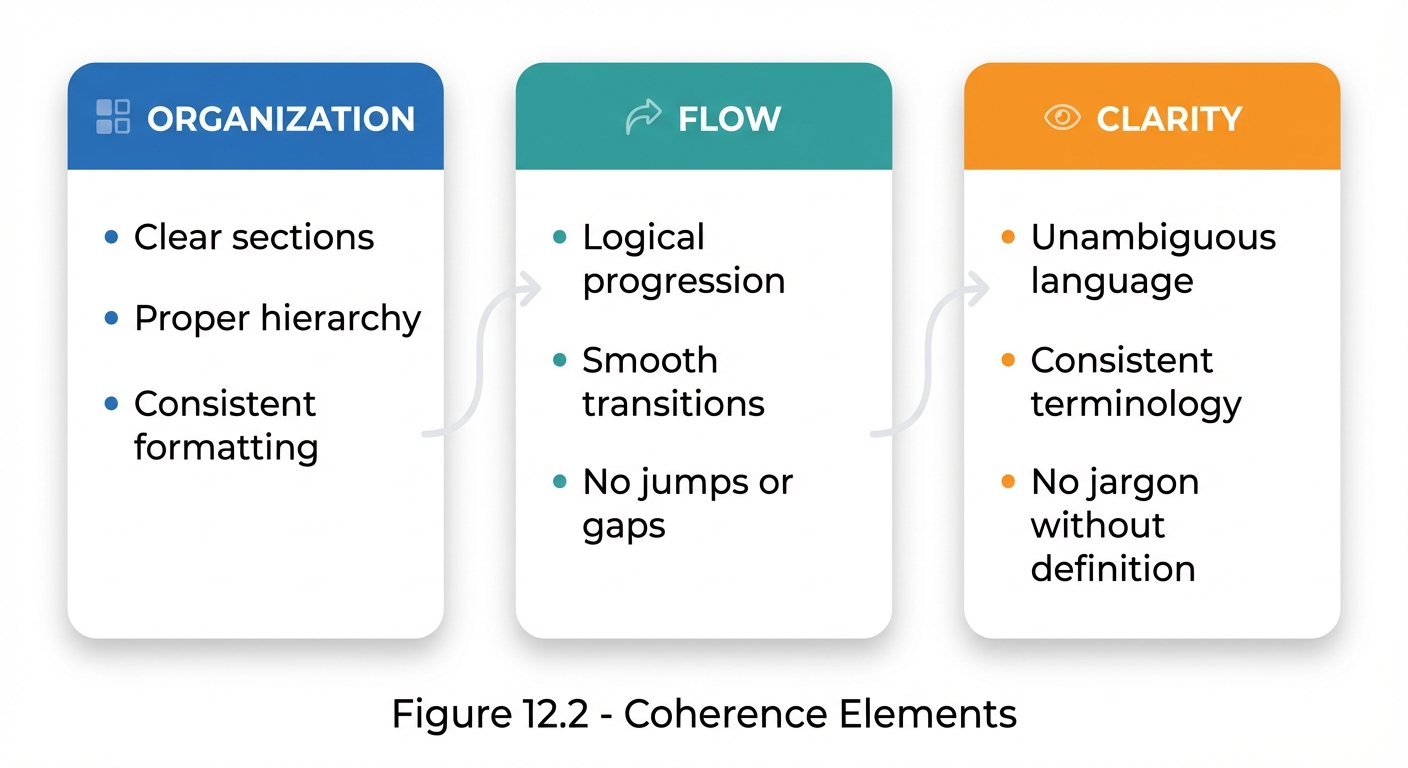 Figure 12.2: The three elements of coherence—Organization, Flow, and Clarity—that make responses understandable.
Improving Coherence
Structure Specification:
"Organize your response as:
1. Summary (1-2 sentences)
2. Main explanation (3-4 paragraphs)
3. Key takeaways (bullet points)

Use headers for each section."
Flow Instruction:
"Present information in logical order, from basic to advanced.
Use transition phrases between major points."
Dimension 5: Actionability
Definition
Actionability measures whether the output can be directly used for its intended purpose. An actionable response requires no additional transformation before use.
Actionability Indicators
| Score | Description | Example |
|---|---|---|
| 5 | Immediately usable as-is | Code runs, content is ready to publish |
| 4 | Usable with minor adjustments | Small tweaks needed |
| 3 | Requires moderate work | Useful but needs significant editing |
| 2 | Foundation only, major work needed | Starting point but far from done |
| 1 | Not usable without complete rework | Must start over |
Actionability Factors
HIGHLY ACTIONABLE:
✓ Correct format for intended use
✓ Complete—no placeholders or TODOs
✓ Tested/verified (for code)
✓ Appropriate level of detail
✓ Ready for target audience

POORLY ACTIONABLE:
✗ Wrong format
✗ Contains [placeholder text]
✗ Missing critical pieces
✗ Too abstract or theoretical
✗ Requires significant adaptation
Improving Actionability
Format Matching:
"Provide the output in a format I can directly use:
- If code: Complete, runnable, with no placeholders
- If copy: Publication-ready, no [INSERT X HERE]
- If plan: Specific actions, not general advice"
Completeness Requirement:
"Do not use placeholders. If you're unsure about a specific
detail, ask me rather than using [TODO] or similar."
Quality Assessment Template
Full Assessment Form
## Prompt Quality Assessment

**Prompt ID:** [Identifier]
**Date:** [Date]
**Use Case:** [Description]

### Prompt Text
[The prompt being evaluated]

### Response Summary
[Brief summary of the response received]

### Quality Scoring (1-5 scale)

| Dimension | Score | Notes |
|:----------|:-----:|:------|
| Relevance | _/5 | |
| Accuracy | _/5 | |
| Completeness | _/5 | |
| Coherence | _/5 | |
| Actionability | _/5 | |
| **TOTAL** | _/25 | |

### Issues Identified
1. [Issue 1]
2. [Issue 2]

### Root Cause Analysis
[Why did these issues occur?]

### Prompt Improvements
[Specific changes to make]

### Revised Prompt
[The improved version]
Quick Assessment
For rapid evaluation, use this abbreviated form:
Quick Quality Check:

Relevance:     □ On-target  □ Partial  □ Off-topic
Accuracy:      □ Correct    □ Mostly   □ Errors
Completeness:  □ Full       □ Partial  □ Gaps
Coherence:     □ Clear      □ Okay     □ Confusing
Actionability: □ Ready      □ Needs work □ Not usable

Action: □ Use as-is  □ Minor edit  □ Re-prompt
Quality Improvement Workflow
The Improvement Cycle
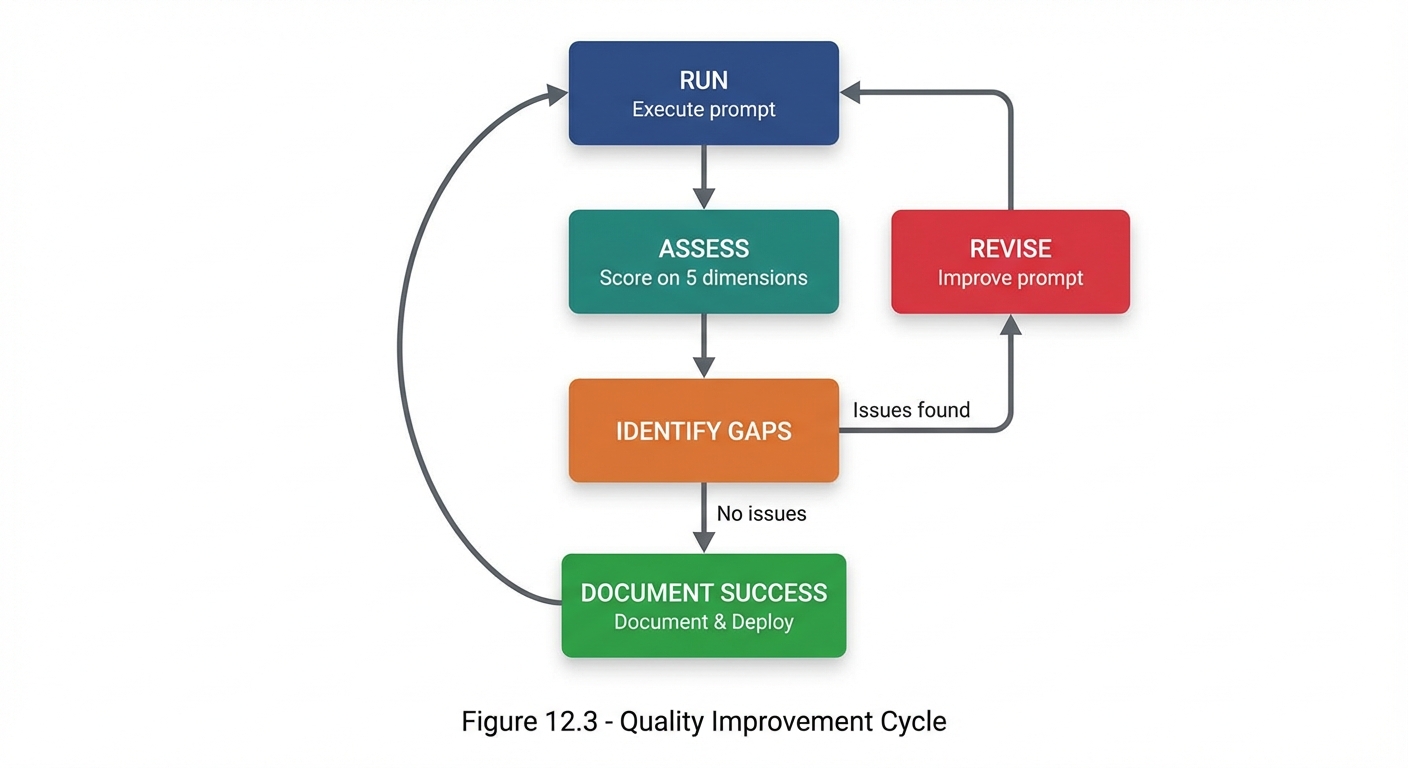 Figure 12.3: The quality improvement cycle—assess, identify gaps, revise, and repeat until success.
Prioritizing Improvements
| Priority | Focus First On |
|---|---|
| 1 | Relevance - If it’s not addressing the right question, nothing else matters |
| 2 | Accuracy - Wrong information is worse than incomplete |
| 3 | Completeness - Missing pieces limit usefulness |
| 4 | Coherence - Structure can be fixed with formatting |
| 5 | Actionability - Final polish for direct use |
Key Takeaways
- The 5 Quality Dimensions provide a comprehensive evaluation framework
- Relevance ensures you get answers to what you actually asked
- Accuracy ensures information is correct
- Completeness ensures nothing important is missing
- Coherence ensures the response is understandable
- Actionability ensures the output is usable
- Systematic assessment identifies specific areas for improvement
Summary
Quality assessment transforms prompt engineering from guesswork into a measurable discipline. The 5 Quality Dimensions—Relevance, Accuracy, Completeness, Coherence, and Actionability—provide a framework for evaluating any prompt-response pair. By systematically assessing against these dimensions, you can identify specific weaknesses and make targeted improvements. Over time, this practice builds intuition for what makes prompts effective.
Review Questions
- What are the 5 Quality Dimensions and their key questions?
- Why is Relevance typically the first dimension to address?
- What factors increase accuracy risk?
- How do you measure Completeness for multi-part requests?
- What makes a response “actionable”?
Practical Exercise
Exercise 12.1: Quality Assessment
Take a recent AI interaction and assess it using the full assessment template. Score each dimension and identify areas for improvement.
Exercise 12.2: Prompt Revision
Using your assessment from 12.1, revise the prompt to address the identified weaknesses. Re-run and compare quality scores.