Chapter 11: Multi-Turn Conversation Design
Orchestrating Effective Extended Conversations
Learning Objectives
After completing this chapter, you will be able to:
- Design multi-turn conversation flows
- Manage state and context across turns
- Handle conversation branches effectively
- Implement context accumulation strategies
- Recover from conversation breakdowns
Understanding Multi-Turn Conversations
What Makes Multi-Turn Different?
Single-turn: One prompt → One response (self-contained)
Multi-turn: Series of exchanges that build on each other
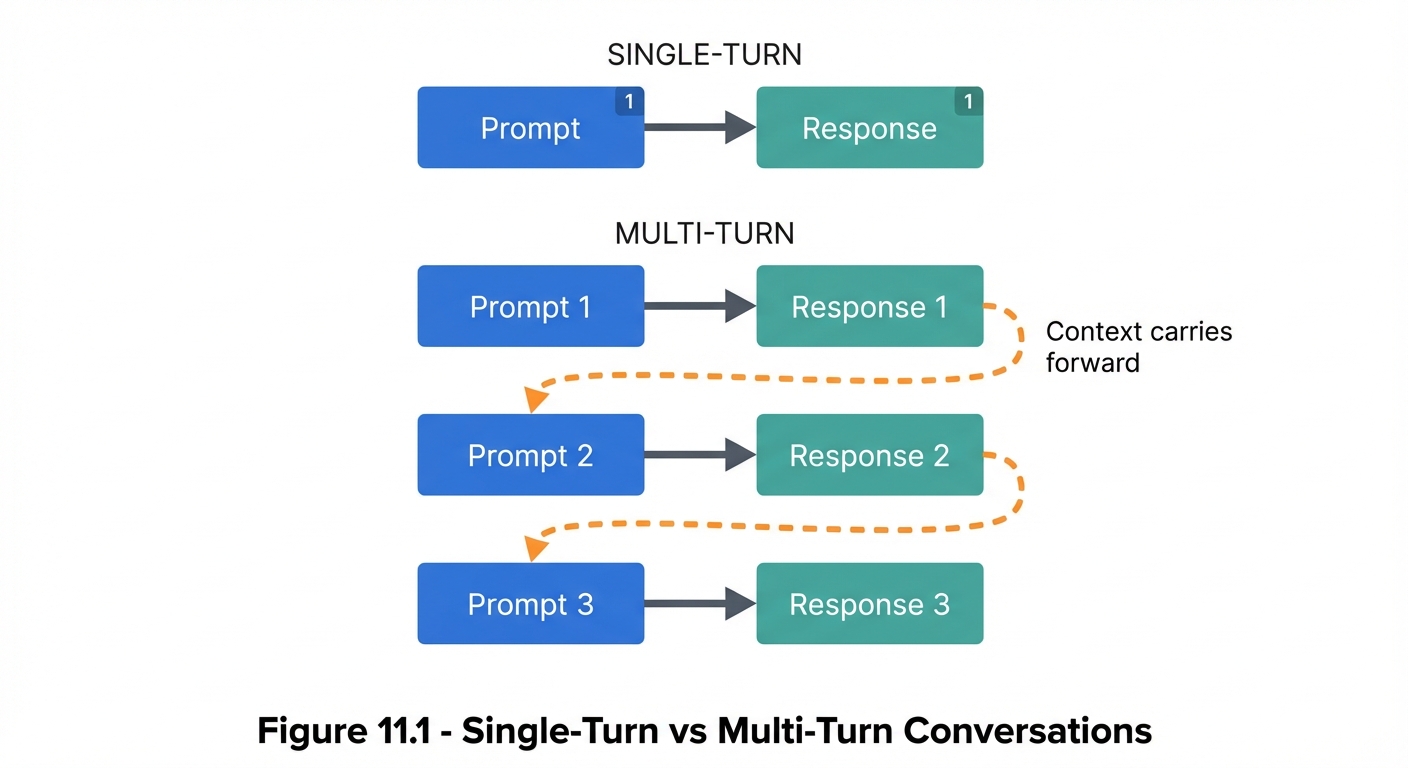 Figure 11.1: Single-turn conversations are self-contained, while multi-turn conversations build context across exchanges.
Key Challenges
| Challenge | Description |
|---|---|
| Context Management | Keeping relevant information across turns |
| State Tracking | Remembering what’s been established |
| Coherence | Maintaining logical flow |
| Context Limits | Staying within token windows |
| Branching | Handling topic changes and returns |
Conversation Flow Design
Conversation Structures
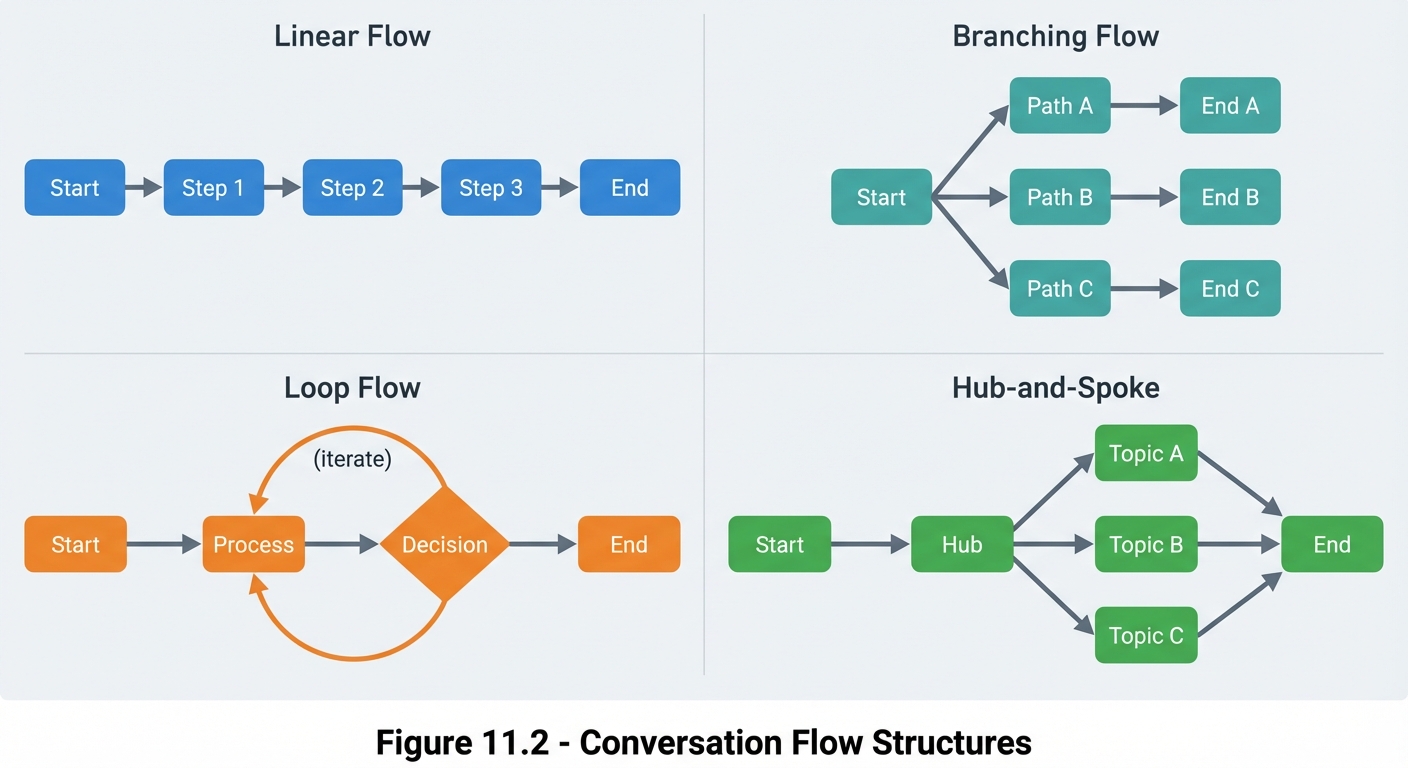 Figure 11.2: Four common conversation flow structures—choose based on task requirements and user interaction patterns.
Flow Design Template
## Conversation Flow: [Name]

### Objective
[What the conversation should accomplish]

### Stages
1. [Stage 1: e.g., Greeting/Discovery]
   - Goal: [What to achieve]
   - Key questions: [What to ask]
   - Transition trigger: [When to move on]

2. [Stage 2: e.g., Information Gathering]
   - Goal: [What to achieve]
   - Key questions: [What to ask]
   - Transition trigger: [When to move on]

3. [Stage 3: e.g., Solution/Conclusion]
   - Goal: [What to achieve]
   - Actions: [What to do]
   - Closing: [How to end]

### Branching Points
- If [condition]: [Go to alternative path]
- If [condition]: [Handle differently]

### Recovery Points
- If lost/confused: [Reset strategy]
- If off-topic: [Redirect strategy]
State Management
What Is Conversational State?
State is the accumulated context that influences how subsequent exchanges are interpreted and handled.
Types of State
 Figure 11.3: The three types of conversational state that must be tracked across multi-turn interactions.
Explicit State Tracking
Instruct the AI to maintain explicit state:
System Prompt Addition:

Maintain a mental note of:
- User's goal for this conversation
- Key facts they've shared
- Decisions made together
- Current stage of the process

If the conversation has been long, briefly summarize your understanding
before continuing to ensure alignment.
State Summary Pattern
After every 3-4 exchanges, provide a brief state summary:

"Let me make sure I have this right:
- You're looking to [goal]
- You've mentioned [key facts]
- We've decided on [decisions]
- We're now working on [current stage]

Is that correct?"
Context Accumulation Strategies
The Context Window Challenge
Total Context Window: 8,000 tokens

Turn 1:  System (500) + User (100) + AI (300)   = 900  tokens
Turn 2:  + User (100) + AI (400)                = 1,400 tokens
Turn 3:  + User (150) + AI (350)                = 1,900 tokens
Turn 4:  + User (200) + AI (500)                = 2,600 tokens
...
Turn 10: [Context window filling up...]         = 6,500 tokens
Turn 15: [Approaching limit...]                 = 8,000 tokens
Strategy 1: Progressive Summarization
System Prompt:

When the conversation exceeds 10 exchanges, include a brief
summary of key points before your response:

"Building on our discussion about [topic]:
- [Key point 1]
- [Key point 2]
- [Current focus]

[New response]"
Strategy 2: Key Fact Extraction
Maintain a running list of key facts:

**Established Facts:**
1. [Fact from turn 1]
2. [Fact from turn 3]
3. [Updated fact from turn 5]

[Reference these facts rather than re-explaining]
Strategy 3: Rolling Context
Keep only the most recent N exchanges plus essential context:
Always Include:
- System prompt
- Initial request/goal
- Most recent 3-5 exchanges
- Critical decisions/facts

May Truncate:
- Intermediate exploration
- Superseded information
- Off-topic tangents
Strategy 4: Explicit Handoffs
At natural breakpoints:

"We've completed [phase 1]. Here's what we established:
[Summary]

Now let's move to [phase 2]. What's your first question?"
Handling Conversation Branches
Branch Types
| Type | Description | Example |
|---|---|---|
| Clarification | User seeks more detail | “Can you explain X more?” |
| Tangent | User explores related topic | “What about Y instead?” |
| Correction | User fixes misunderstanding | “No, I meant Z” |
| Reset | User wants to start over | “Let’s go back to…” |
| Fork | User explores alternative | “What if we did A instead?” |
Branch Management
System Prompt Addition:

When the conversation branches:

Clarification: Provide the detail, then return to main thread.
"[Detailed explanation] Does that clarify? Now, back to [main topic]..."

Tangent: Acknowledge, address briefly, offer to explore or continue.
"Good question about [tangent]. Briefly: [answer]. Would you like to
explore this more, or continue with [main topic]?"

Correction: Acknowledge, adjust understanding, continue.
"I understand now—you meant [correction]. Let me adjust..."

Reset: Confirm, summarize what to keep, restart.
"Sure, let's go back to [point]. Keep in mind we established [key facts].
So from [point], what would you like to do?"
Visual Branch Tracking
Main Thread: A → B → C → D → E
                  ↓
             Branch: X → Y
                         ↓
                    Return to D
Conversation Recovery
Common Breakdown Types
| Breakdown | Symptoms | Recovery |
|---|---|---|
| Lost context | AI forgets earlier info | Summarize and confirm |
| Misalignment | AI solves wrong problem | Restate goal explicitly |
| Loop | Conversation repeats | Break pattern, meta-comment |
| Deadlock | No progress being made | Change approach, ask user |
| Confusion | Neither party clear | Step back, clarify basics |
Recovery Prompts
For Lost Context:
"I want to make sure I'm tracking everything correctly. Could you
briefly summarize what we're working on and where we are?"
For Misalignment:
"It seems like we might be solving different problems. Let me
restate my understanding: I think you want [X]. Is that right,
or is it actually [Y]?"
For Loops:
"I notice we keep coming back to the same point. Let's try a
different approach: [new angle]"
For Deadlock:
"We seem to be stuck. What if we:
A) [Option A]
B) [Option B]
C) Take a step back and reconsider the whole approach

Which would be most helpful?"
Multi-Turn Design Patterns
Pattern 1: The Interview
Goal: Gather structured information through conversation

Turn 1: Set context, ask first question
Turn 2: Acknowledge, ask follow-up
Turn 3: Probe deeper on key point
Turn 4: Confirm understanding
Turn 5: Summarize and conclude

Example:
AI: "I'll help you plan your project. First, what's the main goal?"
User: "Increase user engagement"
AI: "Got it. What's your current engagement level, and what's your target?"
User: "10% active, want 25%"
AI: "Significant goal. What have you tried so far?"
User: "Email campaigns, didn't work well"
AI: "So, to summarize: You want to increase from 10% to 25% active users,
    and email campaigns haven't been effective. Let's explore alternatives..."
Pattern 2: The Tutorial
Goal: Teach through progressive steps

Turn 1: Explain concept
Turn 2: User practices/questions
Turn 3: Feedback and next concept
Turn 4: User practices
Turn 5: Review and reinforce

System Instruction:
"Teach step by step. After each concept, ask the user to demonstrate
understanding before moving on. If they struggle, provide more examples
before continuing."
Pattern 3: The Collaboration
Goal: Create something together iteratively

Turn 1: Understand goal
Turn 2: Propose initial draft
Turn 3: User feedback
Turn 4: Revise based on feedback
Turn 5: Repeat until satisfied

System Instruction:
"Work collaboratively. After each draft:
1. Present your work
2. Ask for specific feedback
3. Confirm understanding of feedback
4. Revise accordingly"
Pattern 4: The Debug Session
Goal: Diagnose and solve a problem

Turn 1: Understand symptom
Turn 2: Hypothesize causes
Turn 3: Gather diagnostic info
Turn 4: Test hypothesis
Turn 5: Apply and verify fix

System Instruction:
"Debug systematically. Don't jump to solutions. Ask diagnostic
questions first. State hypotheses clearly. Verify fixes work."
Testing Multi-Turn Designs
Test Scenarios
1. **Happy Path**: Standard flow, cooperative user
2. **Confused User**: User gives vague or conflicting info
3. **Topic Jump**: User suddenly changes subject
4. **Long Session**: Conversation exceeds 15 exchanges
5. **Correction**: User corrects mid-conversation
6. **Abandonment**: User loses interest
7. **Return**: User returns to earlier topic
Evaluation Criteria
| Criterion | Question |
|---|---|
| Coherence | Does the conversation flow logically? |
| Memory | Are earlier points remembered and used? |
| Recovery | Does it handle interruptions gracefully? |
| Efficiency | Is progress made without repetition? |
| Satisfaction | Does it achieve the user’s goal? |
Key Takeaways
- Multi-turn conversations require explicit state management
- Context accumulation strategies prevent information loss
- Conversation flows should be designed, not accidental
- Branch handling keeps conversations productive
- Recovery mechanisms rescue broken conversations
- Testing should cover various user behaviors
Summary
Multi-turn conversation design transforms isolated exchanges into coherent, productive dialogues. By managing state, designing flows, handling branches, and building in recovery mechanisms, you can create AI interactions that handle complex tasks requiring sustained engagement. The key is thinking of conversation as a designed experience, not just a series of responses.
Review Questions
- What are the four types of conversation state?
- Name three context accumulation strategies.
- What are the five branch types and how should each be handled?
- How do you recover from a “lost context” breakdown?
- What makes the Interview pattern different from the Collaboration pattern?
Practical Exercise
Exercise 11.1: Conversation Flow Design
Design a multi-turn conversation flow for “Helping a user plan a vacation”:
- Identify 4-5 stages
- Define transition triggers
- Plan for at least 2 branching scenarios
- Include recovery strategies
Exercise 11.2: State Management
For the vacation planning conversation, define:
- What user state to track
- What task state to track
- How to summarize state at checkpoints
- How to handle context window limits