Chapter 6: Instruction Design Principles
Writing Clear, Actionable Instructions That AI Can Follow
Learning Objectives
After completing this chapter, you will be able to:
- Construct clear, unambiguous instructions
- Apply the instruction hierarchy effectively
- Handle ambiguity in task specifications
- Sequence instructions for complex tasks
- Test instructions for clarity and completeness
The Role of Instructions
What Are Instructions?
Instructions are the action-oriented components of a prompt that tell the AI what to do. They transform context into directed action.
Instructions vs. Context
| Aspect | Context | Instructions |
|---|---|---|
| Purpose | Provides background | Directs action |
| Nature | Descriptive | Imperative |
| Focus | Situation | Task |
| Grammar | Statements | Commands |
Example Distinction
CONTEXT: "We are a B2B SaaS company in the project management space.
Our target audience is mid-size professional services firms."

INSTRUCTION: "Write three value propositions highlighting time savings,
collaboration features, and integration capabilities."
The Instruction Hierarchy
Understanding Priority
Instructions can operate at different levels, with higher levels taking precedence:
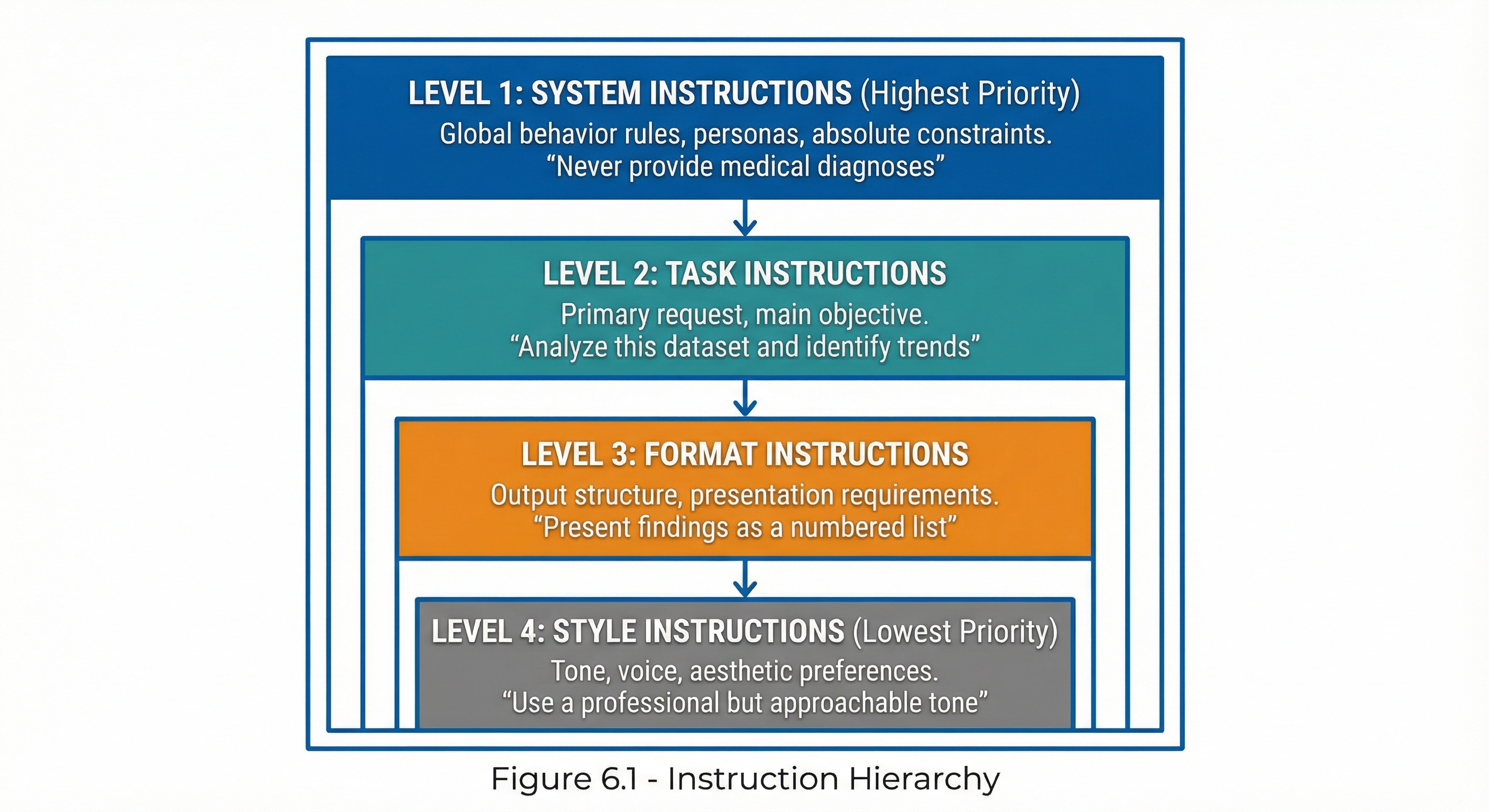 Figure 6.1: The four-level instruction hierarchy showing priority order—system instructions override all others.
Hierarchy in Practice
When instructions conflict, higher levels override lower levels:
System Instruction: "Always cite sources for factual claims"
Task Instruction: "Write a quick summary without citations"

Result: The AI should still cite sources (system overrides task)
Principles of Clear Instructions
Principle 1: Be Specific
Vague instructions invite interpretation; specific instructions direct action.
| Vague | Specific |
|---|---|
| “Improve this code” | “Refactor this function to reduce cyclomatic complexity below 10” |
| “Make it better” | “Increase the click-through rate by making the CTA more prominent” |
| “Write about AI” | “Write a 500-word introduction to neural networks for college freshmen” |
Principle 2: Use Action Verbs
Start instructions with clear action verbs:
| Weak | Strong |
|---|---|
| “You could analyze…” | “Analyze…” |
| “It would be good to…” | “Identify…” |
| “Maybe consider…” | “Evaluate…” |
Common Action Verbs
| Category | Verbs |
|---|---|
| Creation | Write, Create, Generate, Draft, Compose |
| Analysis | Analyze, Evaluate, Compare, Assess, Review |
| Transformation | Convert, Translate, Refactor, Simplify, Expand |
| Organization | List, Categorize, Rank, Prioritize, Structure |
| Explanation | Explain, Describe, Summarize, Clarify, Define |
Principle 3: One Instruction, One Action
Break complex instructions into discrete steps:
❌ COMBINED:
"Analyze the data, identify trends, create visualizations,
and write a summary report with recommendations."

✅ SEPARATED:
"1. Analyze the dataset for patterns and anomalies
2. Identify the top 3 significant trends
3. Describe appropriate visualization for each trend
4. Summarize findings in 200 words
5. Provide 3 actionable recommendations"
Principle 4: Define Success Criteria
Make the goal measurable or verifiable:
❌ UNCLEAR: "Write a good product description"

✅ CLEAR: "Write a product description that:
- Is 100-150 words
- Includes 3 key features
- Contains one compelling benefit statement
- Ends with a call-to-action"
Handling Ambiguity
Types of Ambiguity
| Type | Example | Solution |
|---|---|---|
| Lexical | “Fix the bug” (which bug?) | Specify the exact issue |
| Structural | “Fast car rental service” | Clarify: fast cars or fast service? |
| Referential | “Analyze it” (what’s ‘it’?) | Use explicit references |
| Scope | “Improve the design” (all of it?) | Define boundaries |
Ambiguity Resolution Strategies
Strategy 1: Explicit Enumeration
Instead of: "Handle the errors"
Use: "Handle these specific errors:
1. Network timeout (retry with exponential backoff)
2. Invalid input (return validation message)
3. Authentication failure (redirect to login)"
Strategy 2: Example Clarification
Instead of: "Format like a professional report"
Use: "Format as a professional report:
- Title page with date and author
- Executive summary (1 page max)
- Body with numbered sections
- Appendix for detailed data

Example structure:
1. Introduction
2. Methodology
3. Findings
4. Recommendations"
Strategy 3: Boundary Definition
Instead of: "Improve the user experience"
Use: "Improve the checkout flow user experience specifically:
- In scope: Shopping cart to payment confirmation
- Out of scope: Product browsing, account management
- Focus on: Reducing steps, clearer progress indication"
Instruction Sequencing
Why Sequence Matters
The order of instructions affects how AI processes and prioritizes them.
Sequencing Principles
Principle 1: Critical First Place the most important instructions early.
Principle 2: Logical Flow Order instructions in the sequence they should be considered or executed.
Principle 3: Constraints Before Actions State limitations before the task they constrain.
Sequencing Example
✅ WELL-SEQUENCED:

**Constraints (First):**
- Maximum 500 words
- No technical jargon
- Must include a real-world analogy

**Task (Second):**
Explain how blockchain works to a high school student.

**Format (Third):**
1. Opening hook (1 sentence)
2. Core explanation (3-4 paragraphs)
3. Practical example
4. Summary of key points
Sequencing for Multi-Step Tasks
STEP 1: Read and understand the provided code
↓
STEP 2: Identify potential security vulnerabilities
↓
STEP 3: Rank vulnerabilities by severity
↓
STEP 4: For the top 3 vulnerabilities:
   a. Explain the risk
   b. Show the vulnerable code
   c. Provide corrected code
↓
STEP 5: Summarize overall security posture
Instruction Patterns
Pattern: The Explicit Request
[Action Verb] + [Object] + [Specifications]

"Write a function that calculates compound interest
with parameters for principal, rate, time, and compounding frequency."
Pattern: The Conditional Instruction
IF [condition] THEN [action] ELSE [alternative]

"If the input contains PII, redact it and note what was removed.
Otherwise, process the input normally."
Pattern: The Prioritized List
Complete the following in order of priority:
1. [Critical task]
2. [Important task]
3. [Nice-to-have task]

If time/space is limited, complete as many as possible starting from #1.
Pattern: The Iterative Refinement
First: Generate an initial draft
Then: Review for [criteria]
Finally: Revise to address any issues found

Show both the initial draft and final version.
Pattern: The Comparative Analysis
Compare [A] and [B] across these dimensions:
- [Dimension 1]
- [Dimension 2]
- [Dimension 3]

Present as a table, then provide a recommendation.
Testing Your Instructions
The Interpretation Test
Ask: “Could someone interpret this differently than I intend?”
❌ AMBIGUOUS: "Make the button better"
Interpretations: Bigger? Different color? Different text? Different position?

✅ UNAMBIGUOUS: "Make the button more prominent by:
- Increasing size to 48px height
- Using primary brand color (#0066CC)
- Adding 'Get Started Now' as the text"
The Completeness Test
Ask: “Do my instructions cover all necessary aspects?”
Checklist:
- What to do (task)
- How to do it (method/approach)
- What to produce (output)
- What to avoid (constraints)
- How to handle edge cases
The Clarity Test
Ask: “Would a new team member understand this?”
❌ INSIDER LANGUAGE:
"Use the standard TPS report format for the Q4 metrics"

✅ EXPLICIT:
"Format as a quarterly metrics report with:
- Executive summary (1 paragraph)
- KPI table (metric, target, actual, variance)
- Trend analysis (2-3 paragraphs)
- Action items (bulleted list)"
Instruction Refinement Workflow
The Refinement Loop
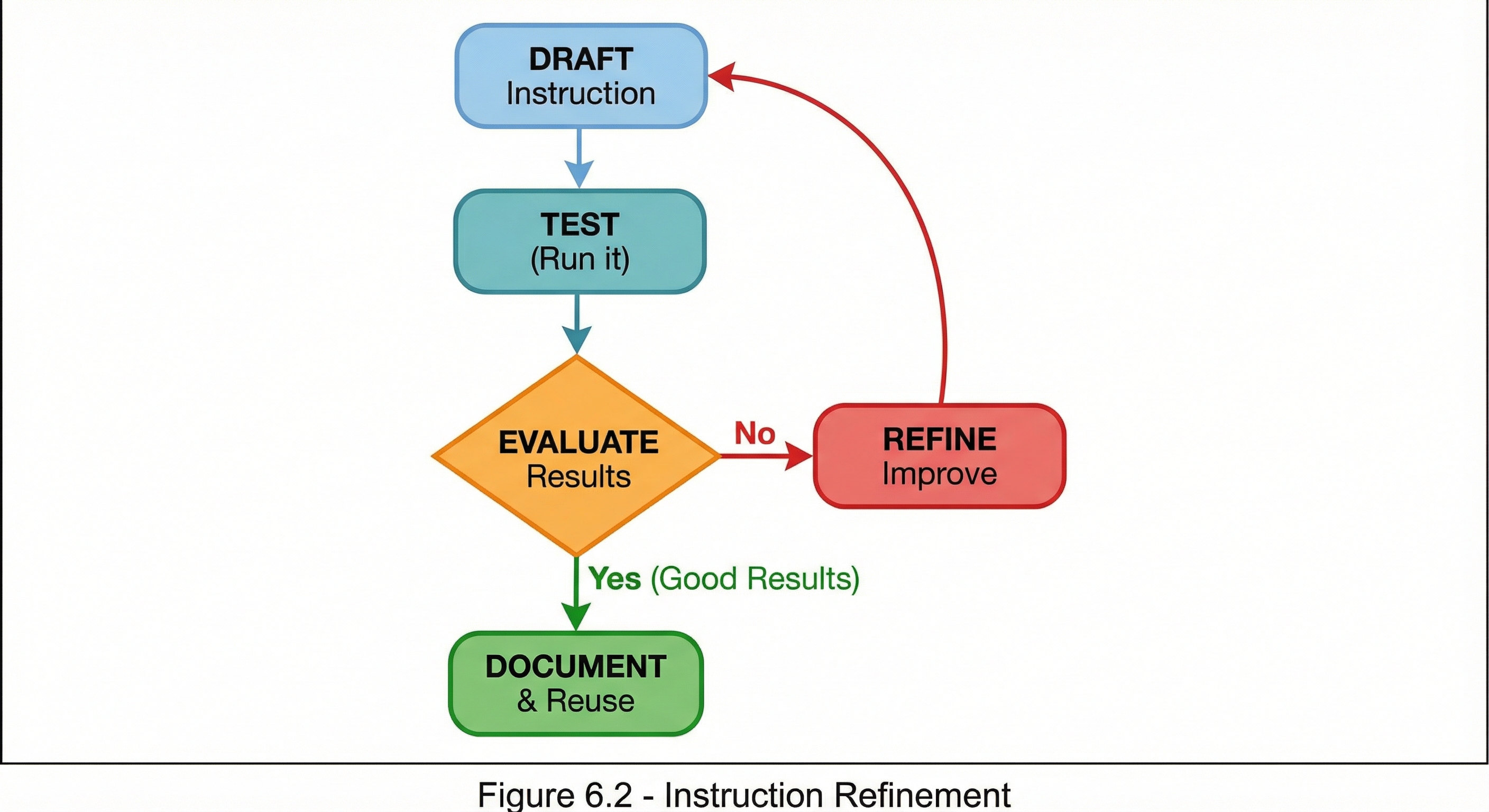 Figure 6.2: The instruction refinement loop—an iterative process for improving instruction clarity through testing and evaluation.
Refinement Questions
After testing, ask:
- Did the output match expectations?
- What was missing or wrong?
- What instruction would have prevented that?
- Is the refined instruction still clear?
Common Instruction Mistakes
Mistake 1: Instruction Overload
Problem: Too many instructions overwhelm and confuse.
❌ OVERLOADED:
"Write, edit, proofread, format, optimize for SEO, add images,
include citations, translate to Spanish, and publish the article."

✅ FOCUSED:
"Write a 1000-word article on [topic]. I'll handle editing and SEO separately."
Mistake 2: Contradictory Instructions
Problem: Instructions conflict with each other.
❌ CONTRADICTORY:
"Be concise. Include comprehensive details on all aspects."

✅ RESOLVED:
"Provide comprehensive details, but express each point concisely—
no filler words or redundant explanations."
Mistake 3: Assuming Prior Knowledge
Problem: Instructions assume understanding that doesn’t exist.
❌ ASSUMES:
"Use the standard format for the client deck"

✅ EXPLICIT:
"Format as a client presentation:
- 10-15 slides
- One key point per slide
- Executive summary on slide 2
- Recommendation on final slide"
Key Takeaways
- Instructions direct action; they are the imperative core of prompts
- The instruction hierarchy determines priority when conflicts arise
- Specific, action-oriented language produces better results
- Break complex tasks into discrete, sequential steps
- Ambiguity is the enemy—resolve it through explicit specification
- Test and refine instructions through iterative improvement
Summary
Instruction design is where prompting becomes actionable. Clear, specific, well-sequenced instructions transform context and intent into directed AI behavior. By applying the principles in this chapter—specificity, action verbs, single-action steps, success criteria, and systematic ambiguity resolution—you ensure your prompts produce the outputs you actually need.
Review Questions
- What are the four levels of the instruction hierarchy?
- Why should complex instructions be broken into discrete steps?
- What are three strategies for resolving ambiguity?
- How does instruction sequencing affect AI output?
- What three tests can you apply to evaluate instruction clarity?
Practical Exercise
Exercise 6.1: Instruction Improvement
Take this vague instruction and improve it: “Help me with my presentation”
Improved version should include:
- Specific action verbs
- Clear deliverables
- Format specifications
- Success criteria
Exercise 6.2: Instruction Sequencing
Given this task: “Create a marketing email campaign for a product launch”
Write sequenced instructions that:
- Define the task hierarchy
- Break into logical steps
- Include constraints
- Specify output format