Chapter 3: The Prompting Pillars Framework
The 7 Pillars That Form the Foundation of Effective AI Communication
Learning Objectives
After completing this chapter, you will be able to:
- Name and define the 7 Prompting Pillars
- Explain how the pillars work together
- Apply each pillar to improve your prompts
- Assess prompts using the pillar framework
- Identify which pillars need strengthening in any given prompt
Introduction to the 7 Prompting Pillars
The 7 Prompting Pillars framework provides a comprehensive mental model for constructing effective prompts. Each pillar represents a critical dimension of prompt design. Together, they ensure your prompts are complete, clear, and capable of eliciting the results you need.
The Pillars Overview
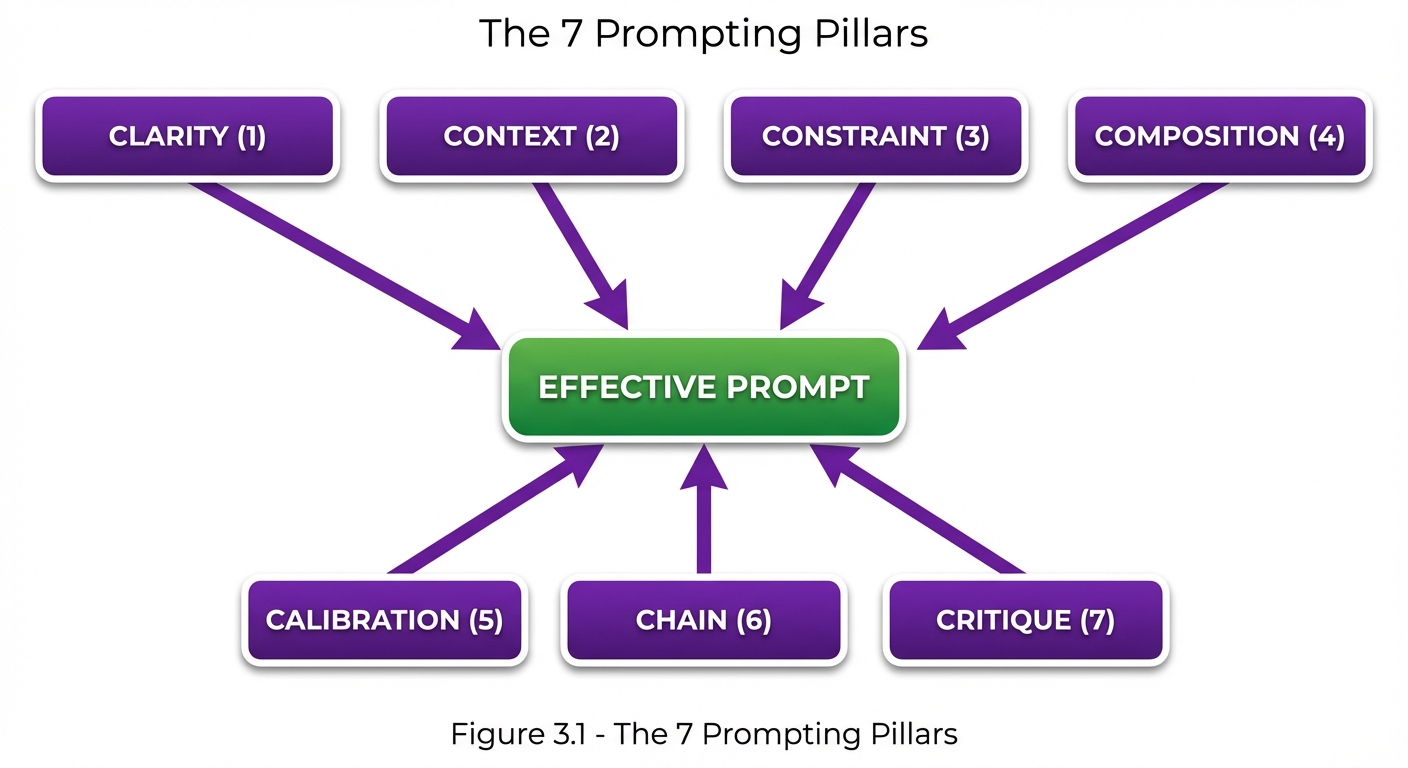 Figure 3.1: The 7 Prompting Pillars - A comprehensive framework where seven interconnected pillars work together to create effective prompts. Pillars 1-4 provide structural elements while Pillars 5-7 add refinement and quality assurance.
Quick Reference
| # | Pillar | Core Question | Focus |
|---|---|---|---|
| 1 | Clarity | Is the intent unambiguous? | Communication |
| 2 | Context | Is relevant background provided? | Information |
| 3 | Constraint | Are boundaries defined? | Limitations |
| 4 | Composition | Is structure specified? | Format |
| 5 | Calibration | Is tone/style appropriate? | Voice |
| 6 | Chain | Is reasoning enabled? | Logic |
| 7 | Critique | Is self-evaluation built in? | Quality |
Pillar 1: Clarity
Definition
Clarity ensures that your prompt communicates intent without ambiguity. A clear prompt leaves no room for misinterpretation.
Why It Matters
Ambiguous prompts lead to:
- Responses that miss the point
- Multiple interpretations of the same request
- Wasted iterations clarifying intent
Clarity Principles
| Principle | Description | Example |
|---|---|---|
| Specificity | State exactly what you want | “List 5 items” vs. “List some items” |
| Precision | Use exact terms | “Python 3.11” vs. “Python” |
| Directness | Avoid hedging | “Write code” vs. “Could you maybe write code?” |
| Completeness | Include all requirements | “Sort ascending by date” vs. “Sort the list” |
Clarity Assessment
❌ UNCLEAR: "Help me with my code"
- What code? What kind of help?

✅ CLEAR: "Debug the Python function below that should calculate
          compound interest but returns incorrect values for
          periods greater than 12 months."
- Specific task, language, problem described
Clarity Checklist
- Task is explicitly stated
- No ambiguous pronouns (it, this, that) without clear referents
- Technical terms are precise
- Quantities are specified where relevant
- Success criteria are defined
Pillar 2: Context
Definition
Context provides the background information needed for the AI to understand and appropriately respond to your request.
Why It Matters
Without sufficient context:
- Responses may be generic rather than specific
- Critical assumptions may be wrong
- Output may not fit your actual situation
Types of Context
| Type | Description | Example |
|---|---|---|
| Domain | Field or industry | “In healthcare compliance…” |
| Task | What you’re trying to accomplish | “For a sales presentation…” |
| User | Who you are or represent | “As a junior developer…” |
| System | Technical environment | “Using React 18 with TypeScript…” |
| Historical | Previous relevant information | “Following up on our earlier discussion…” |
Context Loading Pattern
**Domain Context:**
You are helping with financial analysis for a mid-size retail company.

**Task Context:**
We're preparing for Q4 board presentation.

**Data Context:**
Here are the quarterly sales figures: [data]

**Constraint Context:**
The board prefers visual summaries and dislikes jargon.

**Request:**
Create an executive summary of Q4 performance.
Context Calibration
Too little context:
"Write a function to process the data."
Right amount of context:
"Write a Python function that processes customer transaction data
(CSV format with columns: date, customer_id, amount, category)
and returns monthly spending totals by category."
Too much context:
[Unnecessary company history, irrelevant technical details,
personal anecdotes that don't affect the task...]
Pillar 3: Constraint
Definition
Constraint defines the boundaries, limitations, and requirements that the response must adhere to.
Why It Matters
Without constraints:
- Responses may be too long or too short
- Content may include unwanted elements
- Output may violate important requirements
Types of Constraints
| Type | Examples |
|---|---|
| Length | “Maximum 200 words”, “Exactly 5 bullet points” |
| Format | “JSON only”, “No markdown”, “Table format” |
| Content | “No technical jargon”, “Include citations” |
| Scope | “Only discuss X”, “Exclude Y” |
| Style | “Formal language”, “Simple vocabulary” |
| Technical | “Python 3.x only”, “No external dependencies” |
Constraint Specification Pattern
**Constraints:**
- Length: 150-200 words
- Format: Bullet points
- Tone: Professional but approachable
- Must include: Action items
- Must exclude: Technical implementation details
- Audience: C-level executives
Positive vs. Negative Constraints
| Type | Example | Use When |
|---|---|---|
| Positive | “Include a summary” | Requiring specific elements |
| Negative | “Do not include code” | Excluding specific elements |
| Bounded | “Between 100-150 words” | Setting ranges |
Pillar 4: Composition
Definition
Composition specifies the structure, format, and organization of the desired output.
Why It Matters
Clear composition specifications:
- Make outputs immediately usable
- Ensure consistency across responses
- Enable automated processing
Composition Elements
| Element | Description | Example |
|---|---|---|
| Structure | Overall organization | “Three sections: Intro, Body, Conclusion” |
| Format | Output type | “JSON”, “Markdown table”, “Numbered list” |
| Sections | Required parts | “Include: Summary, Details, Next Steps” |
| Hierarchy | Nesting and levels | “H2 for main points, H3 for sub-points” |
Composition Templates
List Format:
Provide your response as a numbered list:
1. [First item]
2. [Second item]
...
Table Format:
Format as a markdown table with columns:
| Item | Description | Priority |
JSON Format:
Return valid JSON with this structure:
{
  "summary": "string",
  "items": ["array", "of", "strings"],
  "confidence": number
}
Structured Sections:
Organize your response with these sections:
## Overview
[High-level summary]

## Details
[In-depth analysis]

## Recommendations
[Actionable next steps]
Pillar 5: Calibration
Definition
Calibration sets the tone, style, persona, and voice for the response.
Why It Matters
Proper calibration ensures:
- Appropriate language for the audience
- Consistent voice across interactions
- Responses that match the situation
Calibration Dimensions
| Dimension | Spectrum |
|---|---|
| Formality | Casual ←→ Formal |
| Complexity | Simple ←→ Technical |
| Emotion | Neutral ←→ Empathetic |
| Confidence | Tentative ←→ Assertive |
| Detail | High-level ←→ Granular |
Calibration Techniques
Role Assignment:
You are a senior software architect with 20 years of experience.
Respond as this expert would.
Audience Specification:
Explain this for a non-technical audience who has never
used a computer terminal.
Tone Direction:
Use an encouraging, supportive tone suitable for a
nervous first-time presenter.
Style Matching:
Match the writing style of the following example:
[Example text]
Calibration Examples
| Scenario | Calibration |
|---|---|
| Executive briefing | Formal, high-level, confident |
| User documentation | Friendly, step-by-step, patient |
| Technical review | Precise, detailed, objective |
| Customer support | Empathetic, solution-focused, clear |
Pillar 6: Chain
Definition
Chain enables logical sequencing, step-by-step reasoning, and structured thinking processes.
Why It Matters
Chain-of-thought approaches:
- Improve accuracy on complex problems
- Make reasoning transparent
- Enable verification of logic
Chain Techniques
| Technique | Description | Trigger Phrase |
|---|---|---|
| Step-by-step | Sequential reasoning | “Think through this step by step” |
| Show work | Visible reasoning | “Show your reasoning” |
| Decomposition | Break into parts | “First analyze X, then Y, then Z” |
| Verification | Self-check | “Verify your answer” |
Chain Patterns
Basic Chain:
Solve this problem step by step, showing your work:
[Problem]
Structured Chain:
Approach this in three phases:
1. UNDERSTAND: Restate the problem in your own words
2. PLAN: Outline your approach
3. EXECUTE: Implement the solution
Verification Chain:
1. Solve the problem
2. Check your solution against the requirements
3. Identify any potential issues
4. Provide your final answer
When to Use Chain
| Task Type | Chain Benefit |
|---|---|
| Math problems | Shows calculation steps |
| Logic puzzles | Reveals reasoning process |
| Complex analysis | Structures thinking |
| Code debugging | Traces through logic |
| Decision making | Documents factors considered |
Pillar 7: Critique
Definition
Critique builds in self-evaluation, quality checks, and iterative refinement.
Why It Matters
Built-in critique:
- Catches errors before delivery
- Improves output quality
- Enables self-correction
Critique Techniques
| Technique | Description | Example |
|---|---|---|
| Self-review | Check own work | “Review your response for errors” |
| Alternative check | Consider other options | “What might you have missed?” |
| Quality rating | Self-assess | “Rate confidence 1-10” |
| Assumption check | Surface assumptions | “What assumptions are you making?” |
Critique Patterns
Post-Response Review:
After providing your answer:
1. Review for factual accuracy
2. Check for completeness
3. Note any uncertainties
Confidence Indication:
End your response with:
- Confidence level (High/Medium/Low)
- Any caveats or limitations
- Suggested verification steps
Alternative Consideration:
After your recommendation:
1. State the main recommendation
2. Provide one alternative approach
3. Explain trade-offs between them
Pillar Integration
How the Pillars Work Together
The pillars are not isolated—they interact and reinforce each other:
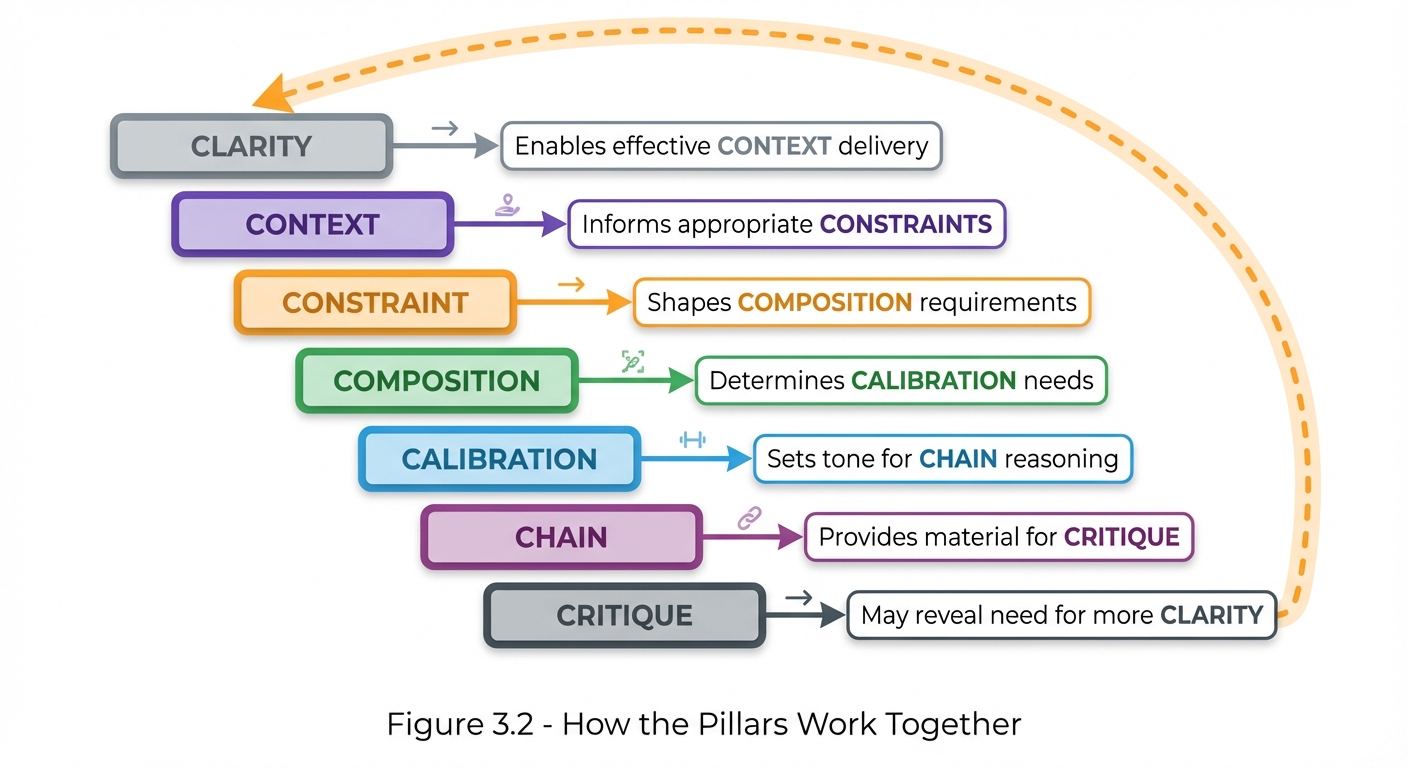 Figure 3.2: Pillar Interactions - Each pillar builds upon and enables the next in a continuous improvement cycle. Clear intent enables context delivery, which informs constraints, and so on through critique, which may reveal the need for additional clarity.
Complete Example
Here’s a prompt that integrates all seven pillars:
**CONTEXT (Pillar 2):**
You are a senior data scientist at a fintech company. We're building
a fraud detection system for credit card transactions.

**CLARITY (Pillar 1):**
Design a feature engineering pipeline that extracts behavioral
patterns from transaction data to identify anomalies.

**CONSTRAINTS (Pillar 3):**
- Must process 10,000 transactions per second
- Cannot use customer PII directly
- Must be explainable for regulatory compliance
- Implementation in Python

**COMPOSITION (Pillar 4):**
Structure your response as:
1. Feature Categories (table format)
2. Implementation Approach (numbered steps)
3. Example Code (Python)
4. Validation Strategy

**CALIBRATION (Pillar 5):**
Write for a technical audience familiar with ML but new to fraud detection.
Use precise terminology but explain domain-specific concepts.

**CHAIN (Pillar 6):**
Think through this systematically:
- First, identify what transaction patterns indicate fraud
- Then, determine how to encode these as features
- Finally, consider computational efficiency

**CRITIQUE (Pillar 7):**
After your design, evaluate:
- Potential blind spots in the feature set
- Scalability concerns
- Regulatory compliance risks
Pillar Assessment Tool
Rate Your Prompts
For any prompt, rate each pillar 1-5:
| Pillar | Score (1-5) | Notes |
|---|---|---|
| Clarity | ___ | Is intent unambiguous? |
| Context | ___ | Is background sufficient? |
| Constraint | ___ | Are boundaries clear? |
| Composition | ___ | Is format specified? |
| Calibration | ___ | Is tone appropriate? |
| Chain | ___ | Is reasoning enabled? |
| Critique | ___ | Is self-check built in? |
| Total | ___/35 |
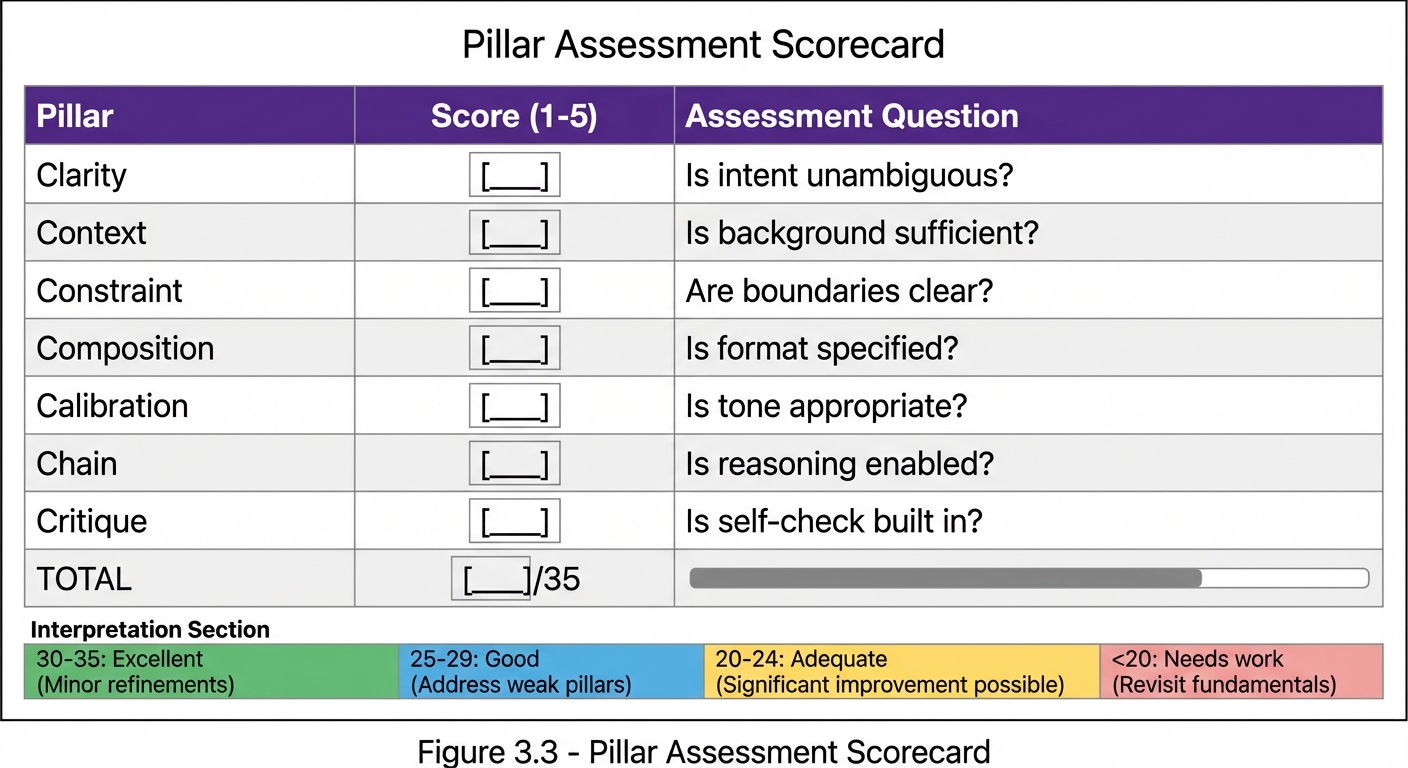 Figure 3.3: Pillar Assessment Scorecard - Use this tool to evaluate any prompt against the 7 Pillars. Rate each pillar 1-5, calculate your total, and use the interpretation guide to identify areas for improvement.
Interpretation
| Score | Level | Action |
|---|---|---|
| 30-35 | Excellent | Minor refinements |
| 25-29 | Good | Address weak pillars |
| 20-24 | Adequate | Significant improvement possible |
| <20 | Needs work | Revisit fundamentals |
Key Takeaways
- The 7 Prompting Pillars provide a comprehensive framework for prompt design
- Clarity ensures unambiguous communication
- Context provides necessary background
- Constraint defines boundaries
- Composition specifies structure
- Calibration sets tone and style
- Chain enables reasoning
- Critique builds in quality checks
- Pillars work together—strengthen all for best results
Summary
The 7 Prompting Pillars framework transforms prompt creation from an ad-hoc activity into a systematic process. By considering each pillar—Clarity, Context, Constraint, Composition, Calibration, Chain, and Critique—you ensure your prompts are comprehensive, effective, and capable of eliciting high-quality responses. Use this framework as a checklist for every important prompt you craft.
Review Questions
- Name all 7 Prompting Pillars and their core focus areas.
- What are three types of context you might include in a prompt?
- How do positive and negative constraints differ?
- When is the Chain pillar most valuable?
- What techniques implement the Critique pillar?
Practical Exercise
Exercise 3.1: Pillar Analysis
Take a recent prompt you’ve used and analyze it against each pillar. Identify which pillars are strong and which need improvement. Then rewrite the prompt to address the weak areas.
Exercise 3.2: Pillar Building
Start with this basic prompt and add elements for each pillar:
Basic: “Write a blog post about AI.”
Enhanced with all 7 pillars: [Your improved version]