Chapter 19: Moving Forward with Continuous Improvement
Learning Objectives
After completing this chapter, you will be able to:
- Apply handbook knowledge to your organizational context
- Develop your personal and organizational OCM capabilities
- Establish continuous improvement for OCM practices
- Connect with the broader OCM community and resources
- Chart your path forward in OCM practice
Applying What You’ve Learned
This handbook has provided a comprehensive guide to organizational change management. The real value comes from applying this knowledge to your specific organizational context.
Getting Started
If you’re new to OCM, begin with these foundational steps:
Assess your current situation: Where is your organization on the OCM maturity model? What OCM practices currently exist, even if informal?
Identify a starting point: You don’t need to implement everything at once. Select one or two areas for initial focus based on greatest need or opportunity.
Find sponsors and allies: Identify leaders who understand OCM value and stakeholders who would benefit from improved change practices.
Start small and demonstrate value: Apply OCM principles to a visible change and document the results. Success stories build support for broader adoption.
Build gradually: Expand OCM application and capability incrementally as you demonstrate value and build organizational support.
For Experienced Practitioners
If you already practice OCM, use this handbook to:
- Benchmark your practices against the frameworks and best practices presented
- Identify gaps in your current approach
- Refresh and update methodologies that may have become stale
- Build capability in areas where you’re less experienced
- Develop common language and frameworks for your organization
Developing OCM Capability
Personal Development
Continuous learning is essential for OCM practitioners:
Formal Education
- Prosci Change Management Certification
- ACMP Certified Change Management Professional (CCMP)
- Graduate programs in organizational development
- Industry conferences and workshops
Experience Building
- Seek diverse change assignments (different types, sizes, industries)
- Take on challenging changes that stretch your capabilities
- Learn from both successes and failures
- Document your learnings and case studies
Skill Development
- Communication and facilitation skills
- Coaching and consulting skills
- Data analysis and measurement skills
- Strategic thinking and business acumen
Network Building
- Connect with other OCM practitioners
- Join professional associations
- Participate in communities of practice
- Find mentors and be a mentor
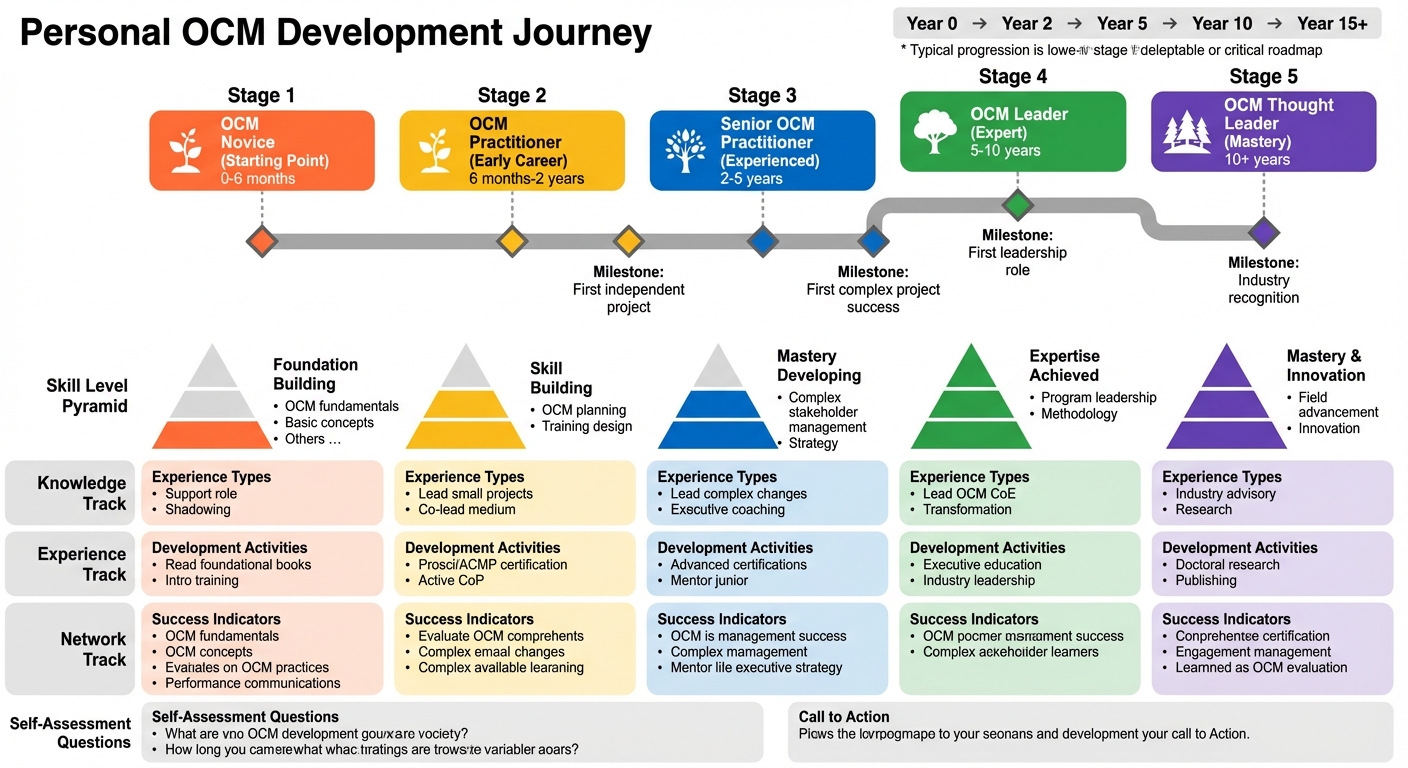
Figure 19.2 - Personal OCM Development Journey: OCM mastery develops through five stages over 10-15+ years. Progress requires continuous learning, diverse experiences, and contribution to others. Your journey is unique; this map provides typical progression.
Organizational Development
Build organizational OCM capability systematically:
Foundation Building
- Establish OCM as a recognized discipline
- Develop or adopt standard methodology
- Create basic tools and templates
- Train initial practitioners
Capability Expansion
- Expand practitioner pool
- Apply OCM to more changes
- Build supporting infrastructure
- Develop governance and standards
Maturity Advancement
- Measure and optimize practices
- Build change-ready culture
- Integrate OCM into organizational systems
- Achieve sustainable capability
Continuous Improvement
Improvement Framework
Apply continuous improvement principles to OCM practice:
Plan: Identify improvement opportunities based on data and feedback
Do: Implement improvements in controlled manner
Check: Evaluate results against expectations
Act: Standardize what works; adjust what doesn’t
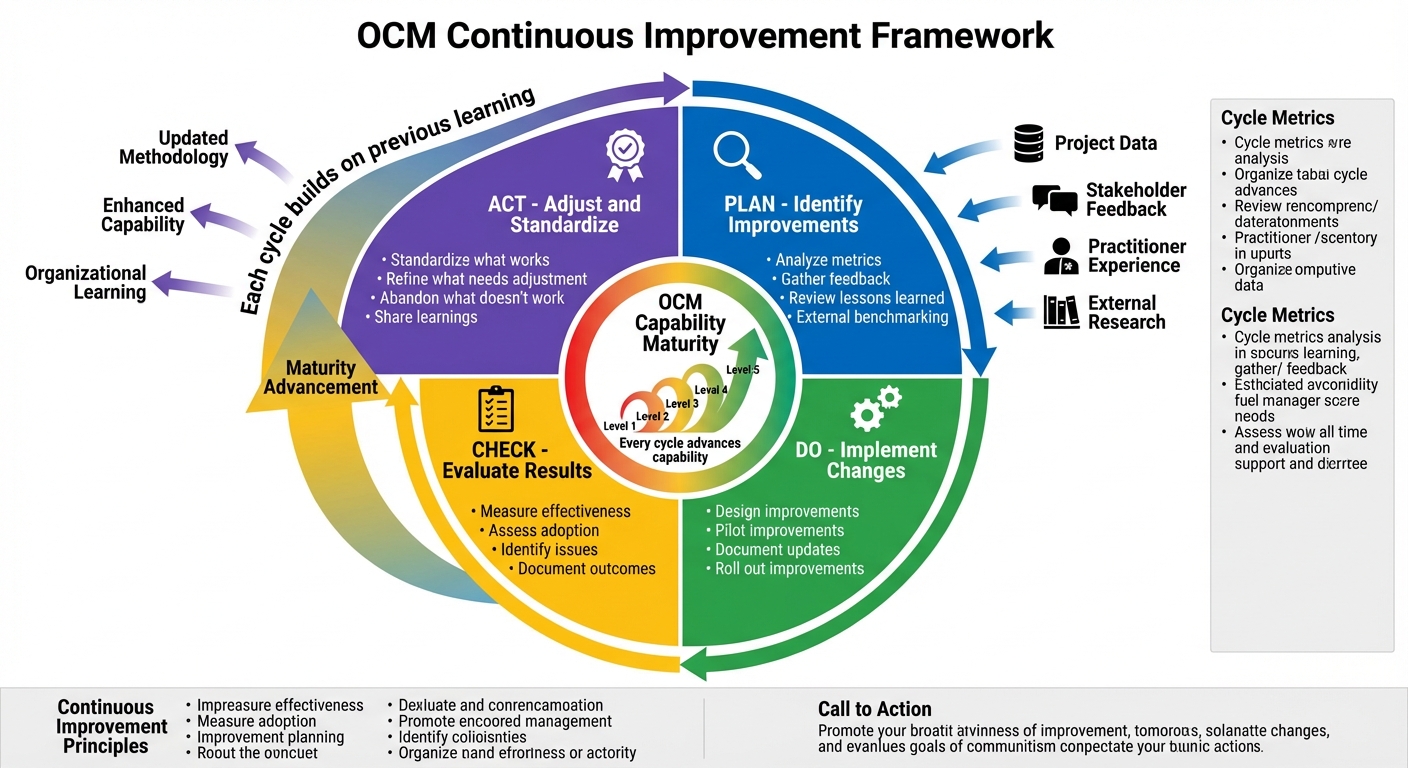
Figure 19.1 - OCM Continuous Improvement Framework: Systematic improvement cycle advances OCM capability through Plan-Do-Check-Act. Each cycle builds on previous learning, progressively advancing maturity from ad-hoc to optimized.
Sources of Improvement Insights
Metrics Analysis
- Which metrics consistently fall short of targets?
- What patterns emerge across changes?
- Where do outcomes vary most?
Stakeholder Feedback
- What do impacted stakeholders say about OCM support?
- What do sponsors and leaders observe?
- What do practitioners find most challenging?
Lessons Learned
- What works well that should be standardized?
- What problems recur that should be addressed?
- What innovations have shown promise?
External Benchmarking
- How do industry leaders approach OCM?
- What emerging practices should be considered?
- What can be learned from research and publications?
Improvement Priorities
Focus improvement efforts on areas with greatest impact:
| Priority | Focus | Indicators |
|---|---|---|
| High | Areas where current practice consistently underperforms | Metrics below target, repeated problems |
| Medium | Areas where practice is adequate but could improve | Meeting targets but room for efficiency |
| Low | Areas where practice is strong | Exceeding targets, few problems |
The Evolving Landscape
Emerging Trends in OCM
The field of organizational change management continues to evolve:
Agile and Continuous Change
- Shift from discrete projects to continuous change
- Adaptation of OCM for agile and iterative approaches
- Building organizational capacity for ongoing adaptation
Digital Transformation
- Managing human side of digital change
- Remote and hybrid workforce considerations
- Digital tools for OCM activities
Employee Experience
- Integration of OCM with employee experience
- Focus on change fatigue and wellbeing
- Building resilient, adaptable workforce
Data and Analytics
- Increased use of data in OCM decision-making
- Predictive analytics for change risk
- Real-time adoption monitoring
Cultural Change
- Deeper focus on cultural transformation
- Integration with diversity, equity, and inclusion
- Building inclusive change practices
Staying Current
Stay current with OCM developments:
- Follow OCM thought leaders and publications
- Attend industry conferences
- Participate in professional associations
- Engage with research and academic work
- Experiment with emerging practices
Resources for Continued Learning
Professional Associations
Association of Change Management Professionals (ACMP)
- Global community of change practitioners
- CCMP certification program
- Annual conference and events
- Standards and body of knowledge
Prosci
- ADKAR model and methodology
- Research and benchmarking
- Certification programs
- Resources and tools
Key Publications
Books
- “ADKAR: A Model for Change in Business, Government, and Our Community” by Jeff Hiatt
- “Leading Change” by John Kotter
- “Switch: How to Change Things When Change Is Hard” by Chip and Dan Heath
- “Managing Transitions” by William Bridges
Research
- Prosci Best Practices in Change Management
- Academic journals (Journal of Change Management, etc.)
- Industry research from consulting firms
Communities
- LinkedIn OCM groups
- Local ACMP chapters
- Organization-specific communities of practice
- Industry-specific OCM networks
Your Path Forward
Reflection Questions
As you conclude this handbook, consider:
Where are you now? What is your current OCM capability—personal and organizational?
Where do you want to be? What does OCM success look like for you and your organization?
What’s the gap? What specific capabilities, practices, or resources need development?
What’s your next step? What single action will you take to move forward?
Committing to Action
Knowledge without action is wasted. Commit to specific actions:
This Week: What one thing will you do in the next week to apply what you’ve learned?
This Month: What one capability will you develop in the coming month?
This Quarter: What one improvement will you drive in the coming quarter?
This Year: What one goal will you achieve in the coming year?
Final Thoughts
Organizational change management is both a discipline and a craft. The frameworks, methodologies, and best practices in this handbook provide structure and guidance. But effective OCM also requires judgment, empathy, and adaptability that come from experience and reflection.
The organizations that will thrive in an increasingly dynamic environment are those that master change. They don’t just survive change—they embrace it, lead it, and leverage it for competitive advantage. OCM capability is not optional for these organizations; it’s essential.
Your role as an OCM practitioner is to help people successfully navigate the human side of change. You help them move from confusion to clarity, from resistance to engagement, from incompetence to proficiency. This work matters—not just for organizational performance, but for the people whose work lives you help make better.
The journey of OCM mastery is lifelong. Every change is an opportunity to learn and improve. Every success builds confidence and capability. Every failure—learned from and not repeated—becomes wisdom.
Go forward with confidence. Apply what you’ve learned. Learn from what you apply. And help your organization become truly change-ready.
Acknowledgments
This handbook synthesizes knowledge from decades of change management research and practice. Thanks to the many practitioners, researchers, and thought leaders whose work informs these pages. And thanks to you, the reader, for your commitment to mastering this essential discipline.