Chapter 14: Maturity Model and Assessment
Learning Objectives
After completing this chapter, you will be able to:
- Understand the five levels of OCM maturity
- Assess your organization’s current OCM maturity level
- Identify improvement opportunities at each maturity level
- Develop a roadmap for advancing OCM maturity
- Apply maturity model insights to improve change outcomes
The Value of Maturity Assessment
OCM maturity assessment helps organizations understand their current capability for managing the people side of change and provides a roadmap for improvement. Organizations with higher OCM maturity consistently achieve better change outcomes—faster adoption, less resistance, higher sustainment, and better benefits realization.
Maturity assessment serves several purposes:
Benchmark Current State: Understand where you are today
Identify Gaps: Recognize specific areas needing improvement
Prioritize Investments: Focus limited resources on highest-impact improvements
Track Progress: Measure advancement over time
Set Expectations: Calibrate expectations based on current capability
The Five Maturity Levels
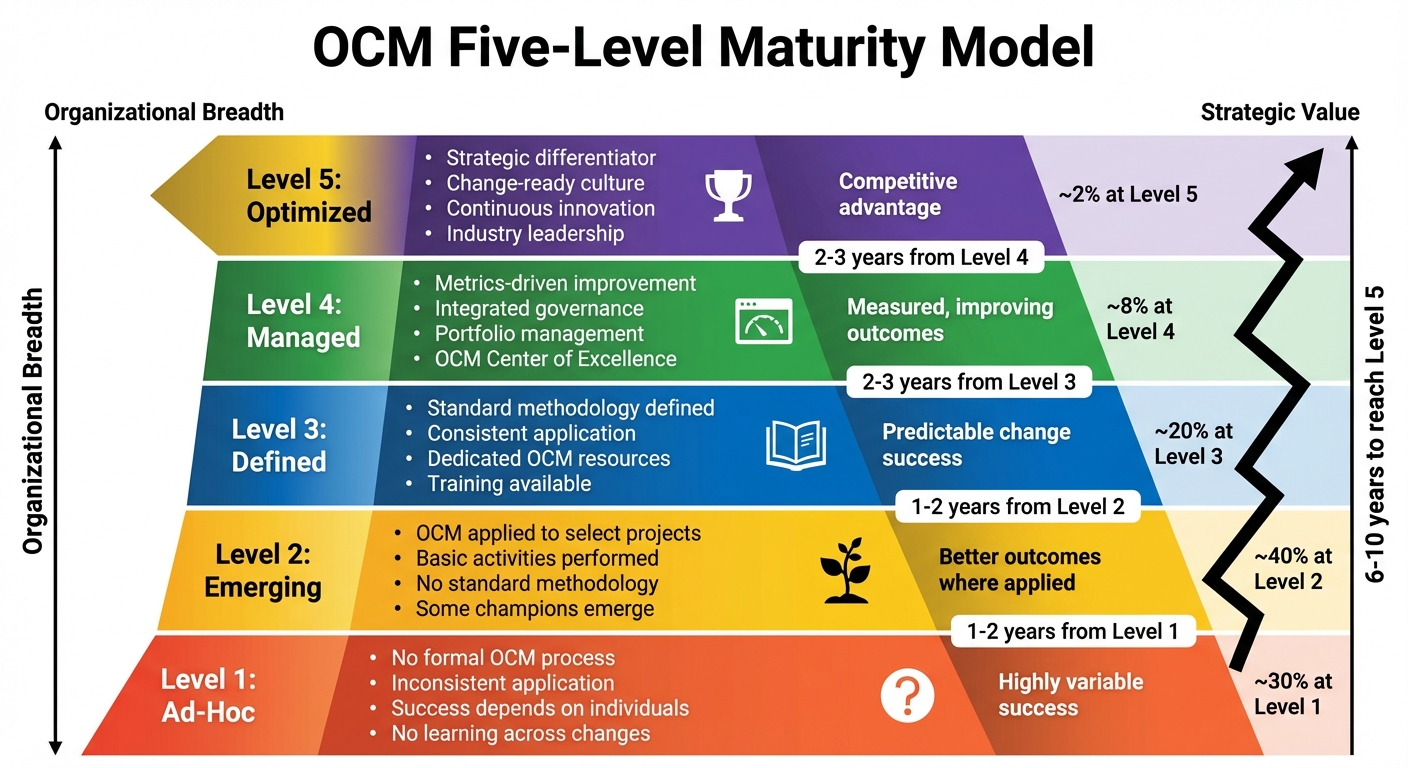
Figure 14.1: OCM Maturity Model - Five Levels - Organizations progress from ad-hoc (Level 1) where OCM is not recognized, to optimized (Level 5) where change capability is a strategic differentiator. Advancement typically takes 6-10 years.
Level 1: Ad-Hoc
At the Ad-Hoc level, change management is not a recognized discipline. Changes are implemented without deliberate attention to the people side, and outcomes depend entirely on individual leader capability and luck.
Characteristics:
- No formal OCM process or methodology
- Change activities happen inconsistently, if at all
- No dedicated OCM resources or roles
- Success depends on individual heroics
- Little awareness that OCM is a discipline
Typical Outcomes:
- Highly variable change success
- Frequent resistance and adoption failures
- No learning across changes
- Repeated mistakes
Indicators:
- “We just announce changes and expect people to adapt”
- “Change management? That’s just common sense”
- “Our last three system implementations failed to achieve adoption”
Level 2: Emerging
At the Emerging level, the organization recognizes that OCM matters and applies it to some changes, typically large or high-visibility projects. Approach is inconsistent and dependent on individual practitioners.
Characteristics:
- OCM applied to select projects
- Basic activities (communication, training) performed
- No standard methodology or templates
- OCM resources borrowed from other roles
- Some leaders champion OCM; others don’t
Typical Outcomes:
- Better outcomes on projects with OCM
- Significant variation in OCM quality
- Some learning, poorly shared
- Growing recognition of OCM value
Indicators:
- “We do change management on big projects”
- “It depends on whether the project manager believes in it”
- “Our OCM approach varies significantly across projects”
Level 3: Defined
At the Defined level, the organization has standardized OCM methodology, tools, and expectations. OCM is applied consistently to changes meeting defined criteria, with dedicated resources and defined roles.
Characteristics:
- Standard OCM methodology defined
- Templates, tools, and playbooks available
- OCM roles defined (even if not full-time)
- Consistent application based on criteria
- Training available for OCM practitioners
Typical Outcomes:
- Consistent OCM application
- More predictable change outcomes
- Learning captured and shared
- Growing organizational capability
Indicators:
- “We have an OCM methodology that projects follow”
- “Our OCM templates help ensure nothing is missed”
- “Projects are required to have an OCM plan”
Level 4: Managed
At the Managed level, OCM effectiveness is measured and managed. Data drives continuous improvement of OCM practices. OCM is integrated into project governance and portfolio management.
Characteristics:
- Metrics track OCM effectiveness
- Data-driven continuous improvement
- OCM integrated into project governance
- Portfolio view of change capacity
- Dedicated OCM function or center of excellence
Typical Outcomes:
- Measured and improving outcomes
- Proactive identification of at-risk changes
- Organizational change capacity managed
- OCM viewed as strategic capability
Indicators:
- “We measure OCM effectiveness on every change”
- “Our change portfolio is managed for saturation risk”
- “Our OCM practices improve based on what we learn”
Level 5: Optimized
At the Optimized level, OCM capability is a strategic differentiator. The organization has a change-ready culture that embraces continuous evolution. OCM is embedded in organizational DNA.
Characteristics:
- OCM expertise drives competitive advantage
- Change-ready culture throughout organization
- Continuous improvement is continuous
- Innovation in OCM practices
- OCM embedded in all strategic initiatives
Typical Outcomes:
- Change is a core organizational competency
- Faster time-to-value on all initiatives
- Resilient, adaptable workforce
- Industry-leading change outcomes
Indicators:
- “Our ability to change faster than competitors is a strategic advantage”
- “Change readiness is part of our culture”
- “We’re known for our excellence in managing change”
Assessing Your Maturity Level
Assessment Dimensions
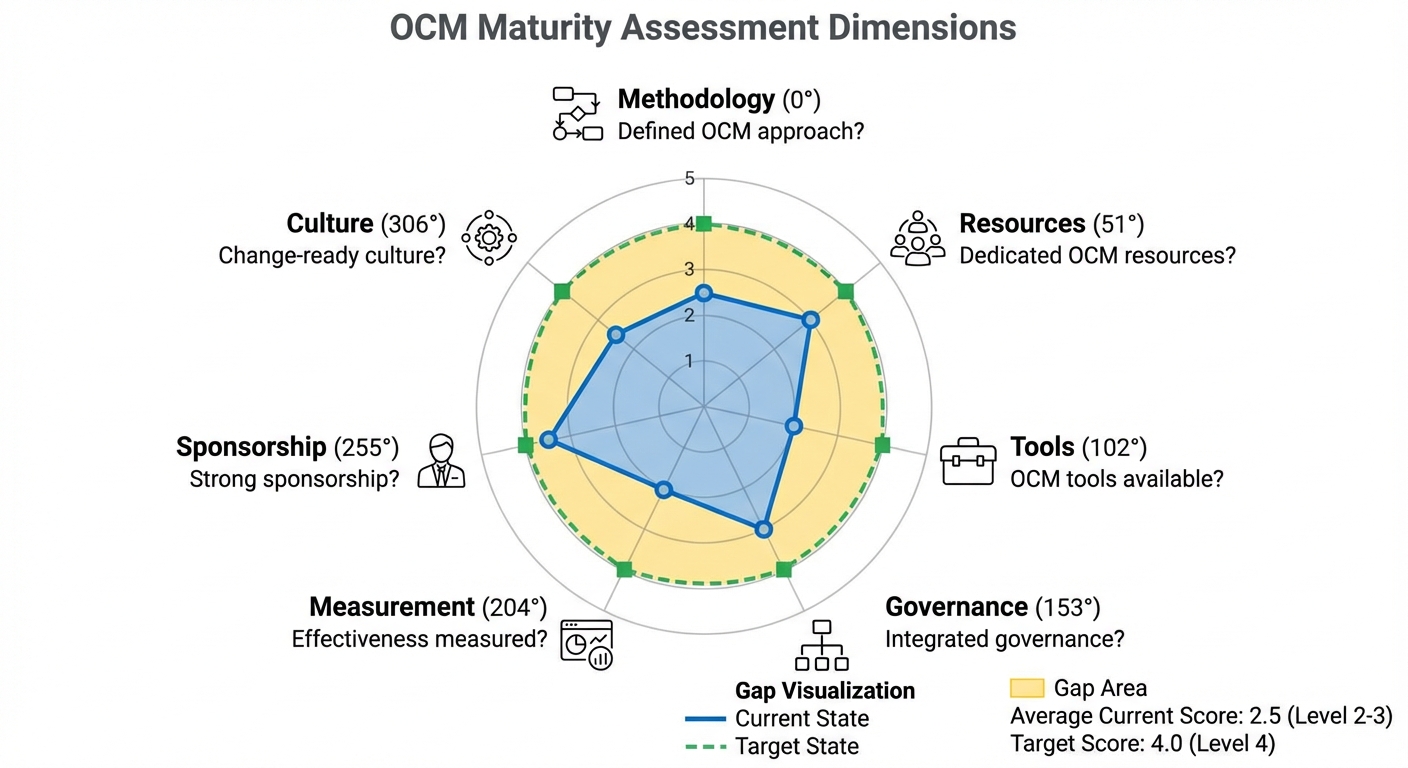
Figure 14.2: OCM Maturity Assessment Dimensions - Assess maturity across seven dimensions to identify specific strengths and improvement opportunities. Gap analysis shows where to focus development efforts.
Evaluate maturity across multiple dimensions:
| Dimension | Question |
|---|---|
| Methodology | Is there a defined OCM approach? How consistently is it applied? |
| Resources | Are dedicated OCM resources available? What is their expertise? |
| Tools | Are OCM tools and templates available? How effective are they? |
| Governance | Is OCM integrated into project governance? Are OCM requirements enforced? |
| Measurement | Is OCM effectiveness measured? Are metrics used for improvement? |
| Sponsorship | Do leaders understand and support OCM? Is sponsorship consistently strong? |
| Culture | Is change embraced? How change-ready is the organization? |
Self-Assessment Questions
For each dimension, rate your organization (1-5):
Methodology
- No methodology exists
- Informal approaches used inconsistently
- Standard methodology defined and applied
- Methodology continuously improved based on data
- Best-in-class methodology, industry recognition
Resources
- No dedicated OCM resources
- Part-time or borrowed resources
- Defined OCM roles, some dedicated resources
- Staffed OCM function, professional development
- Strategic OCM capability, industry-leading expertise
Tools
- No OCM tools or templates
- Basic templates used inconsistently
- Comprehensive toolkit, consistent use
- Tools integrated with project management systems
- Advanced tools, analytics, continuous innovation
Governance
- No OCM governance requirements
- OCM encouraged but not required
- OCM required for qualifying projects
- OCM integrated into project lifecycle governance
- OCM embedded in all change activities, strategic planning
Measurement
- No OCM measurement
- Activity tracking only
- Outcome metrics defined and tracked
- Data-driven improvement, benchmarking
- Predictive analytics, leading indicators
Sponsorship
- Sponsorship not understood
- Some sponsors effective, inconsistent
- Sponsor expectations defined, generally met
- Strong sponsorship consistent across changes
- Sponsorship is organizational strength, model for others
Culture
- Change is resisted, feared
- Mixed response to change
- Change generally accepted with support
- Change embraced as opportunity
- Change-ready culture, continuous evolution
Calculating Overall Maturity
Average scores across dimensions, then map to maturity level:
| Average Score | Maturity Level |
|---|---|
| 1.0 - 1.5 | Level 1: Ad-Hoc |
| 1.5 - 2.5 | Level 2: Emerging |
| 2.5 - 3.5 | Level 3: Defined |
| 3.5 - 4.5 | Level 4: Managed |
| 4.5 - 5.0 | Level 5: Optimized |
Advancing Maturity
Moving from Level 1 to Level 2
Focus: Establish OCM awareness and begin applying basics
Actions:
- Build awareness of OCM as a discipline among leadership
- Apply OCM to 2-3 pilot projects with visible results
- Develop basic communication and training capabilities
- Identify OCM champions who can advocate for expansion
- Document lessons learned from pilot projects
Moving from Level 2 to Level 3
Focus: Standardize OCM approach and ensure consistent application
Actions:
- Develop standard OCM methodology
- Create templates, tools, and playbooks
- Define OCM roles and responsibilities
- Establish criteria for when OCM is required
- Provide training for OCM practitioners and project managers
- Integrate OCM requirements into project governance
Moving from Level 3 to Level 4
Focus: Measure effectiveness and drive continuous improvement
Actions:
- Define and track OCM metrics consistently
- Establish feedback loops for continuous improvement
- Create OCM center of excellence or community of practice
- Integrate OCM into project portfolio management
- Develop advanced OCM capabilities (change saturation analysis, etc.)
- Build change capacity planning capability
Moving from Level 4 to Level 5
Focus: Embed OCM in organizational culture and achieve excellence
Actions:
- Build change-ready culture through ongoing development
- Integrate OCM into strategic planning processes
- Develop predictive analytics and leading indicators
- Innovate OCM practices, contribute to industry
- Achieve recognition as change management leader
- Embed continuous change capability in organizational DNA
Maturity Roadmap
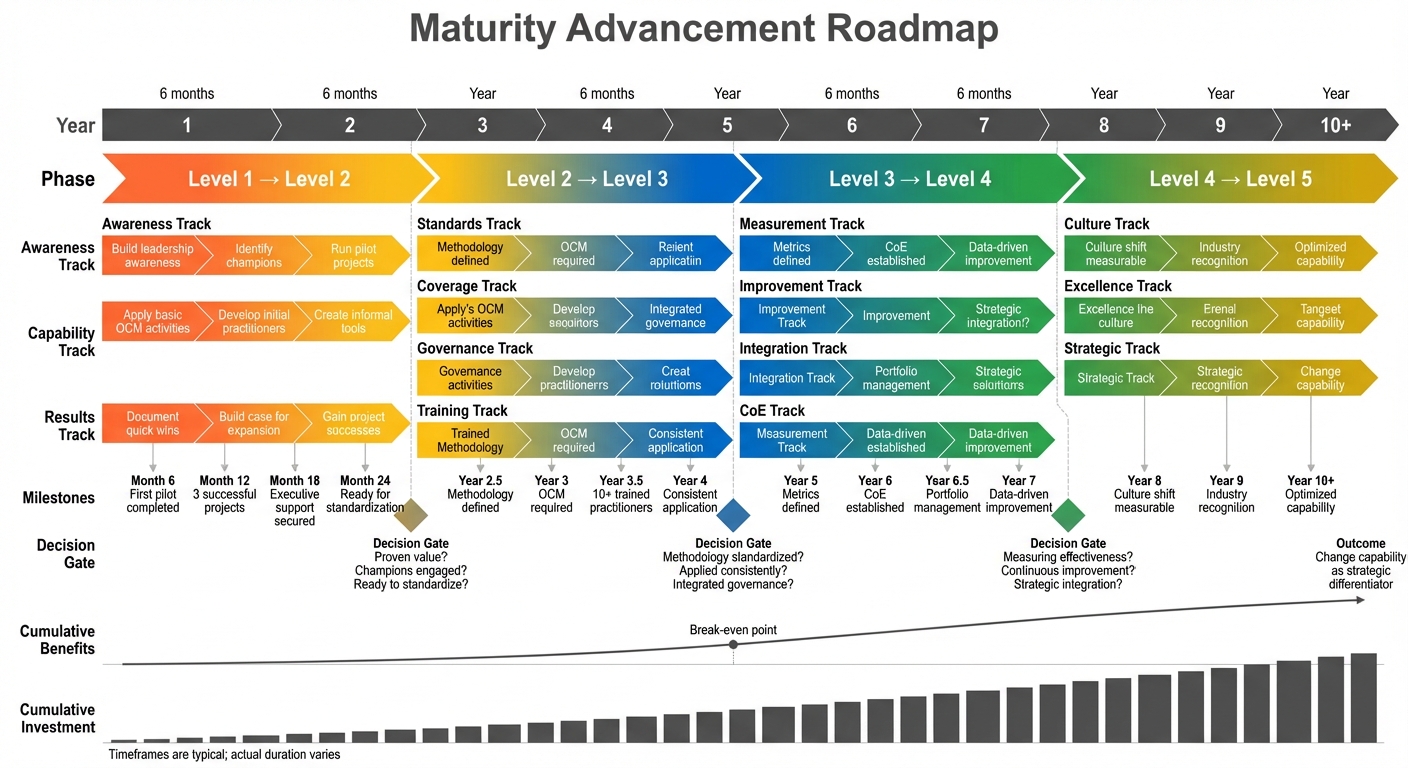
Figure 14.3: Maturity Advancement Roadmap - Advancing OCM maturity is a multi-year journey with distinct phases, parallel workstreams, and decision gates. Typical progression spans 6-10 years to reach optimized capability.
Develop a realistic roadmap for maturity advancement:
Assess Current State: Where are you today across dimensions?
Define Target State: Where do you want to be? (Usually 1-2 levels higher)
Identify Gaps: What specific improvements are needed?
Prioritize Actions: Which improvements will have greatest impact?
Develop Plan: Create actionable plan with timelines and ownership
Execute and Monitor: Implement improvements and track progress
Reassess: Periodically reassess maturity to measure advancement
Adjust: Refine roadmap based on progress and learning
Key Takeaways
- Five maturity levels describe the progression from ad-hoc to optimized OCM capability
- Multiple dimensions contribute to maturity: methodology, resources, tools, governance, measurement, sponsorship, culture
- Assessment identifies specific gaps that guide improvement priorities
- Maturity advancement is gradual—typically one level at a time over 1-3 years per level
- Higher maturity correlates with better outcomes—investment in OCM capability pays off
- Maturity is a journey, not a destination—even Level 5 organizations continue improving
Summary
The OCM Maturity Model provides a framework for understanding and advancing organizational capability for managing the people side of change. From Level 1 (Ad-Hoc) where OCM is not recognized as a discipline, through Level 5 (Optimized) where change capability is a strategic differentiator, organizations can assess their current state and chart a path for improvement.
Maturity assessment examines multiple dimensions including methodology, resources, tools, governance, measurement, sponsorship, and culture. By identifying specific gaps and prioritizing improvements, organizations can systematically advance their OCM capability and achieve consistently better change outcomes.
The investment in advancing OCM maturity pays significant dividends. Organizations with mature OCM capability experience faster adoption, less resistance, higher sustainment, and better benefits realization across all their change initiatives.