Chapter 11: Resistance Management
Learning Objectives
After completing this chapter, you will be able to:
- Understand the root causes of resistance to change
- Identify resistance early through monitoring and feedback mechanisms
- Diagnose resistance using the ADKAR framework
- Develop targeted intervention strategies for different types of resistance
- Convert resisters to supporters through effective engagement
Understanding Resistance
Resistance to change is a natural human response, not a character flaw or management problem. When people face change, they experience uncertainty, potential loss, and disruption to established patterns. Resistance is often a rational response to perceived threats to competence, status, relationships, or control.
Effective resistance management begins with understanding, not judgment. Labeling resisters as “difficult” or “obstacles” prevents understanding the legitimate concerns that drive resistance. When resistance is understood, it can be addressed; when it is dismissed, it intensifies.
Why People Resist
People resist change for many reasons, often related to gaps in the ADKAR model:
Awareness Gaps
- Don’t understand why change is necessary
- Don’t believe current state is problematic
- Haven’t received or absorbed communication
Desire Gaps
- See costs as outweighing benefits
- Don’t believe change will succeed
- Have negative past experiences with change
- Fear loss of status, competence, or control
- Have competing priorities
Knowledge Gaps
- Don’t understand what to do differently
- Feel unprepared for new requirements
- Lack confidence in ability to learn
Ability Gaps
- Cannot perform new behaviors despite training
- Face barriers to implementation
- Lack time, resources, or support
Reinforcement Gaps
- Don’t see consequences for non-adoption
- Aren’t recognized for adoption efforts
- See old behaviors still accepted or rewarded
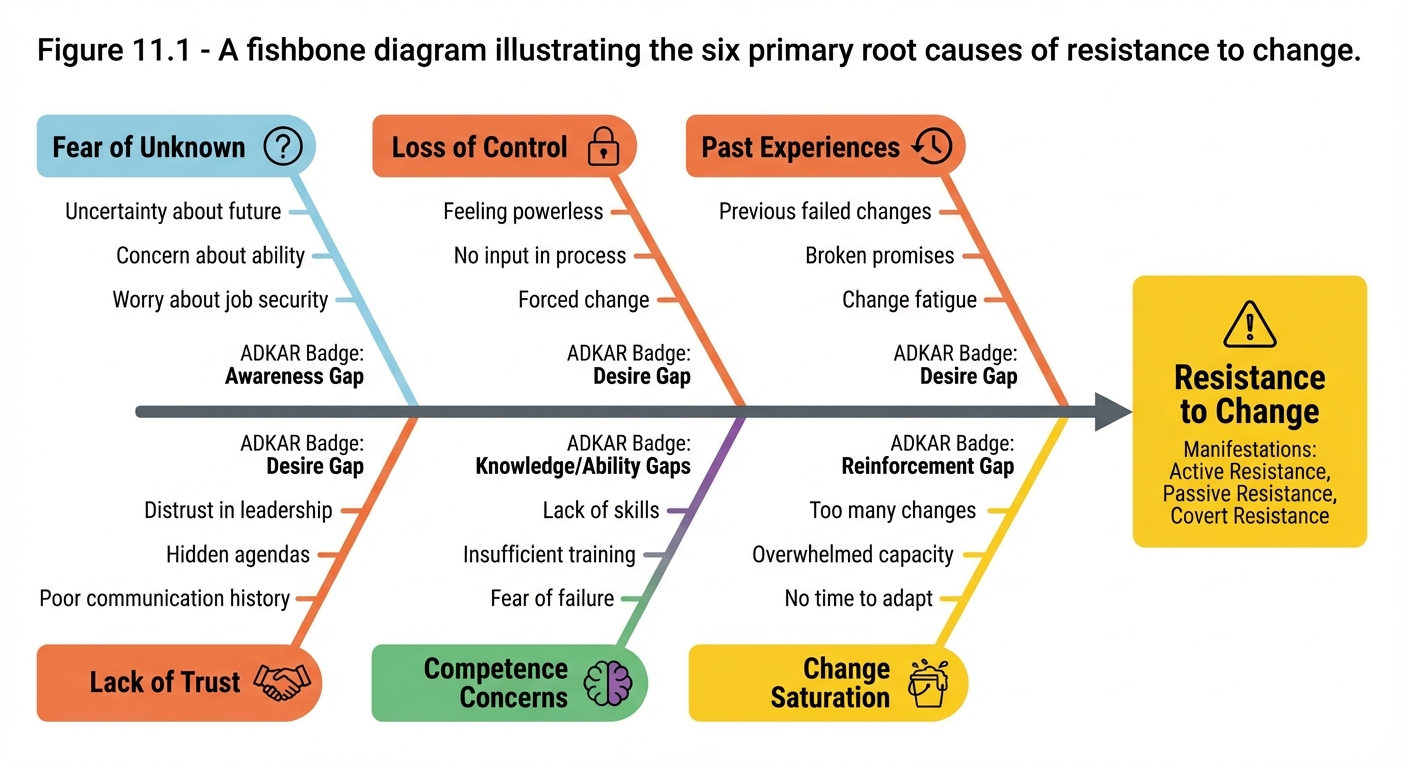
Figure 11.1: Resistance stems from six primary sources: Fear of the Unknown (Awareness gap), Loss of Control (Desire gap), Past Experiences (Desire gap), Lack of Trust (Desire gap), Competence Concerns (Knowledge/Ability gaps), and Change Saturation (capacity issue). Each cause requires different interventions aligned with the ADKAR element affected.
Forms of Resistance
Resistance manifests in various forms:
| Type | Behaviors | Impact |
|---|---|---|
| Vocal/Active | Open criticism, complaints, arguments | Visible but manageable |
| Passive | Non-compliance, slow adoption, “forgetting” | Insidious, harder to address |
| Covert | Undermining, gossip, negative influence on others | Damaging to morale and adoption |
| Institutional | Policies, processes that block change | Structural barriers |
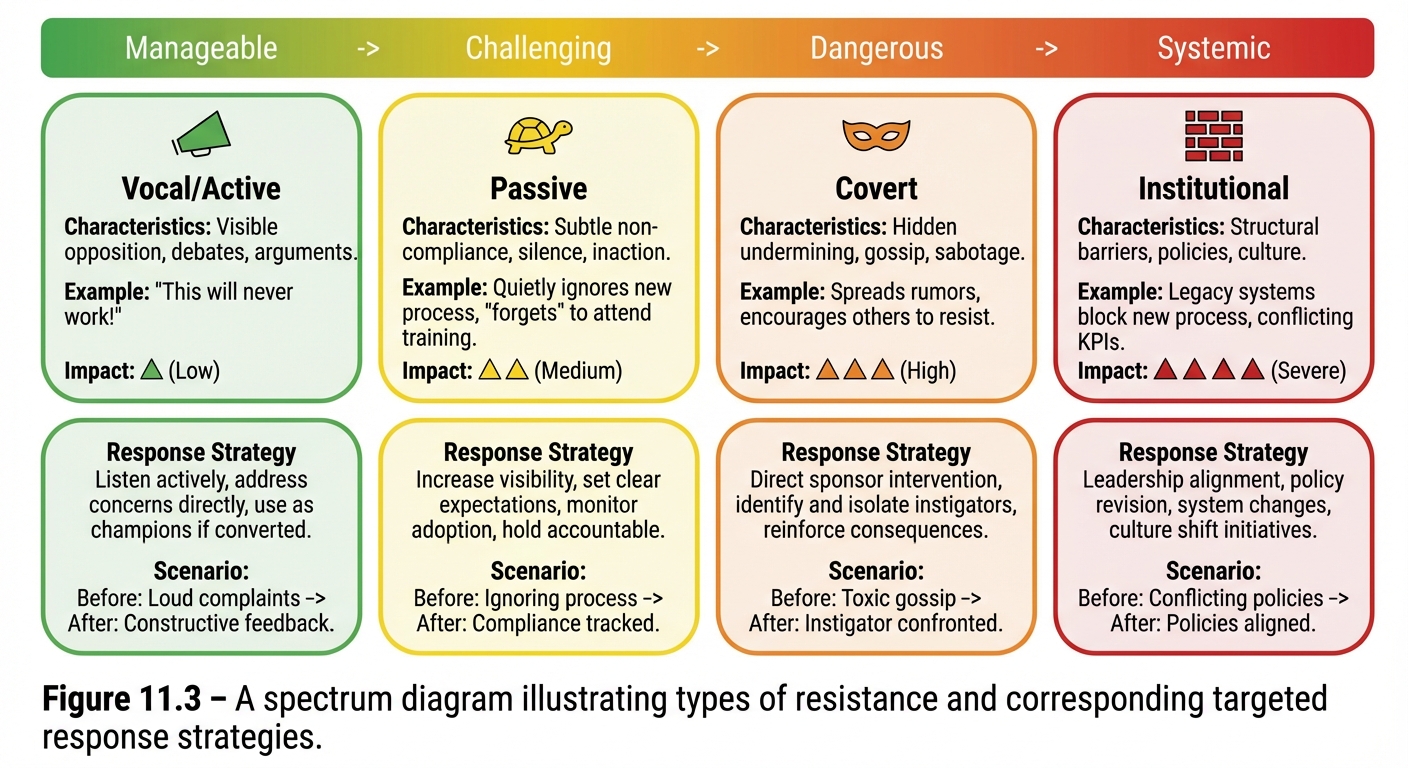
Figure 11.3: Resistance manifests in four forms with increasing difficulty: Vocal/Active (visible opposition, manageable through dialogue), Passive (subtle non-compliance, requires monitoring and accountability), Covert (hidden undermining, dangerous and requiring direct engagement), and Institutional (structural barriers, requiring systemic change). Match response strategies to resistance type for effectiveness.
Identifying Resistance
Early Warning Signs
Resistance often emerges gradually. Watch for early indicators:
Behavioral Signs
- Decreased participation in change activities
- Increased absenteeism from training or meetings
- Slow adoption or repeated “mistakes”
- Workarounds that circumvent new processes
Communication Signs
- Increased questions about “why”
- Negative comments in meetings or feedback channels
- Rumors and misinformation spreading
- Silence (absence of expected engagement)
Organizational Signs
- Missed deadlines related to change
- Resource allocation conflicts
- Competing initiatives gaining priority
- Manager non-compliance or mixed messages
Monitoring Mechanisms
Build mechanisms to surface resistance early:
Pulse Surveys: Regular brief surveys measuring sentiment and adoption
Change Agent Network: Change agents positioned to gather ground-level feedback
Manager Check-ins: Regular conversations with managers about team concerns
Feedback Channels: Easy ways for employees to ask questions and raise concerns
Metrics Monitoring: Adoption metrics that reveal compliance gaps
Listening Posts: Informal conversations, lunch sessions, “office hours”
Diagnosing Resistance
When resistance is identified, diagnose root causes before intervening. The ADKAR model provides a diagnostic framework.
ADKAR-Based Diagnosis
For each resisting individual or group, assess which ADKAR element is the barrier:
| ADKAR Element | Diagnostic Questions | Signs of Gap |
|---|---|---|
| Awareness | Do they know change is happening? Do they understand why? | Questions about rationale; surprise at changes |
| Desire | Do they want to participate? What’s their motivation? | “I don’t see why we need this”; WIIFM concerns |
| Knowledge | Do they know what to do and how? | “I don’t know how”; errors despite training |
| Ability | Can they perform new behaviors? What barriers exist? | “I can’t”; time/resource constraints |
| Reinforcement | Are new behaviors being reinforced? | Regression to old behaviors; “Why bother?” |
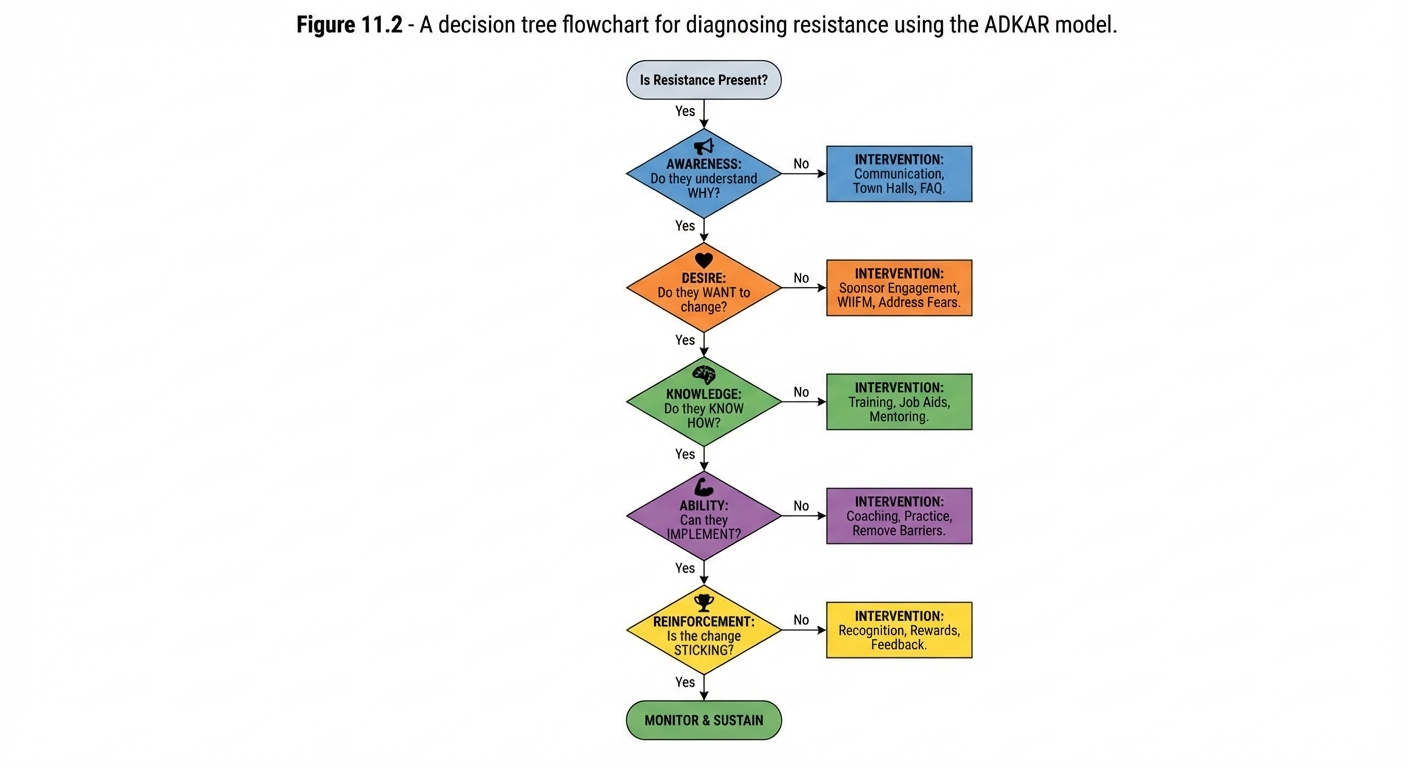
Figure 11.2: Use the ADKAR diagnostic flowchart to identify resistance root causes. Start with Awareness: “Do they understand why change is needed?” If No, intervention = enhanced communication. If Yes, move to Desire: “Do they want to change?” Continue through Knowledge, Ability, and Reinforcement. Each No response indicates the specific gap requiring intervention.
Root Cause Analysis
Go deeper to understand why the gap exists:
For Awareness Gaps:
- Has communication reached them?
- Is the message clear and compelling?
- Are they receiving conflicting information?
For Desire Gaps:
- What are they afraid of losing?
- What benefits are they not seeing?
- What past experiences influence their view?
- Who influences their opinion?
For Knowledge Gaps:
- Did they attend training?
- Was training appropriate for their role?
- Do they have access to reference materials?
For Ability Gaps:
- What specific barriers prevent adoption?
- Do they have time to implement?
- Are systems and tools working correctly?
- Is support available when needed?
For Reinforcement Gaps:
- Are managers supporting adoption?
- Is performance management aligned?
- Are early adopters being recognized?
Intervention Strategies
Matching Interventions to Root Causes
Different root causes require different interventions:
| Root Cause | Intervention Strategies |
|---|---|
| Awareness Gap | Targeted communication; 1:1 conversations; share success stories |
| Desire Gap | WIIFM messaging; address specific concerns; sponsor engagement; peer influence |
| Knowledge Gap | Additional training; job aids; coaching; demonstration |
| Ability Gap | Barrier removal; additional support; practice time; process adjustment |
| Reinforcement Gap | Recognition; accountability; performance management; celebrate success |
Engagement Strategies
For significant resistance, deeper engagement may be needed:
One-on-One Conversations
- Listen first, advocate second
- Seek to understand concerns fully
- Acknowledge legitimate issues
- Find common ground
- Develop personalized action plans
Small Group Discussions
- Address common concerns in groups
- Allow peer influence to work
- Surface issues that individuals won’t raise alone
- Build collective commitment
Involvement in Solutions
- Invite resisters to help solve problems they’ve identified
- Give voice in design decisions
- Create ownership through participation
Sponsor Engagement
- For influential resisters, engage sponsors directly
- Clear expectations from leadership
- Career implications made explicit if necessary
Addressing Different Stakeholder Types
Skeptics: Often have legitimate concerns; engage to understand; address concerns; can become advocates
Fence-Sitters: Need to see momentum and success; peer influence; low-risk ways to engage
Quiet Resisters: Need to be surfaced through feedback mechanisms; one-on-one engagement
Vocal Critics: Need direct engagement; either convert or contain; don’t ignore
Saboteurs: Rare but dangerous; require sponsor intervention; may require accountability consequences
Managing Persistent Resistance
When Initial Interventions Don’t Work
For persistent resistance, escalate approaches:
Escalation Sequence:
- Manager conversation and coaching
- OCM practitioner engagement
- Sponsor discussion
- HR involvement if necessary
- Performance management consequences
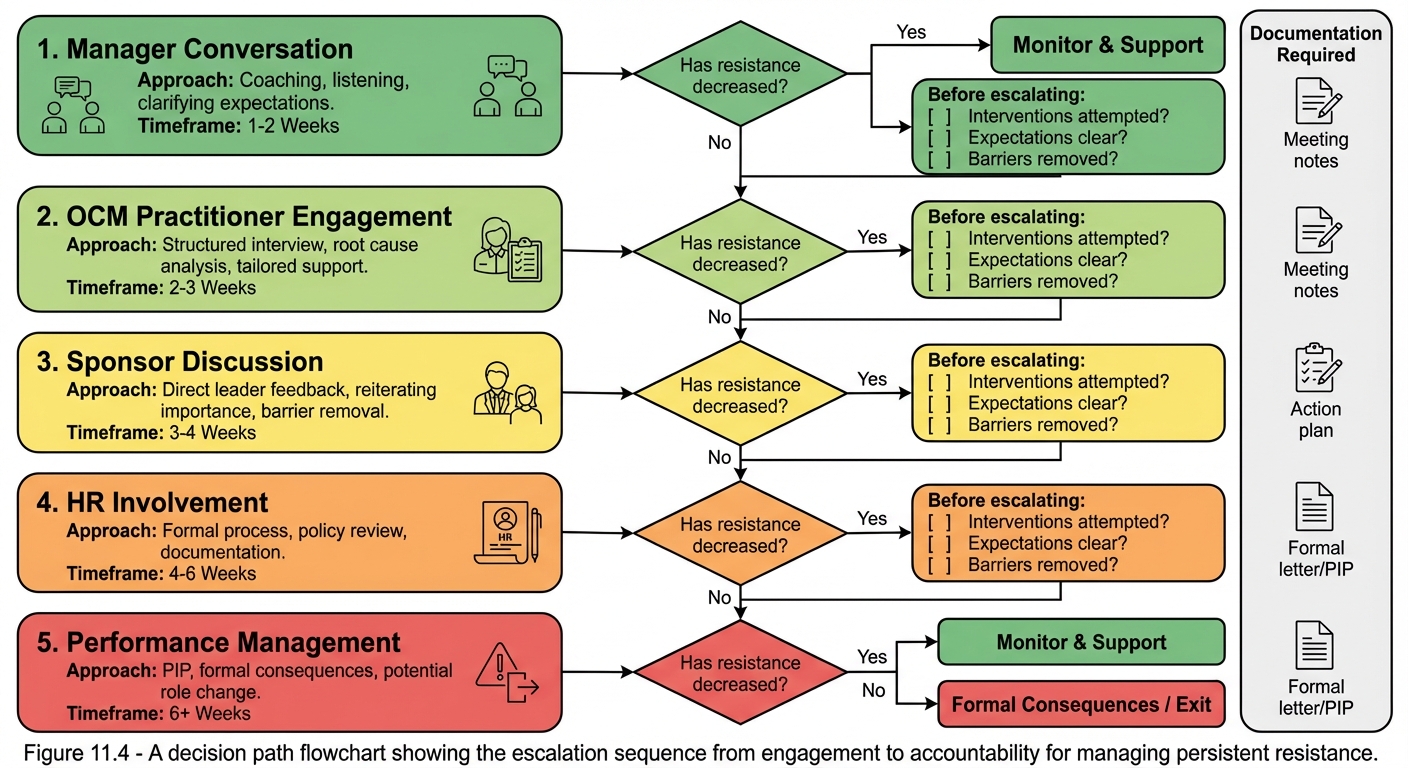
Figure 11.4: Address persistent resistance through progressive escalation: (1) Manager conversation and coaching, (2) OCM practitioner engagement, (3) Sponsor discussion, (4) HR involvement, (5) Performance management consequences. At each level, assess if resistance has decreased. If yes, monitor and support. If no, escalate. Document at every stage. Before escalating, ensure interventions were attempted, expectations are clear, and barriers were removed.
Accountability Conversations
When engagement fails, accountability may be necessary:
Before Accountability:
- Have interventions been attempted?
- Does the person understand expectations?
- Have barriers been removed?
- Is the expectation reasonable?
Accountability Approach:
- Clear statement of expected behavior
- Consequence of non-compliance
- Support offered to enable compliance
- Follow-up timeline
- Documentation
Accepting Partial Success
Not everyone will become an advocate. Levels of acceptable outcome:
- Advocate: Actively supports and promotes change
- Supporter: Willingly adopts and helps others
- Compliant: Adopts because expected, without enthusiasm
- Neutral: Neither supports nor undermines
- Resistor: Actively opposes
For some individuals, moving from resistor to compliant may be a reasonable goal.
Preventing Resistance
Proactive Strategies
The best resistance management is prevention:
Early Engagement: Involve stakeholders early; people support what they help create
Transparent Communication: Fill information voids before rumors; be honest about impacts
Address Concerns Preemptively: Anticipate concerns and address in communication
Manager Preparation: Equip managers to support teams before resistance emerges
Quick Wins: Early successes build momentum and demonstrate value
Respect the Past: Acknowledge what worked in current state; don’t denigrate what people built
Creating Psychological Safety
People resist less when they feel safe:
- Mistakes during transition are learning, not failure
- Questions are welcomed, not punished
- Concerns can be raised without retribution
- Personal impact is acknowledged and addressed
- Support is available for those who struggle
Tracking and Reporting
Resistance Metrics
| Metric | Target | Measurement Method |
|---|---|---|
| Resistance level | <10% active resistance | Pulse surveys, feedback |
| Issue resolution time | <2 weeks average | Resistance log tracking |
| Resistance trend | Decreasing over time | Periodic measurement |
| Escalation rate | Decreasing | Escalation tracking |
Resistance Log
Maintain a log of resistance issues:
| ID | Description | Stakeholder | Root Cause | Intervention | Owner | Status |
|---|---|---|---|---|---|---|
| R-001 | Operations mgr concerns about capacity | J. Smith | Desire | Sponsor 1:1 | Sponsor | In Progress |
| R-002 | Finance team slow adoption | Finance Dept | Knowledge | Additional training | Training Lead | Resolved |
| R-003 | IT passive resistance | Support team | Ability | Process simplification | Project Lead | Planned |
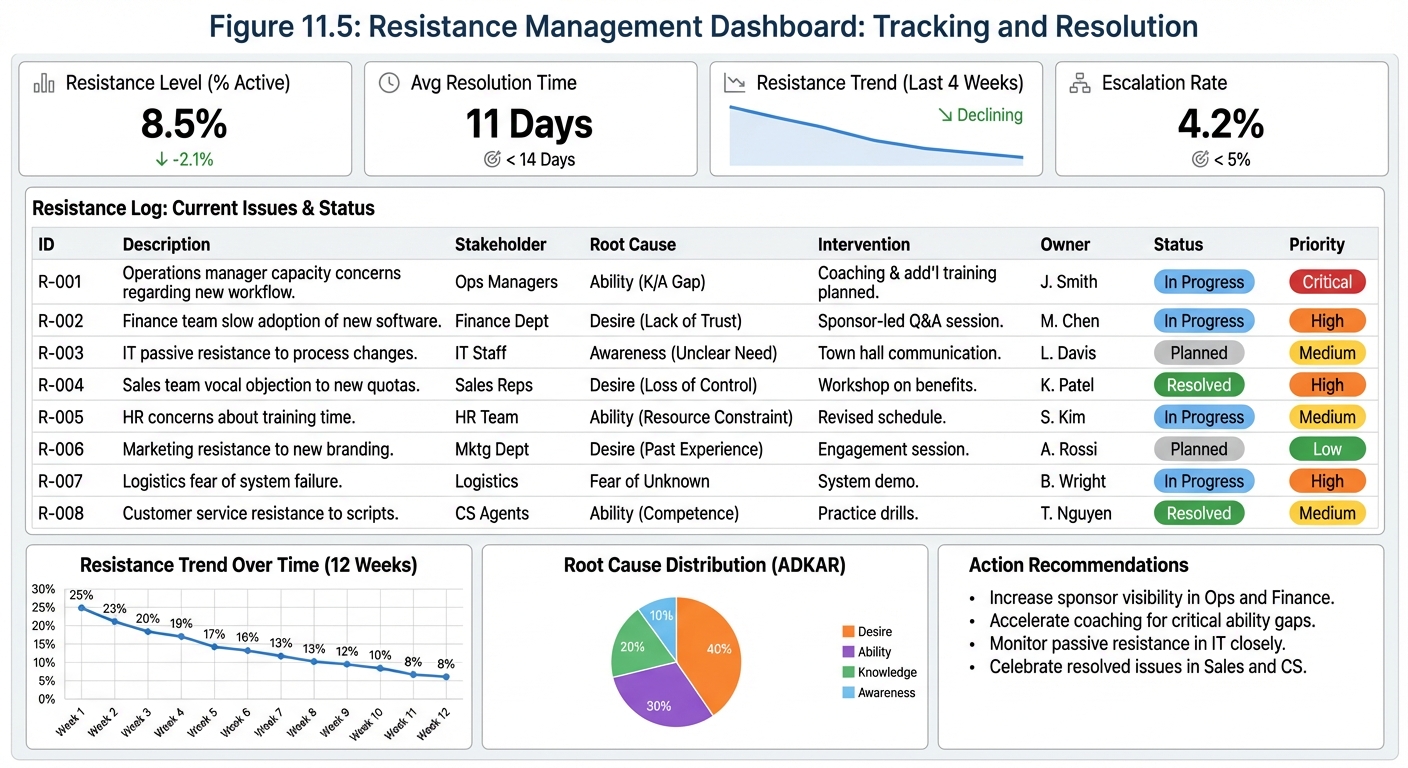
Figure 11.5: The Resistance Management Dashboard tracks key metrics (current resistance level with target <10%, average resolution time with target <2 weeks, trend direction, escalation rate) and provides detailed issue tracking. The resistance log shows individual resistance cases with root causes, interventions, owners, and status. Trend analysis reveals patterns and informs prevention strategies.
Key Takeaways
- Resistance is natural and often indicates legitimate concerns that should be understood
- ADKAR diagnosis identifies root causes so interventions can be targeted
- Different interventions address different types of resistance
- Engagement before accountability is the preferred sequence
- Monitoring and early identification enable proactive management
- Prevention through involvement, communication, and support is most effective
- Some resistance is acceptable—not everyone needs to be an advocate
Summary
Resistance management is a critical OCM capability that determines whether change obstacles are addressed or allowed to derail implementation. Effective resistance management begins with understanding—recognizing that resistance often reflects legitimate concerns about loss, competence, and control.
The ADKAR model provides a diagnostic framework for understanding why people resist. Once root causes are identified, targeted interventions can address specific barriers. Engagement strategies seek to convert resisters through understanding and involvement, while accountability measures address persistent non-compliance when engagement fails.
The most effective resistance management is prevention. By involving stakeholders early, communicating transparently, addressing concerns proactively, and creating psychological safety, organizations can minimize resistance before it emerges. When resistance does occur, prompt identification and targeted response prevent it from spreading and undermining change success.