Chapter 10: Sponsorship and Leadership Engagement
Learning Objectives
After completing this chapter, you will be able to:
- Define effective sponsorship roles and responsibilities
- Build and maintain sponsor coalitions across the organization
- Engage sponsors throughout the change lifecycle
- Support sponsors in fulfilling their roles effectively
- Measure and improve sponsorship effectiveness
The Critical Role of Sponsorship
Sponsorship is consistently identified as the number one predictor of change success. Research by Prosci and others demonstrates that projects with active, visible sponsorship succeed at significantly higher rates than those without. Yet sponsorship is frequently one of the weakest elements in change initiatives.
Effective sponsorship provides the visible, active leadership support that signals organizational commitment to change. When employees see senior leaders actively championing change—not just approving it, but personally engaged in making it succeed—they conclude that adoption is expected and valued. Without this visible leadership engagement, employees may reasonably conclude that the change is optional or low priority.
Sponsorship operates at multiple levels. Executive sponsors provide strategic direction, resources, and enterprise-wide credibility. Middle management sponsors translate executive commitment into local action and support their teams through transition. Without alignment at both levels, change initiatives suffer from either lack of strategic support or lack of execution capability.
What Sponsors Do
Effective sponsors fulfill several critical functions:
Authorize: Formally sanction the change and provide decision-making authority
Fund: Allocate budget and resources for change activities
Champion: Actively advocate for the change and its importance
Communicate: Deliver key messages about why change is necessary
Remove Barriers: Eliminate obstacles that impede progress
Hold Accountable: Ensure adoption expectations are clear and enforced
Recognize: Celebrate progress and acknowledge successful adoption
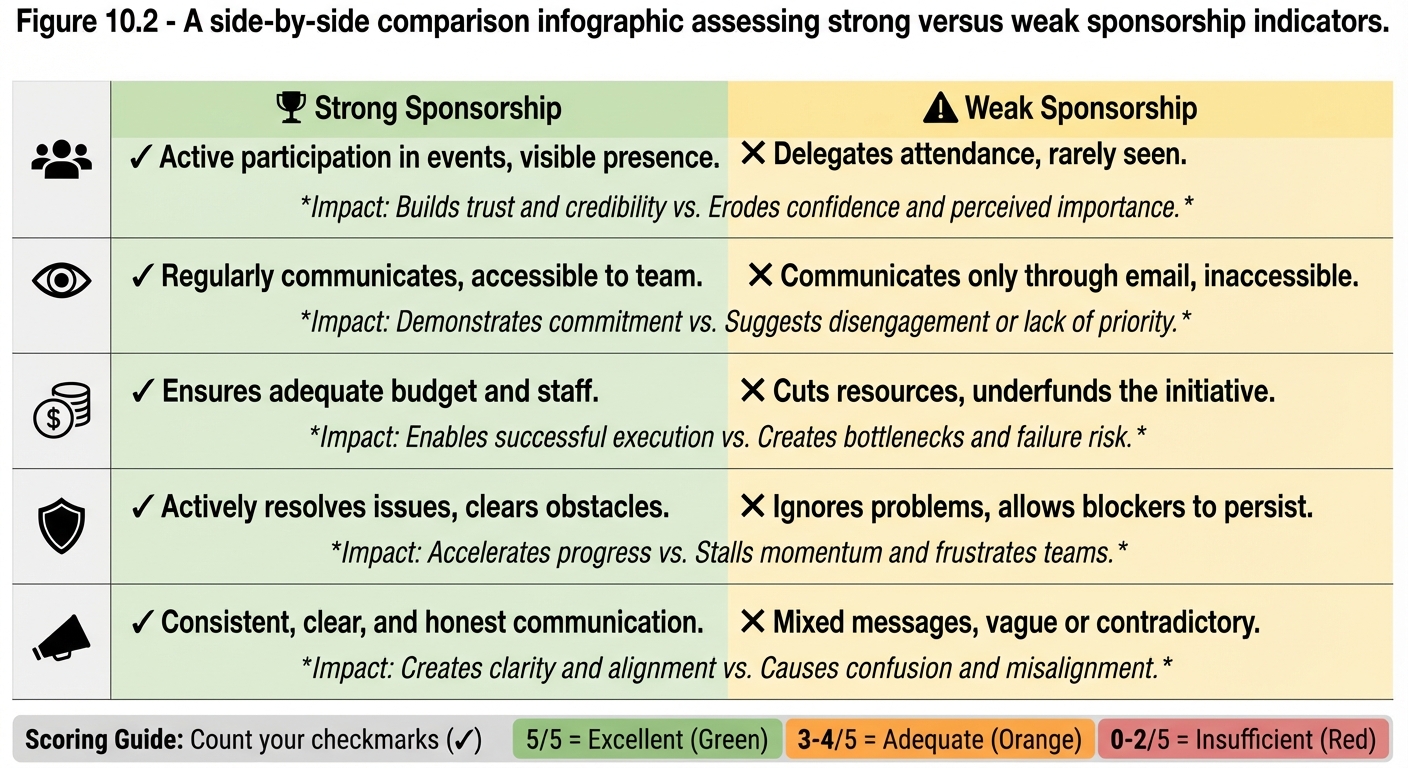
Figure 10.2: Use this comparison to assess sponsor effectiveness across five dimensions. Strong sponsorship shows active participation in events, high visibility, protected resources, rapid barrier removal, and consistent messaging. Weak sponsorship shows delegation, absence, resource cuts, unresolved issues, and mixed messages. Score 5/5 = Excellent, 3-4/5 = Adequate, 0-2/5 = Insufficient requiring intervention.
Sponsorship Roles
Primary Sponsor
The primary sponsor (often called executive sponsor) is the senior leader who authorizes and owns the change. This individual:
- Has sufficient authority to make decisions for the full scope of change
- Controls or can influence necessary resources
- Has credibility with impacted stakeholder groups
- Is willing to invest personal time and political capital
Primary Sponsor Responsibilities:
- Own the business case and expected outcomes
- Communicate vision and case for change
- Allocate and protect resources
- Make timely decisions
- Remove escalated barriers
- Hold leaders accountable for adoption
- Remain visibly engaged throughout
Sponsoring Coalition
For enterprise-wide change, a single sponsor cannot reach all impacted groups. A sponsoring coalition extends sponsorship reach throughout the organization.
Coalition Structure:
Primary Sponsor (Executive Level)
        │
        ├── Business Unit Sponsor 1
        │       └── Department Managers
        │
        ├── Business Unit Sponsor 2
        │       └── Department Managers
        │
        └── Functional Sponsor (IT/HR/Finance)
                └── Team Leads
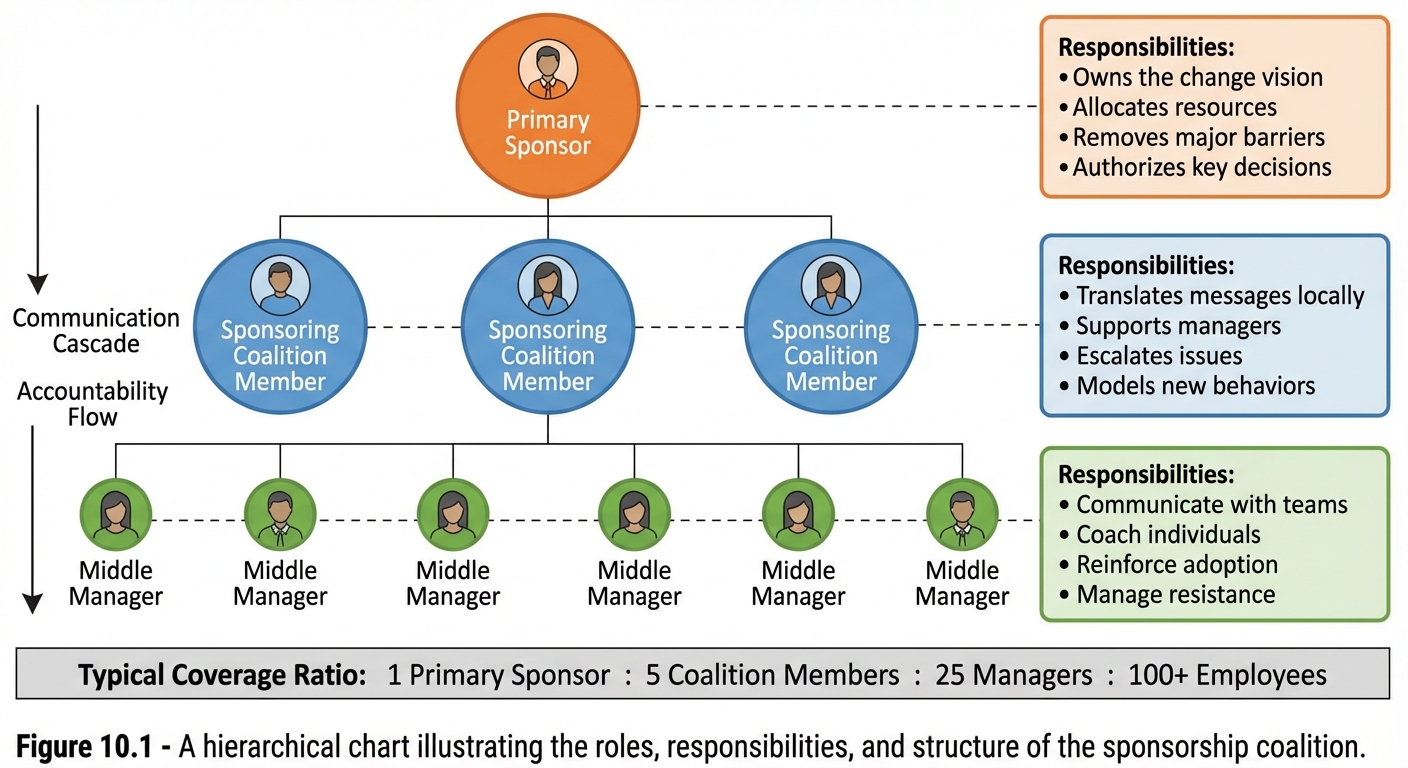
Figure 10.1: An effective sponsorship coalition operates at three levels: Primary Sponsor (owns the change, allocates resources, removes barriers), Sponsoring Coalition (translates messages locally, supports managers, escalates issues), and Middle Managers (communicate with teams, coach individuals, reinforce adoption). Typical ratio: 1 primary sponsor : 5 coalition members : 25 managers : 100+ employees.
Coalition Member Responsibilities:
- Translate enterprise messages to local context
- Communicate with their stakeholder groups
- Support managers in their change roles
- Identify and escalate issues and resistance
- Reinforce adoption expectations
- Report on progress and concerns
Middle Manager Role
Middle managers are critical sponsors who often receive insufficient attention. They directly supervise impacted employees and have the most influence on day-to-day adoption.
Middle Manager Sponsor Activities:
- Communicate change messages to teams
- Create desire by explaining “what’s in it for us”
- Enable training participation
- Coach and support individuals through transition
- Model expected behaviors
- Address resistance within teams
- Provide feedback to project team
- Recognize and reinforce adoption
Building Effective Sponsorship
Assessing Sponsor Readiness
Before relying on sponsors, assess their readiness:
| Factor | Assessment Questions |
|---|---|
| Authority | Do they have decision rights for the scope of change? |
| Credibility | Are they respected by impacted stakeholders? |
| Availability | Can they dedicate sufficient time to sponsor activities? |
| Commitment | Do they genuinely support the change? |
| Skill | Do they know how to sponsor effectively? |
Developing Sponsors
Many leaders have not been trained in effective sponsorship. Support sponsor development through:
Sponsor Briefings: Regular updates on change status, key messages, and upcoming needs
Sponsorship Roadmap: Clear timeline of sponsor activities and commitments
Talking Points: Prepared messages and Q&A for communications
Coaching: One-on-one support for challenging sponsor situations
Feedback: Constructive input on sponsor effectiveness
Sponsor Commitment Conversations
Have explicit conversations with sponsors about expectations:
Topics to Cover:
- Time commitment required
- Specific activities expected
- Support that will be provided
- How success will be measured
- Consequences of inadequate sponsorship
Make Commitments Concrete: Instead of “Please support this change,” seek specific commitments:
- “Will you deliver the announcement at the all-hands meeting on March 15?”
- “Can you commit to weekly 30-minute briefings with your direct reports?”
- “Will you personally call the top 10 resisters to understand their concerns?”
Sponsor Activities by Phase
Initiation Phase
| Activity | Purpose |
|---|---|
| Articulate vision and case for change | Establish foundation for all communication |
| Authorize project and allocate resources | Demonstrate organizational commitment |
| Identify sponsoring coalition members | Build sponsorship structure |
| Initial communication to organization | Signal change is coming and why |
Planning Phase
| Activity | Purpose |
|---|---|
| Approve OCM strategy | Ensure alignment with business objectives |
| Communicate to management | Prepare managers for their roles |
| Engage resistant leaders | Address leadership concerns early |
| Reinforce priority amid competing demands | Maintain focus and resources |
Execution Phase
| Activity | Purpose |
|---|---|
| Deliver key communications | Leverage sponsor credibility |
| Visible presence at events | Demonstrate personal commitment |
| Remove escalated barriers | Enable progress |
| Recognize progress and success | Build momentum |
| Address persistent resistance | Ensure accountability |
Sustainment Phase
| Activity | Purpose |
|---|---|
| Communicate success and benefits | Reinforce value of change |
| Hold accountable for sustained adoption | Prevent backsliding |
| Integrate into performance expectations | Make adoption “how we work” |
| Transition to business-as-usual | Ensure ongoing ownership |
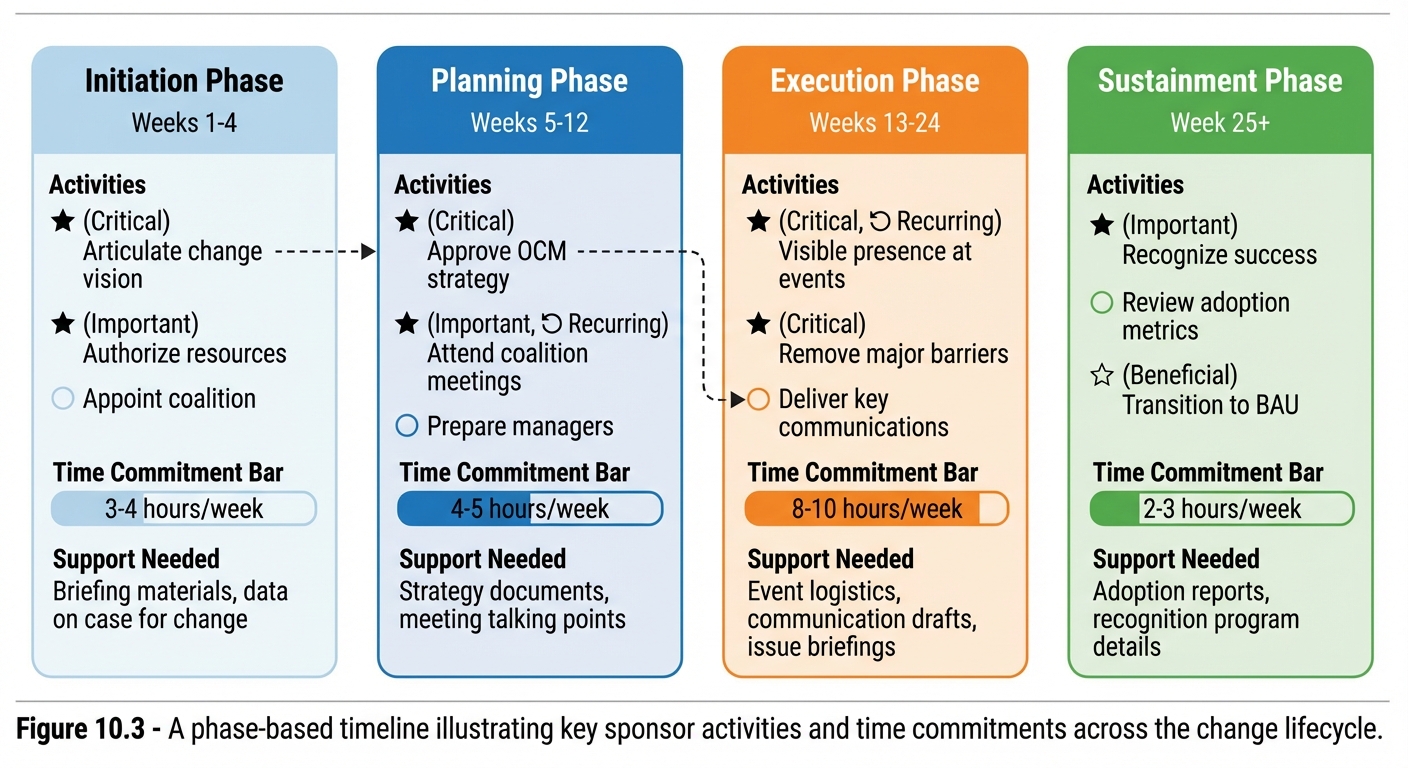
Figure 10.3: Sponsor activities vary by project phase. Initiation requires vision articulation and resource authorization. Planning needs strategy approval and manager preparation. Execution demands visible presence, communication delivery, and barrier removal. Sustainment focuses on recognition, accountability, and business-as-usual transition. Time commitment is typically highest during Execution phase.
Engaging Sponsors Effectively
Making Sponsorship Easy
Sponsors are busy leaders with many demands. Make sponsorship activities as easy as possible:
Prepare Materials: Don’t ask sponsors to create content; provide talking points, presentations, and messages
Schedule Proactively: Get on calendars early; confirm logistics; send reminders
Provide Briefings: Brief sponsors before events so they’re prepared and confident
Minimize Time Demands: Focus on high-impact activities; don’t over-burden
Handle Logistics: Manage details so sponsors can focus on leading
Keeping Sponsors Engaged
Sponsor engagement often wanes as projects progress. Maintain engagement through:
Regular Updates: Brief, focused updates on progress and needs
Success Stories: Share positive feedback and adoption wins
Issue Escalation: Bring issues that need sponsor attention (don’t only share problems)
Visibility Opportunities: Create occasions for sponsors to be seen supporting change
Recognition: Thank sponsors for their contributions
Handling Reluctant Sponsors
Sometimes sponsors are reluctant or ineffective. Strategies include:
Understand Root Causes: Why are they reluctant? Competing priorities? Disagreement? Discomfort?
Address Concerns: If concerns are legitimate, address them
Provide Support: If discomfort with activities, offer coaching or support
Adjust Expectations: If time is limited, focus on highest-impact activities
Escalate if Necessary: If sponsorship is inadequate, escalate to higher authority
Work Around: If sponsors can’t be moved, find alternative sources of support
Measuring Sponsorship Effectiveness
Sponsor Activity Metrics
Track whether sponsors are performing expected activities:
| Metric | Measurement |
|---|---|
| Planned activities completed | % of committed activities delivered |
| Communication delivery | Messages delivered as planned |
| Event participation | Attendance at scheduled events |
| Decision timeliness | Time to resolve escalated decisions |
| Barrier removal | Escalated barriers resolved |
Sponsor Impact Metrics
Track whether sponsorship is having intended impact:
| Metric | Measurement |
|---|---|
| Stakeholder perception | Survey: “Leadership is supporting this change” |
| Manager readiness | % of managers prepared to support teams |
| Resistance levels | % active resistance (should decrease with good sponsorship) |
| Adoption rates | Correlation between sponsor activity and adoption |
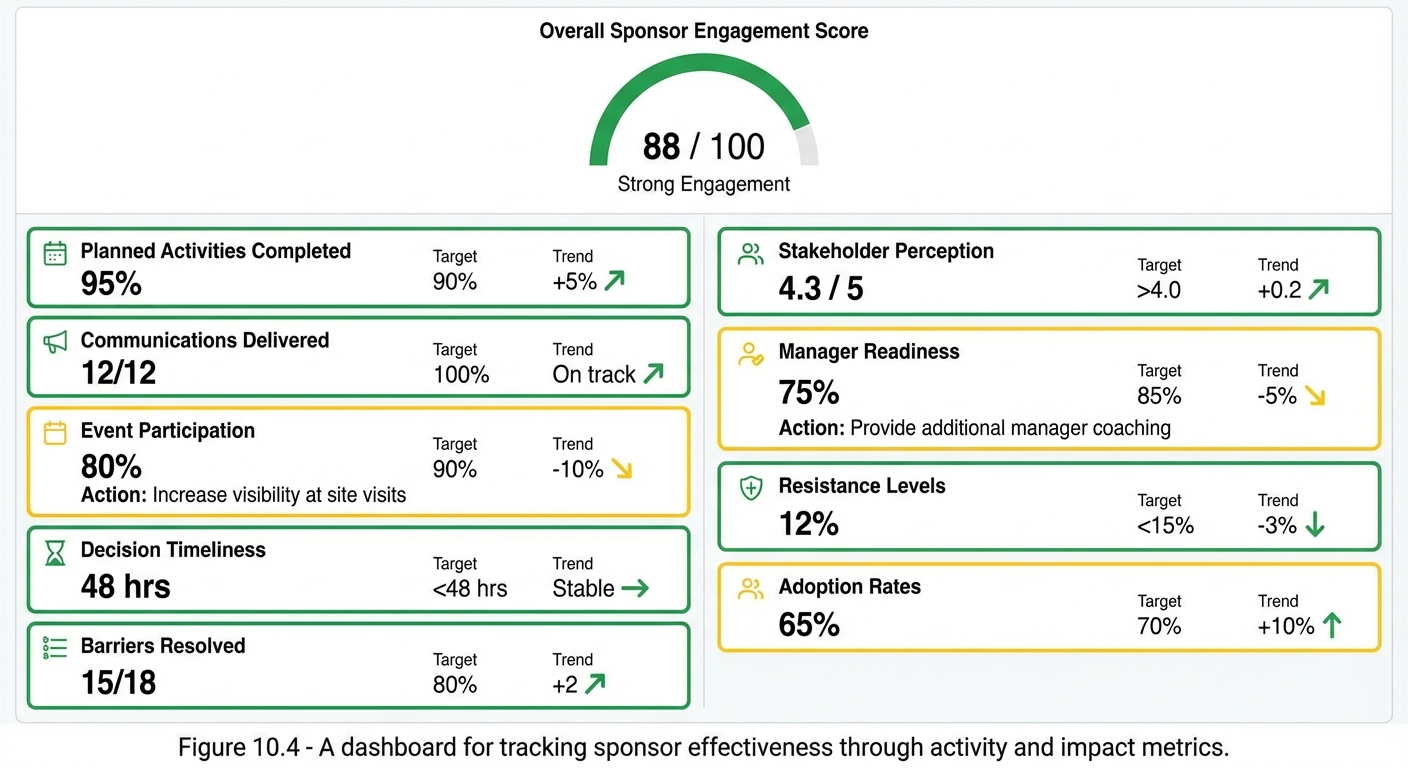
Figure 10.4: Sponsor effectiveness is measured through activity metrics (planned activities completed, communications delivered, event participation, decision speed, barriers resolved) and impact metrics (stakeholder perception of leadership support, manager readiness, resistance levels, adoption rates). Track both to ensure sponsors are both active and effective. Overall engagement score combines all metrics.
Sponsor Feedback
Gather feedback on sponsor effectiveness:
Stakeholder Surveys: Include questions about leadership support Manager Feedback: Do managers feel supported by their sponsors? Change Agent Input: What are change agents hearing about leadership? Self-Assessment: How do sponsors rate their own effectiveness?
Common Sponsorship Challenges
Absent Sponsors
Symptoms: Sponsors don’t attend events, don’t deliver communications, are unavailable Solutions: Explicit commitments, calendar blocking, delegate when appropriate, escalate if necessary
Passive Sponsors
Symptoms: Sponsors approve but don’t actively advocate; delegate everything Solutions: Clarify active vs. passive sponsorship; identify high-impact activities; make it easy
Misaligned Sponsors
Symptoms: Sponsors send mixed messages; don’t agree on approach Solutions: Alignment sessions; unified message platform; address disagreements privately
Competing Priority Sponsors
Symptoms: Change is perpetually deprioritized for “more urgent” matters Solutions: Re-confirm commitment; escalate to higher authority; link to business objectives
Departing Sponsors
Symptoms: Key sponsors leave or change roles during implementation Solutions: Succession planning; relationship building with potential successors; rapid onboarding
Key Takeaways
- Sponsorship is the #1 predictor of change success and must be actively cultivated
- Sponsors at multiple levels are needed—executive sponsors for strategic support, managers for local execution
- Sponsor effectiveness requires development—many leaders don’t know how to sponsor well
- Explicit commitments and support make sponsorship more achievable
- Measurement enables improvement—track both activity and impact
- Common challenges can be addressed with proactive strategies
Summary
Sponsorship provides the visible leadership support that signals organizational commitment to change. Without active, engaged sponsors at executive and management levels, change initiatives lack the credibility, resources, and accountability needed for success.
Building effective sponsorship requires intentional effort. Sponsors must be assessed for readiness, developed for effectiveness, supported with materials and briefings, engaged throughout the lifecycle, and measured for impact. When sponsorship challenges arise, they must be addressed proactively rather than ignored.
The investment in building and maintaining strong sponsorship pays dividends throughout the change. Projects with effective sponsorship move faster, encounter less resistance, and achieve higher sustained adoption. Sponsorship is not optional—it is essential.