Chapter 9: Training and Capability Building
Learning Objectives
After completing this chapter, you will be able to:
- Design role-based training strategies aligned with impact assessment
- Develop effective training content using adult learning principles
- Select appropriate delivery methods for different learning needs
- Implement training logistics and scheduling
- Evaluate training effectiveness using the Kirkpatrick model
The Role of Training in OCM
Training is the primary mechanism for building the knowledge and skills stakeholders need to successfully adopt change. In the ADKAR model, training directly addresses the Knowledge element and creates the foundation for Ability. Without effective training, even motivated employees cannot successfully adopt new ways of working.
However, training alone is not sufficient for change adoption. A common mistake is treating training as the entirety of OCM, assuming that if people are trained, they will adopt. Training builds knowledge, but other OCM activities must build awareness, desire, ability (through practice and support), and reinforcement. Training is necessary but not sufficient.
Effective training in a change context differs from routine skills training in several important ways:
Context Matters: Training must connect to why the change is happening and how it benefits learners, not just what to do differently.
Timing is Critical: Training delivered too early is forgotten; training delivered too late creates anxiety and errors.
Application Support: Training must be followed by opportunities to practice and receive support during initial application.
Emotional Dimension: Learners may be anxious about their ability to succeed. Training must build confidence, not just competence.
Training Strategy Development
Aligning with Impact Assessment
Training strategy begins with impact assessment findings. For each stakeholder group, understand:
- What skills are required in the future state?
- What skills do they currently have?
- What is the gap that training must close?
- How complex is the learning required?
- How much time is available for training?
Defining Learning Objectives
For each training audience, define clear learning objectives that specify what learners will be able to do after training:
Well-Written Learning Objectives:
- “Process a customer order using the new system within 5 minutes”
- “Generate and interpret the weekly sales dashboard”
- “Escalate system issues through the correct support channel”
Poorly-Written Learning Objectives:
- “Understand the new system” (not measurable)
- “Be familiar with the changes” (not specific)
- “Know how to use reports” (not behavioral)
Role-Based Training Design
Different roles require different training. Design role-based curricula that address specific job needs:
| Role | Learning Needs | Training Approach |
|---|---|---|
| End Users | Core transactions, common scenarios | Hands-on practice, job aids |
| Power Users | Advanced functions, troubleshooting | Extended training, certification |
| Managers | Reporting, team support, exception handling | Focused sessions, coaching prep |
| Support Staff | System administration, issue resolution | Technical deep-dive, lab exercises |
| Executives | Dashboard review, strategic insights | Brief overview, key metrics focus |
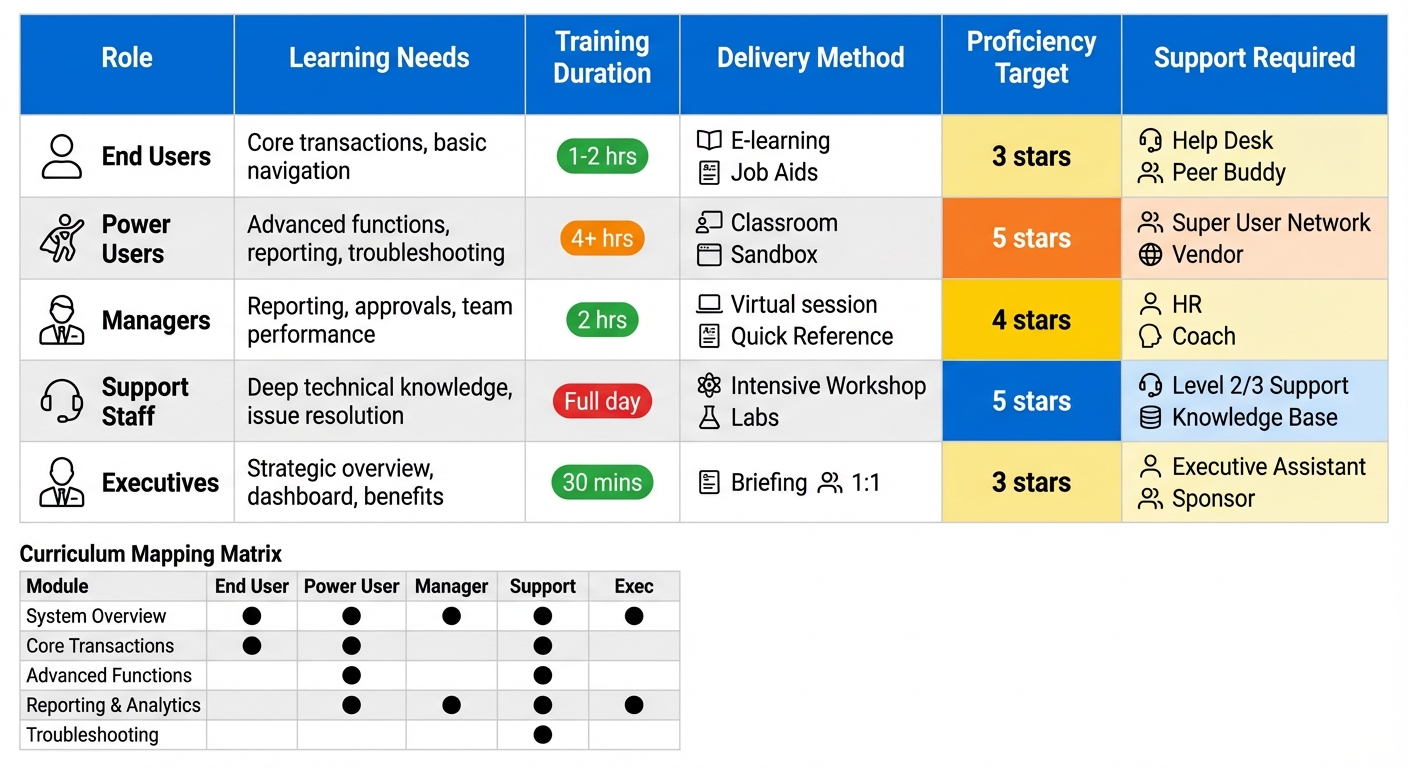
Figure 9.1: Role-based training recognizes that different roles have different learning needs, time constraints, and proficiency requirements. End users need core transactions (1-2 hours), power users need advanced functions (4+ hours), managers need reporting focus (2 hours), support staff need deep technical knowledge (full day), and executives need strategic overview (30 minutes).
Adult Learning Principles
Effective training applies adult learning principles (andragogy) that recognize how adults learn differently from children:
Key Principles
Self-Direction: Adults want control over their learning. Provide choices and self-paced options where possible.
Experience: Adults bring relevant experience. Build on what they already know; connect new learning to existing knowledge.
Relevance: Adults need to see why learning matters. Explain the “why” and connect to their job responsibilities.
Problem-Centered: Adults prefer learning that solves real problems. Use realistic scenarios and practical applications.
Immediate Application: Adults want to apply learning quickly. Train close to when skills will be used.
Respect: Adults expect their time and intelligence to be respected. Avoid condescension; acknowledge their expertise.
Application to Training Design
| Principle | Training Design Implication |
|---|---|
| Self-Direction | Offer e-learning for self-paced modules; provide choice in workshop timing |
| Experience | Include activities that draw on current job knowledge; acknowledge what won’t change |
| Relevance | Start each module by explaining job relevance; use role-specific examples |
| Problem-Centered | Use realistic scenarios based on actual job tasks; include troubleshooting |
| Immediate Application | Schedule training close to go-live; provide job aids for immediate reference |
| Respect | Keep training focused and efficient; acknowledge competing priorities |
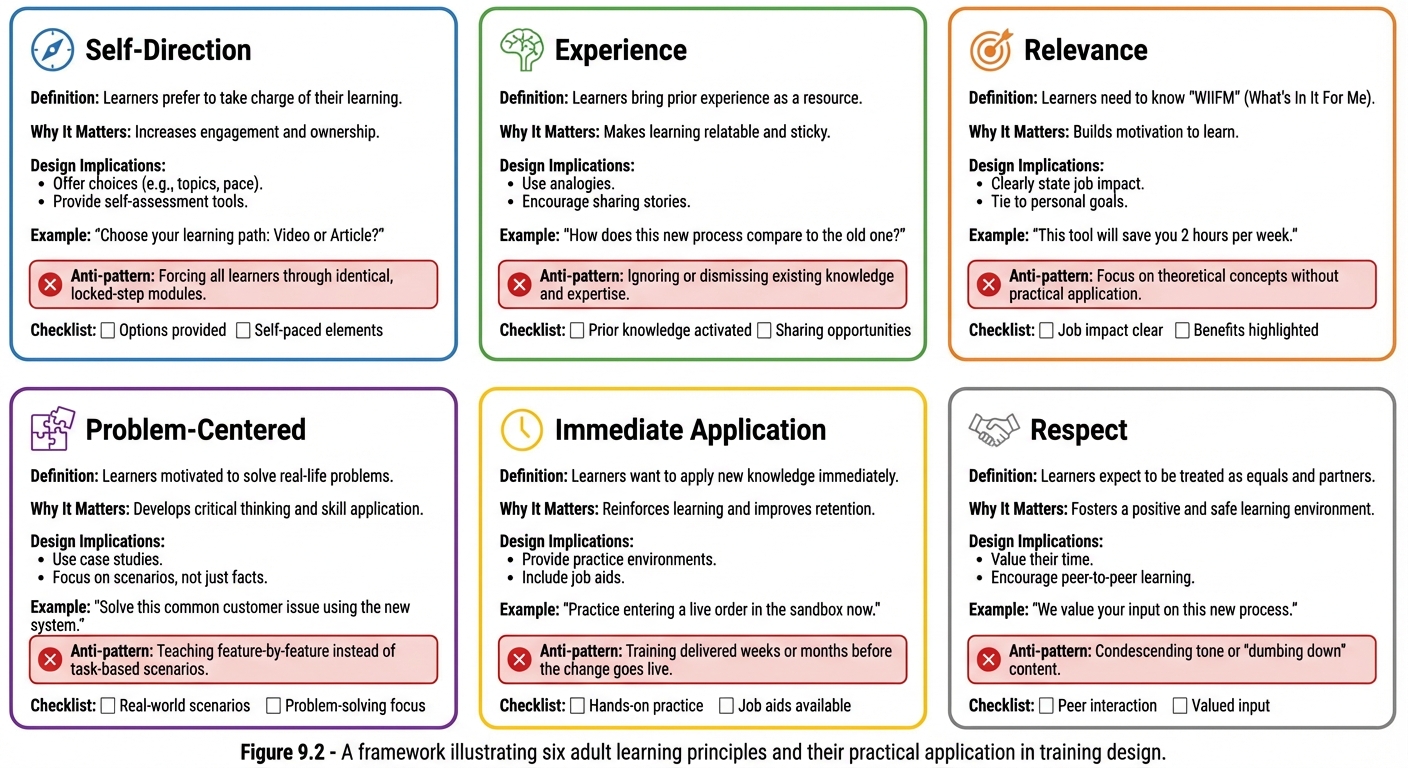
Figure 9.2: Adult learning principles guide effective training design. Apply self-direction by offering choices, leverage experience by building on existing knowledge, ensure relevance by explaining job impact, use problem-centered scenarios, schedule for immediate application, and show respect by valuing time and intelligence. Avoid anti-patterns like forced pacing or condescending content.
Training Content Development
Content Structure
Effective training content follows a logical structure:
Introduction
- Learning objectives (what they’ll be able to do)
- Relevance (why this matters for their job)
- Overview (what will be covered)
Core Content
- Concepts and principles (the “why”)
- Procedures and steps (the “how”)
- Demonstrations (showing how it’s done)
- Practice activities (doing it themselves)
Application
- Realistic scenarios
- Common challenges and solutions
- Tips and best practices
- Resources for ongoing support
Conclusion
- Summary of key points
- Job aids and reference materials
- Next steps and support channels
Content Types
| Content Type | Purpose | Best For |
|---|---|---|
| Conceptual | Explain why and how things work | Building understanding, decision-making |
| Procedural | Step-by-step instructions | Transaction processing, routine tasks |
| Reference | Quick lookup of information | Job aids, help systems, FAQs |
| Scenario-Based | Practice in realistic situations | Complex tasks, judgment calls |
Job Aids
Job aids are reference materials that support performance without requiring memorization. Effective job aids:
- Focus on steps and decisions, not concepts
- Use visual formats (flowcharts, screenshots, checklists)
- Are easily accessible at the point of work
- Are kept up-to-date as processes change
Types of Job Aids:
- Quick reference cards
- Process flowcharts
- Decision trees
- Checklists
- FAQs
- Video tutorials
Training Delivery Methods
Delivery Options
| Method | Strengths | Limitations | Best For |
|---|---|---|---|
| Instructor-Led Classroom | Interaction, practice, immediate feedback | Scheduling, travel, cost | Complex skills, hands-on practice |
| Virtual Instructor-Led | Reaches distributed audiences, interactive | Technology issues, engagement | Remote teams, moderate complexity |
| E-Learning (Self-Paced) | Flexibility, consistency, scalability | Limited interaction, completion rates | Basic concepts, compliance, refresh |
| Blended | Combines benefits of multiple methods | More complex to design | Most change situations |
| On-the-Job | Real context, immediate application | Quality varies, capacity constraints | Practice, reinforcement |
| Coaching/Mentoring | Personalized, addresses individual needs | Resource-intensive | High-complexity, leadership roles |
Blended Learning Design
Most change initiatives benefit from blended learning that combines methods:
Pre-Work (E-Learning)
- Basic concepts and terminology
- System overview and navigation
- Completed before classroom sessions
Classroom/Virtual Sessions
- Hands-on practice with guided instruction
- Realistic scenarios and exercises
- Q&A and discussion
Post-Training (On-the-Job)
- Application with support
- Job aids and quick reference
- Access to help resources
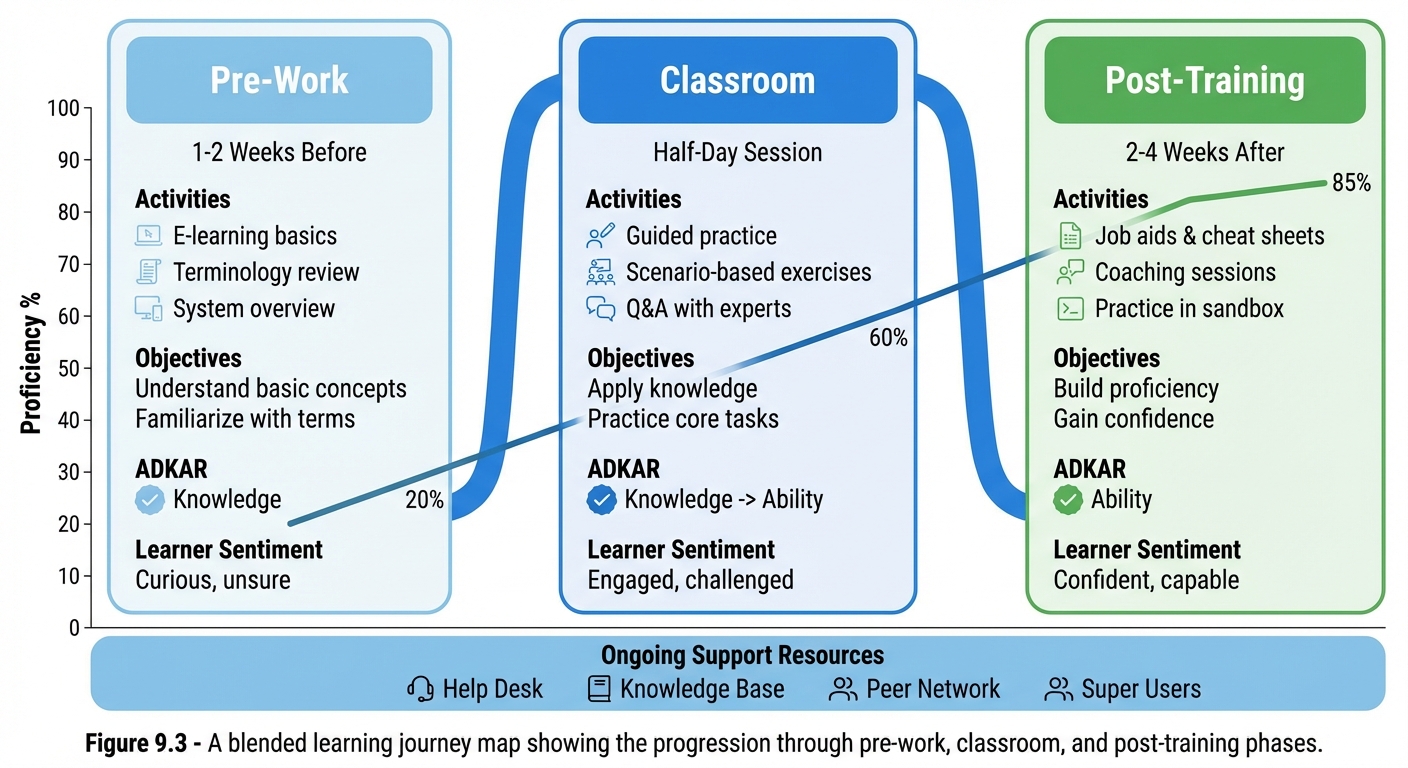
Figure 9.3: Blended learning combines pre-work (e-learning basics, 1-2 hours), classroom sessions (hands-on practice with guidance, half-day), and post-training support (job aids, coaching, practice time, 2-4 weeks). This progression builds knowledge through classroom experience and develops ability through supported practice, aligning with the ADKAR model.
Hands-On Practice
Effective skill-building requires practice, not just information transfer. Design practice activities that:
- Mirror actual job tasks
- Progress from simple to complex
- Provide immediate feedback
- Allow mistakes in a safe environment
- Build confidence through success
Training Logistics
Scheduling Considerations
Training scheduling requires balancing multiple constraints:
Business Operations: Minimize disruption to operations; consider peak periods and coverage needs
Learning Retention: Train close to go-live (within 2-4 weeks) for best retention
Sequencing: Train dependent skills in order; train trainers/support before end users
Capacity: Align with classroom/system capacity and trainer availability
Training Environment
For system training, the training environment matters:
Training System: Separate environment with realistic data that mirrors production
Workstations: Adequate equipment matching actual work setup
Facilities: Appropriate room size, layout, and technology
Materials: All materials prepared and tested in advance
Communication About Training
Stakeholders need to know:
- What training is available/required
- When and where training occurs
- How to register or access
- What to do to prepare
- What support is available after training
Evaluating Training Effectiveness
Kirkpatrick’s Four Levels
The Kirkpatrick model provides a framework for evaluating training at four levels:
Level 1: Reaction
- Did participants like the training?
- Measured by end-of-training surveys
- Useful for improving training design
Level 2: Learning
- Did participants acquire intended knowledge and skills?
- Measured by assessments, demonstrations, tests
- Verifies training achieved learning objectives
Level 3: Behavior
- Are participants applying what they learned on the job?
- Measured by observation, performance data, manager feedback
- Verifies transfer from training to workplace
Level 4: Results
- Did training contribute to business outcomes?
- Measured by business metrics, ROI analysis
- Verifies training delivered intended value
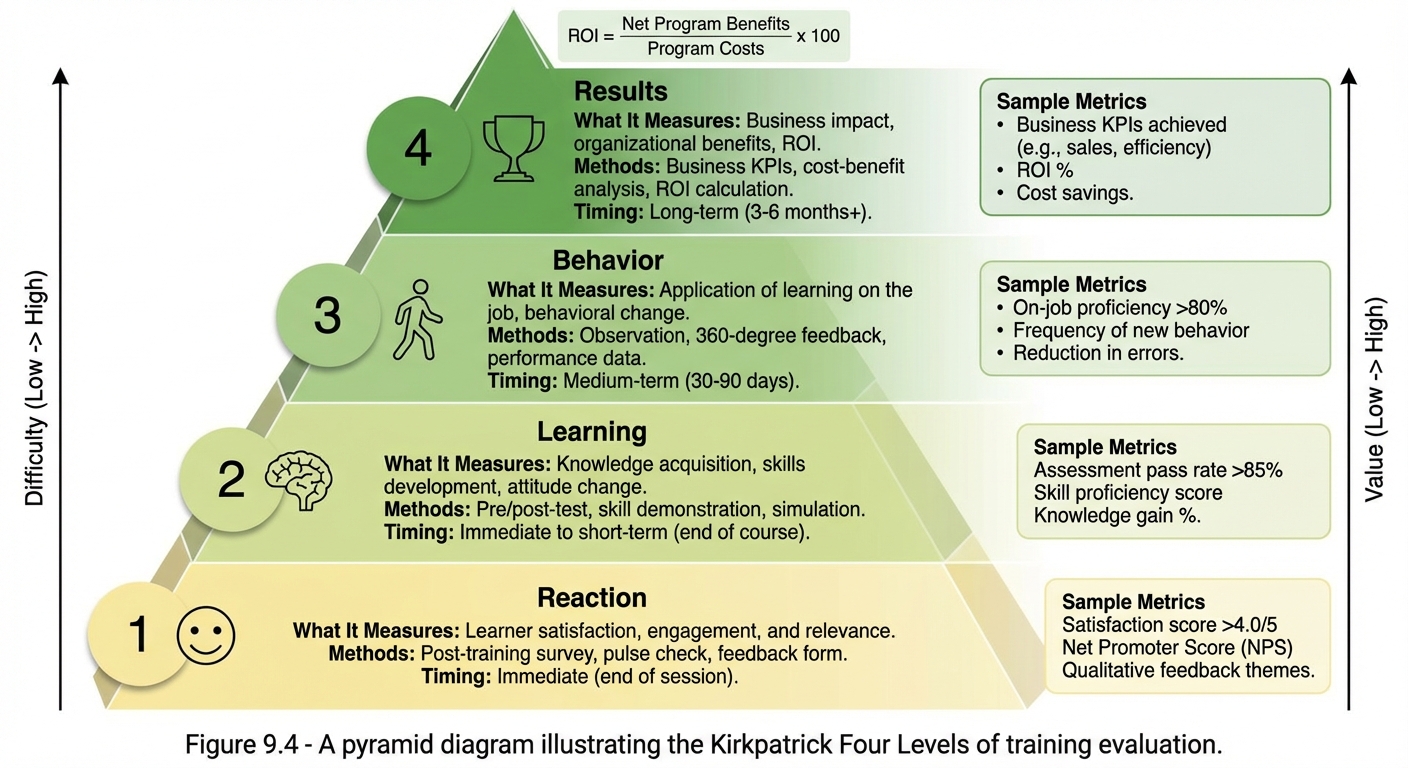
Figure 9.4: The Kirkpatrick Four-Level Model evaluates training from immediate reaction through learning acquisition, behavior change, and ultimately business results. Each level requires different measurement methods and timeframes: Level 1 (immediate feedback), Level 2 (end of training assessments), Level 3 (30-90 days observation), Level 4 (3-6 months business metrics). Higher levels provide greater value but require longer timeframes.
Measurement Methods
| Level | Measurement Methods | Timing |
|---|---|---|
| Reaction | Satisfaction surveys, feedback forms | Immediately after training |
| Learning | Knowledge checks, skill demonstrations, assessments | End of training, shortly after |
| Behavior | Observation, performance metrics, manager assessment | 30-90 days after training |
| Results | Business KPIs, adoption metrics, ROI | 3-6 months after implementation |
Using Evaluation Data
Evaluation data should drive action:
- Low reaction scores: Improve training design, materials, or delivery
- Low learning scores: Redesign content, add practice, adjust pacing
- Low behavior transfer: Add on-the-job support, coaching, reinforcement
- Low business results: Examine other barriers beyond training
Training Challenges and Solutions
Common Challenges
Insufficient Time: Stakeholders feel they don’t have time for training
- Solution: Make training efficient and clearly relevant; executive communication about priority
Training Too Early: Skills forgotten before go-live
- Solution: Train close to go-live; provide refresh options and job aids
No Opportunity to Practice: Training without application
- Solution: Include hands-on practice; sandbox environments; coached application
One-Size-Fits-All: Training doesn’t match audience needs
- Solution: Role-based design; pre-assessment to place learners appropriately
Completion Without Competence: Attendance doesn’t equal proficiency
- Solution: Proficiency assessments; certification requirements; follow-up support
Supporting Struggling Learners
Some learners will struggle with new skills. Support options include:
- Additional practice sessions
- One-on-one coaching or mentoring
- Peer support and buddy systems
- Extended access to training environments
- Modified job assignments during transition
- Patience and encouragement
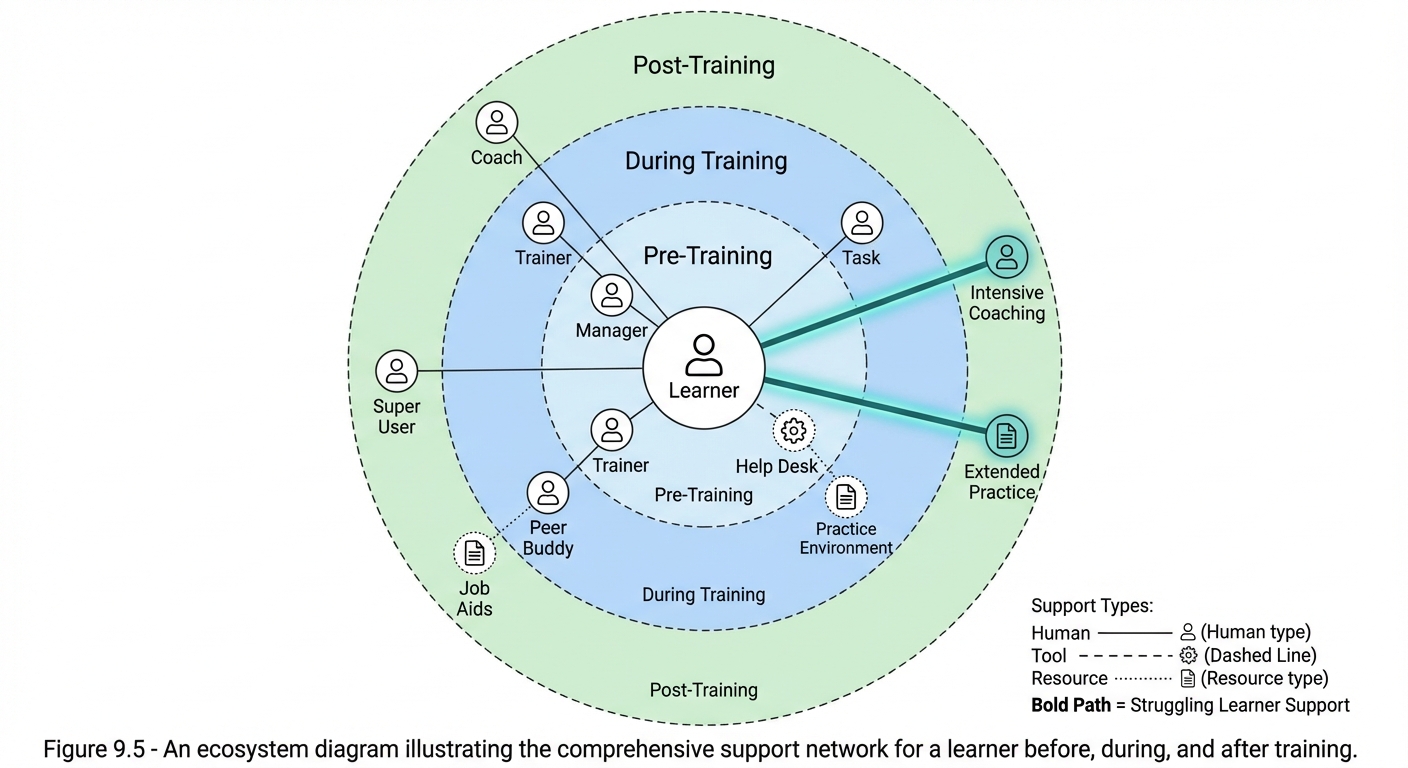
Figure 9.5: Effective training requires a support ecosystem spanning pre-training preparation, during-training guidance, and post-training reinforcement. Support includes human resources (managers, trainers, coaches, peers, super users), tools (help desk, systems), and resources (job aids, practice environments). For struggling learners, activate additional support paths including one-on-one coaching and extended practice time.
Key Takeaways
- Training builds the Knowledge and Ability elements of ADKAR but must be integrated with other OCM activities
- Adult learning principles guide effective training design for organizational change
- Role-based training addresses specific job needs rather than generic content
- Blended learning approaches combine methods for optimal effectiveness
- Timing matters: train close to go-live for retention, but early enough for confidence
- Evaluation at multiple levels ensures training achieves intended outcomes
- Support after training is essential for successful skill transfer
Summary
Training and capability building is a critical OCM execution activity that equips stakeholders with the knowledge and skills needed to succeed in the future state. Effective training is grounded in impact assessment findings, applies adult learning principles, uses appropriate delivery methods, and evaluates outcomes at multiple levels.
Training must be integrated with other OCM activities. Communication builds awareness and desire that motivate learning. Sponsorship signals organizational priority. Post-training support enables successful application. Reinforcement sustains new skills over time. Without this integration, even excellent training will fail to produce sustained adoption.
The investment in well-designed, well-delivered training pays dividends through faster time to proficiency, fewer errors during transition, higher confidence and morale, and ultimately higher sustained adoption rates.