Chapter 8: Communication Planning and Execution
Learning Objectives
After completing this chapter, you will be able to:
- Design comprehensive change communication plans
- Craft effective messages for different audiences
- Select appropriate communication channels
- Build feedback mechanisms into communication approaches
- Measure communication effectiveness and adjust strategies
The Role of Communication in Change
Communication is the lifeblood of organizational change management. Without effective communication, even the most well-designed change initiatives will fail because people cannot adopt what they do not understand, support what they do not trust, or sustain what they have not internalized.
Effective change communication accomplishes several critical objectives. First, it builds awareness and understanding of why change is necessary, addressing the first element of the ADKAR model. Second, it demonstrates respect for employees by keeping them informed rather than surprised. Third, it reduces the uncertainty and anxiety that naturally accompany organizational change. Fourth, it provides channels for questions, feedback, and concerns to surface. Fifth, it reinforces key messages consistently over time, supporting the development of desire, knowledge, and ultimately reinforcement.
However, communication alone cannot drive change adoption. A common mistake is treating communication as a substitute for engagement, training, and other OCM activities. Communication creates awareness and understanding; it does not by itself create desire, knowledge, ability, or reinforcement. Communication is necessary but not sufficient for successful change.
Communication Challenges in Change
Change communication faces unique challenges that distinguish it from routine organizational communication:
Information Void: In the absence of information, people fill the void with speculation, rumors, and often worst-case assumptions. Change communication must proactively fill information voids before they breed misinformation.
Competing Noise: Organizations are saturated with communication. Change messages must compete with day-to-day operational communication, other change initiatives, and external noise. Breaking through this clutter requires strategic planning.
Trust Deficit: Employees who have experienced poorly managed changes in the past may distrust communication about new changes. Rebuilding trust requires consistent messaging backed by consistent action.
Emotional Context: Change triggers emotional responses that affect how messages are received. The same message delivered during periods of high anxiety will be interpreted differently than during periods of stability.
Diverse Audiences: Different stakeholder groups have different information needs, communication preferences, and starting points. One-size-fits-all communication rarely succeeds.
The 5 Rights of Change Communication
Effective change communication applies the framework of the “5 Rights” to ensure messages reach their intended audiences with maximum impact.
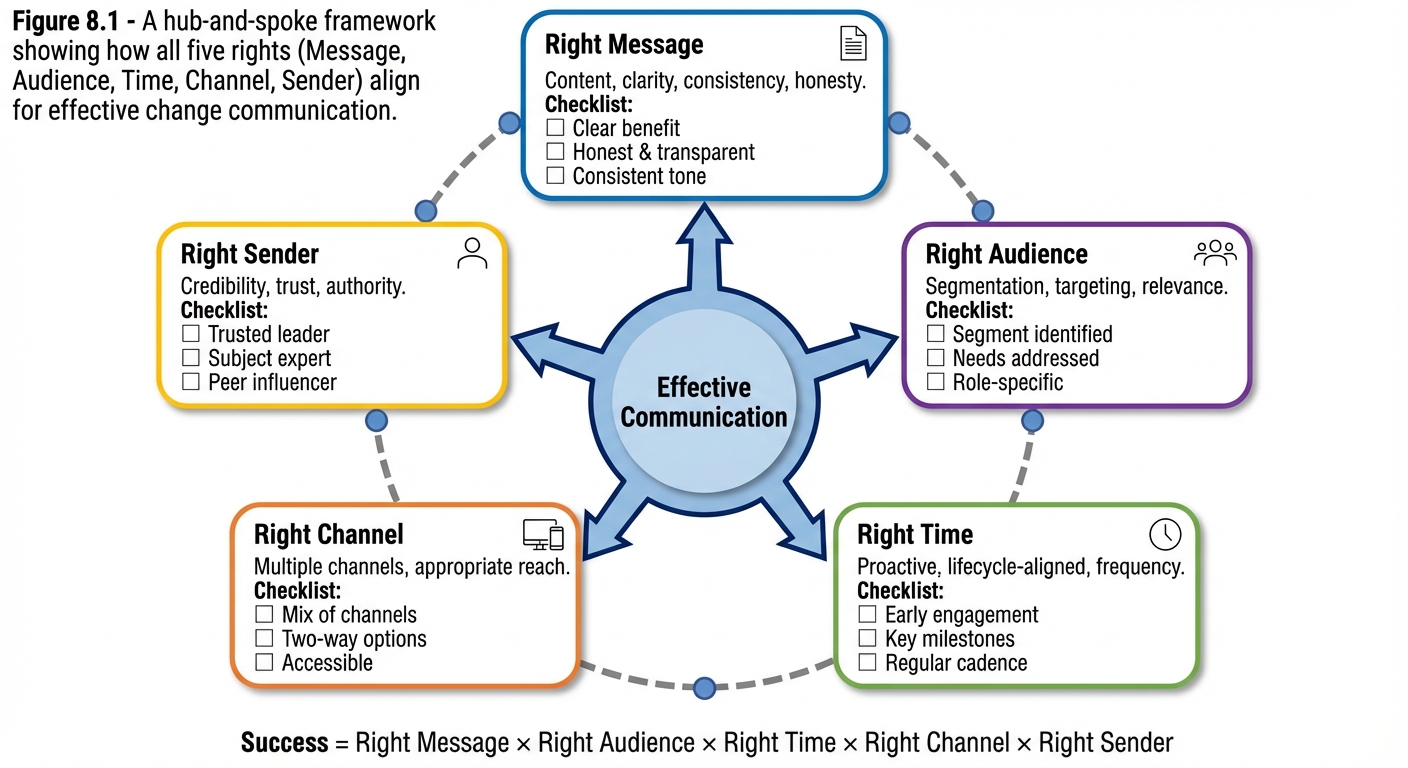
Figure 8.1: The 5 Rights of Effective Change Communication provides a comprehensive framework: deliver the Right Message (clear, consistent, honest) to the Right Audience (segmented and targeted) at the Right Time (proactive and appropriate) through the Right Channel (multi-channel mix) from the Right Sender (credible source). All five must align for communication success.
Right Message
The message itself must be carefully crafted for the intended audience. Key considerations include:
Relevance: Does this message address what this audience needs to know? Different audiences have different information needs. Executives need strategic context; frontline employees need practical impact information.
Clarity: Is the message clear and unambiguous? Avoid jargon, acronyms, and corporate-speak that obscure meaning. Test messages with representatives of the target audience before broad distribution.
Completeness: Does the message provide enough information to be useful without overwhelming? Include answers to predictable questions while avoiding information overload.
Honesty: Is the message truthful and transparent? Never mislead or withhold critical information. Employees will eventually discover the truth, and discovering they were misled destroys trust.
Consistency: Does this message align with previous communications? Contradictory messages create confusion and undermine credibility. Maintain a master message platform to ensure consistency.
Right Audience
Communication must be targeted to specific stakeholder groups with tailored messages:
| Audience Segment | Primary Information Needs | Key Questions They Ask |
|---|---|---|
| Executive Leaders | Strategic alignment, risks, decisions needed | “How does this affect our strategy?” |
| Middle Managers | Team impacts, how to support teams, talking points | “What do I tell my team?” |
| End Users | What’s changing, when, how to prepare, support available | “What do I need to do differently?” |
| IT Support | Technical details, support expectations, escalation paths | “What do I need to know to help users?” |
| Customers/Partners | Service impacts, timing, what to expect | “How will this affect my experience?” |
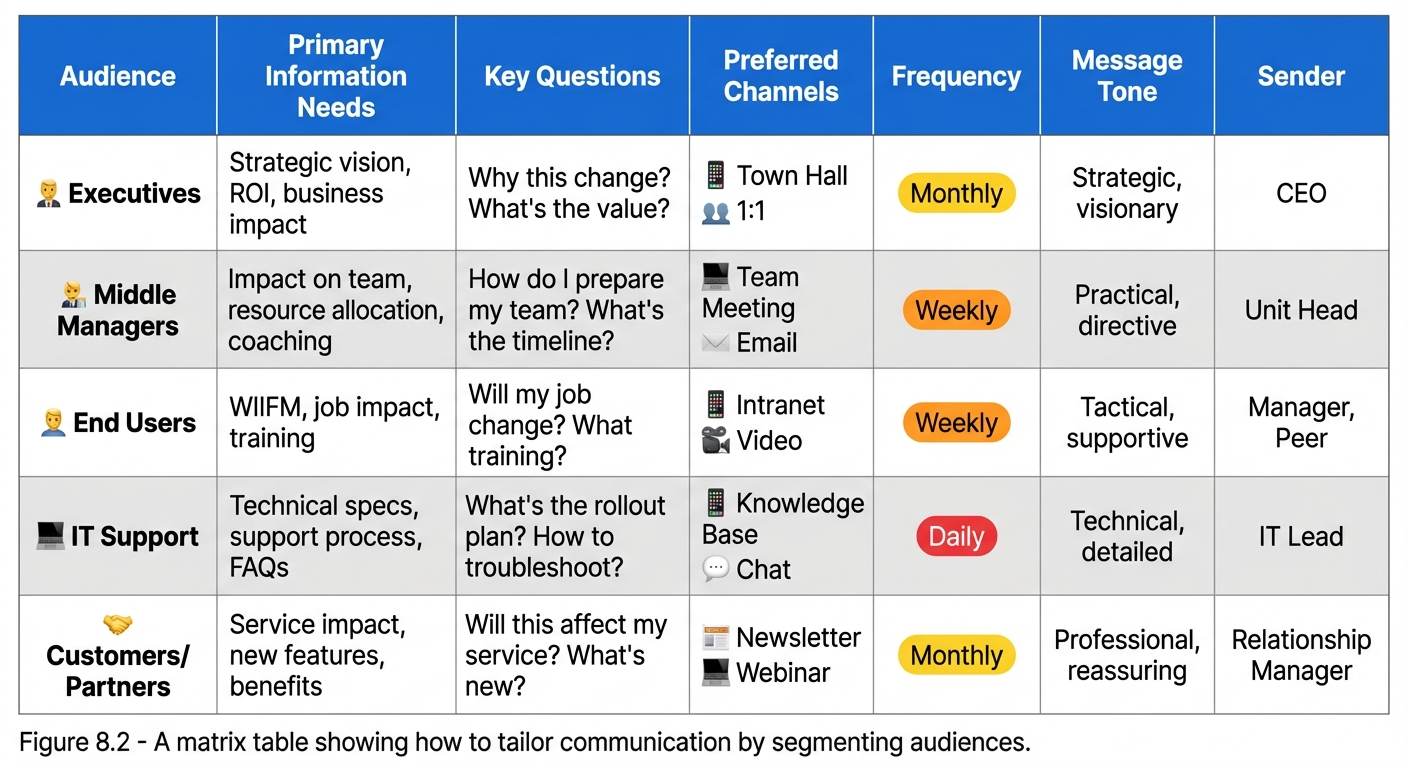
Figure 8.2: Effective audience segmentation recognizes that different stakeholder groups have different information needs, questions, channel preferences, and communication expectations. Tailor messages, timing, tone, and senders to match each audience segment’s specific requirements.
Right Time
Timing significantly affects communication impact:
Proactive vs. Reactive: Communicate before events occur when possible. Being surprised by change creates anxiety and resentment, even if the change itself is positive.
Lifecycle Alignment: Different messages are appropriate at different stages. Early communication focuses on awareness; later communication focuses on practical preparation and reinforcement.
Milestone Synchronization: Time communications to project milestones when stakeholder attention is naturally focused on the change.
Frequency Calibration: Too little communication allows information voids to develop; too much creates fatigue and noise. Adjust frequency based on change phase and audience needs.
Right Channel
Different channels serve different purposes and reach different audiences:
| Channel | Strengths | Best For | Limitations |
|---|---|---|---|
| Town Halls/All-Hands | Broad reach, Q&A, executive visibility | Major announcements, vision sharing | One-way, scheduling challenges |
| Documentation, broad reach | Detailed information, reference material | Easily ignored, no dialogue | |
| Team Meetings | Two-way dialogue, local context | Discussion, Q&A, manager cascade | Inconsistent delivery |
| Intranet/Portal | Always available, searchable | Reference information, FAQs, resources | Requires active seeking |
| Video | Engaging, human connection | Executive messages, demonstrations | Production effort, accessibility |
| Digital Signage | High visibility, passive reach | Awareness, countdown, reminders | Limited content, no targeting |
| 1:1 Conversations | Personalized, addresses concerns | Sensitive topics, individual issues | Not scalable |
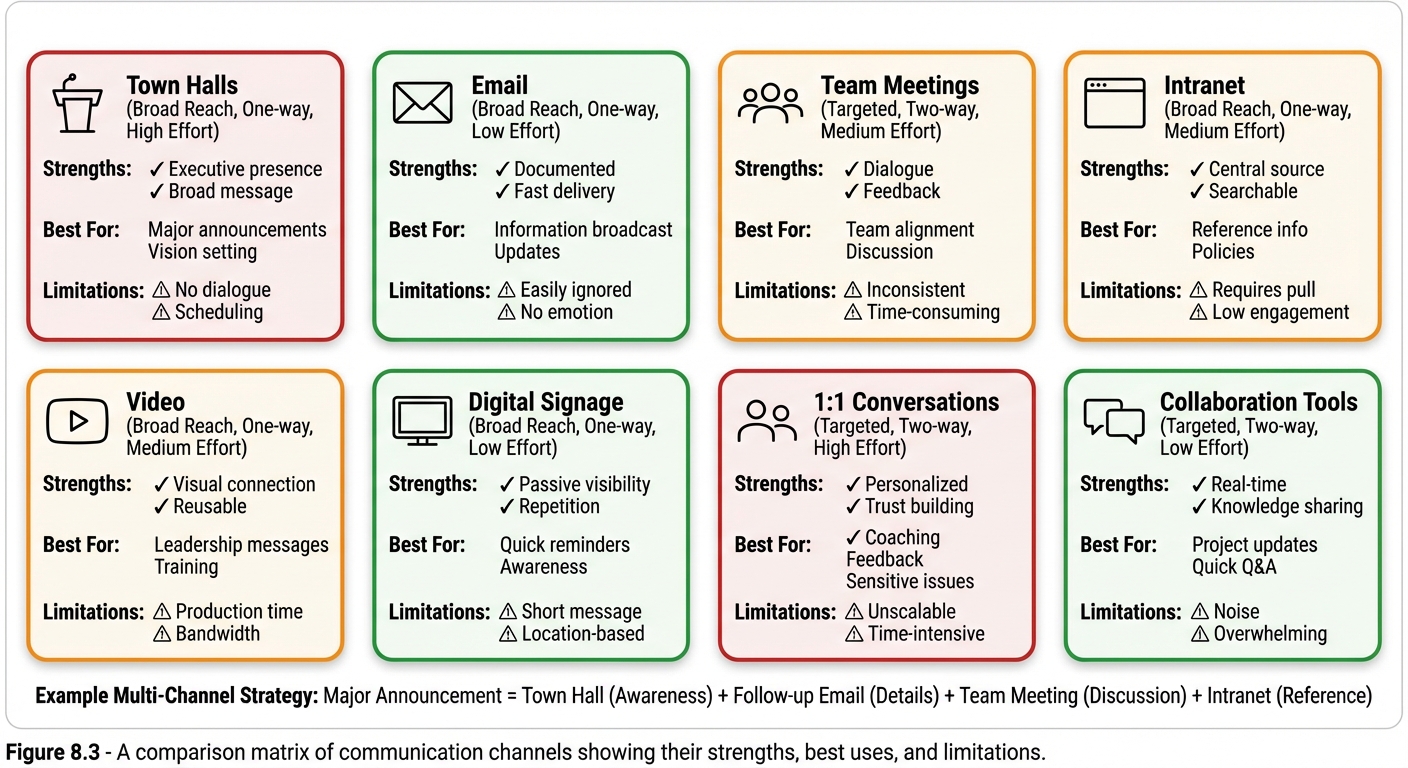
Figure 8.3: Each communication channel has distinct strengths, limitations, and best uses. Town halls provide broad reach and executive visibility but are one-way. Team meetings enable two-way dialogue but require consistent delivery. Email documents information but is easily ignored. Use a multi-channel strategy to reinforce messages and reach different preferences.
Channel Strategy: Use multiple channels to reinforce key messages. Different people consume information differently; multi-channel approaches increase reach and retention.
Right Sender
Who delivers a message significantly affects how it is received:
Executives: Most credible for strategic messages, vision, and commitment. Demonstrates organizational priority.
Direct Managers: Most credible for messages about team impact, expectations, and support. Employees primarily trust their immediate supervisor.
Subject Matter Experts: Most credible for technical information and detailed how-to guidance.
Peers/Change Agents: Most relatable for messages about personal experience and practical tips.
Matching sender to message type increases credibility and impact.
Communication Planning
Developing a Communication Strategy
Before creating individual communications, develop an overarching communication strategy that addresses:
Objectives: What should communication accomplish? Typical objectives include building awareness, creating understanding, addressing concerns, driving action, and reinforcing adoption.
Audiences: Who needs to receive communication? Develop a comprehensive stakeholder list and segment by information needs.
Key Messages: What are the core messages that must be conveyed consistently? Develop a message platform that ensures alignment across all communications.
Channels: What mix of channels will reach audiences effectively? Map channels to audiences based on reach and preferences.
Timeline: When will communications occur? Align with project milestones and stakeholder needs.
Governance: Who approves communications? Establish review and approval processes to ensure quality and consistency.
Measurement: How will effectiveness be measured? Define metrics and feedback mechanisms.
Creating a Communication Plan
A communication plan operationalizes the strategy into specific communications:
| Date | Audience | Message | Channel | Sender | Owner | Status |
|---|---|---|---|---|---|---|
| Week 1 | All employees | Change announcement | Town hall + email | CEO | Comms Lead | Planned |
| Week 2 | Managers | Manager toolkit | Team meeting + portal | OCM Lead | OCM Team | Planned |
| Week 3 | End users | What’s changing | Department meetings | Managers | Managers | Planned |
| Ongoing | All | FAQ updates | Intranet | Support team | Support Lead | Recurring |
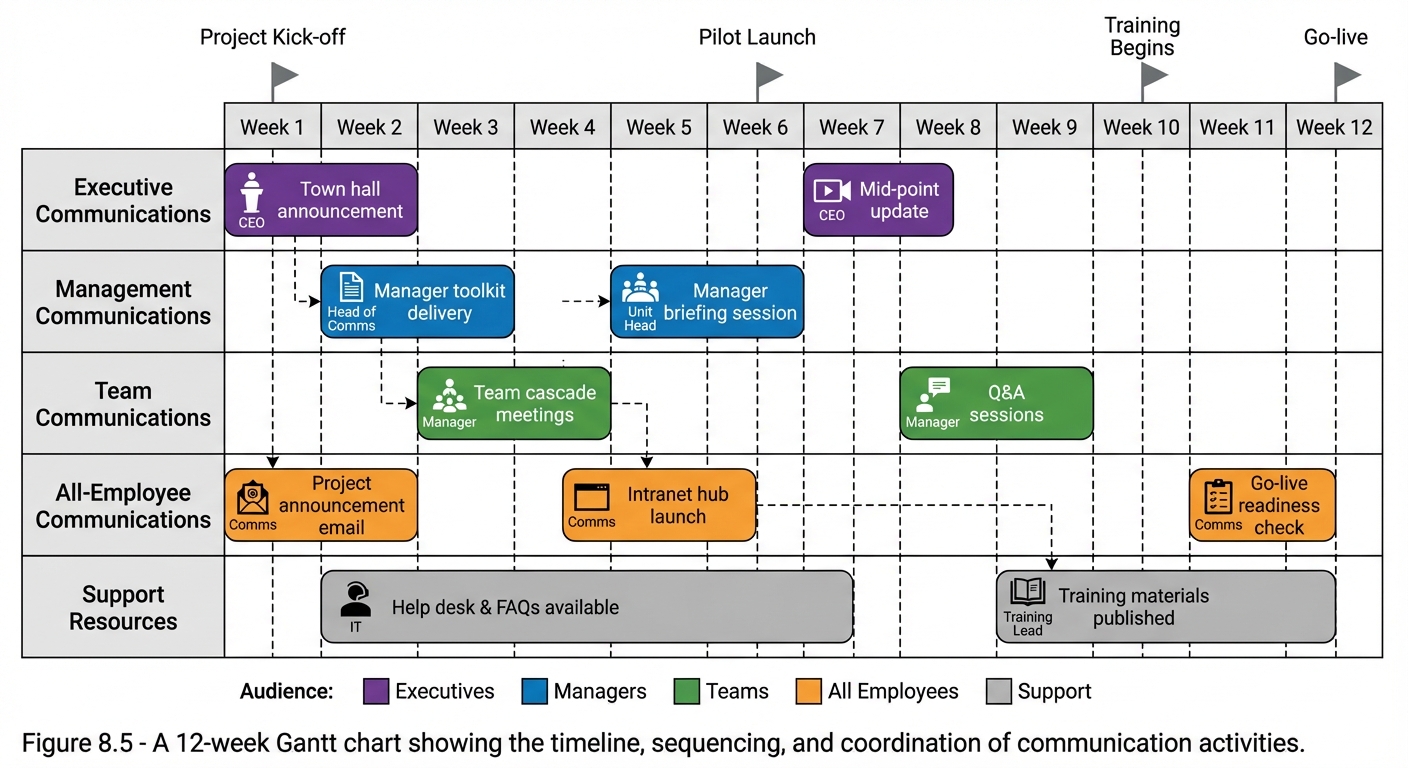
Figure 8.5: A communication plan calendar maps all communication activities across time, showing sequencing, coordination, and frequency. Color coding by audience, icons for channels and senders, and milestone markers ensure comprehensive planning. This example shows a 12-week launch communication campaign.
Message Platform Development
A message platform ensures consistency across communications. Key elements include:
Vision Statement: A compelling description of the future state
- Example: “A unified platform that gives every employee instant access to the information they need to serve customers effectively.”
Case for Change: Why the change is necessary
- Example: “Our current systems create barriers between departments, leading to delays, errors, and frustrated customers. We cannot meet our growth targets without addressing these limitations.”
Benefits by Audience: What’s in it for each stakeholder group
- Example (End Users): “You’ll spend less time searching for information and more time on meaningful work.”
Timeline and Key Milestones: When things will happen
- Example: “Pilot launch in March, full rollout in June, optimization complete by September.”
Support Available: How people can get help
- Example: “Training sessions begin in April, super-users available in every department, help desk extended hours during transition.”
Two-Way Communication
Effective change communication is not one-way broadcasting but two-way dialogue. Feedback mechanisms serve several critical purposes:
Surface Concerns: Provides channels for questions and concerns to emerge before they become resistance.
Identify Gaps: Reveals where communication is not reaching audiences or not being understood.
Build Engagement: People who feel heard are more likely to support change.
Improve Implementation: Feedback often contains valuable suggestions for improving the change approach.
Feedback Mechanisms
Q&A Sessions: Include time for questions in all communication events. Capture questions asked to inform future communications.
Feedback Channels: Establish dedicated email addresses, forms, or tools for submitting questions and concerns. Ensure responses are timely.
Pulse Surveys: Brief, frequent surveys to gauge understanding and sentiment. Track trends over time.
Manager Feedback: Train managers to gather and escalate feedback from their teams. Create systematic reporting mechanisms.
Change Agent Network: Leverage change agents to gather ground-level feedback and identify emerging issues.
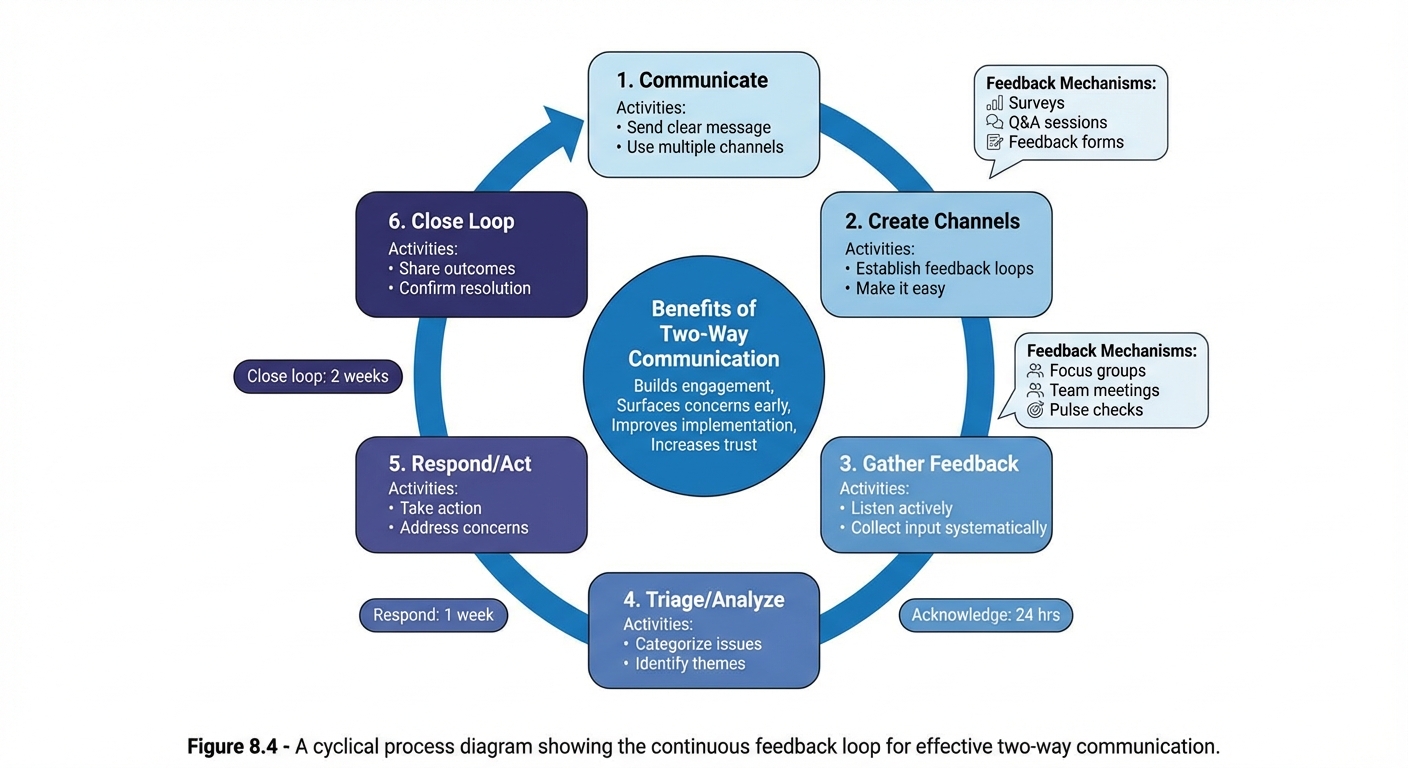
Figure 8.4: Effective two-way communication creates a continuous feedback loop: communicate messages, establish feedback channels, systematically gather input, triage and analyze feedback, respond with actions, and close the loop by communicating how feedback was addressed. This builds engagement, surfaces concerns early, and improves implementation.
Responding to Feedback
Gathering feedback without responding undermines trust. Establish processes to:
- Acknowledge receipt of feedback promptly
- Triage feedback by type and urgency
- Route feedback to appropriate owners
- Track and report on feedback themes
- Close the loop by communicating how feedback was addressed
Communication Challenges and Solutions
Managing Rumors and Misinformation
Rumors flourish in information voids. Strategies to address rumors include:
Proactive Communication: Fill information voids before rumors emerge. If you know a topic will generate questions, address it proactively.
Acknowledge Uncertainty: If decisions haven’t been made, say so. “We don’t have final decisions on X yet, but we expect to know by [date]” is better than silence.
Address Rumors Directly: When rumors emerge, address them explicitly. “We’ve heard concerns about X. Here’s the truth…”
Consistent Sources: Establish authoritative sources so people know where to find accurate information.
Communicating Difficult Messages
Some change messages are inherently difficult—layoffs, benefit changes, office closures. Principles for difficult communications:
Don’t Delay: Delaying bad news rarely makes it easier and often makes it worse through leaks and speculation.
Be Direct: State the difficult information clearly and early in the communication. Don’t bury it.
Explain Rationale: Help people understand why the decision was made, even if they disagree with it.
Acknowledge Impact: Recognize that the news is difficult and that reactions are understandable.
Provide Support: Explain what support is available for those affected.
Allow Time: Build in time for people to process difficult news before expecting action.
Sustaining Communication
Communication often drops off after initial announcements, just when reinforcement is most needed. Strategies for sustaining communication:
Communication Calendar: Plan communications for the entire change lifecycle, not just the launch.
Vary Approaches: Keep communication fresh by varying formats, channels, and messengers.
Celebrate Progress: Communicate wins and milestones to maintain momentum.
Address Emerging Issues: Continue communicating about challenges and how they’re being addressed.
Reinforce Key Messages: Repeat core messages regularly; people need to hear messages multiple times to internalize them.
Measuring Communication Effectiveness
Communication Metrics
| Metric | Definition | Target | Measurement Method |
|---|---|---|---|
| Reach | % of target audience who received communication | 100% | Distribution reports, attendance |
| Open/View Rate | % who opened/viewed communication | >70% | Email analytics, video views |
| Comprehension | % who understood key messages | >85% | Pulse surveys, knowledge checks |
| Satisfaction | Satisfaction with communication quality | >4.0/5 | Feedback surveys |
| Feedback Volume | Quantity of questions/feedback received | Trending up then stable | Feedback tracking |
| Message Retention | % who can recall key messages | >70% | Random sampling, focus groups |
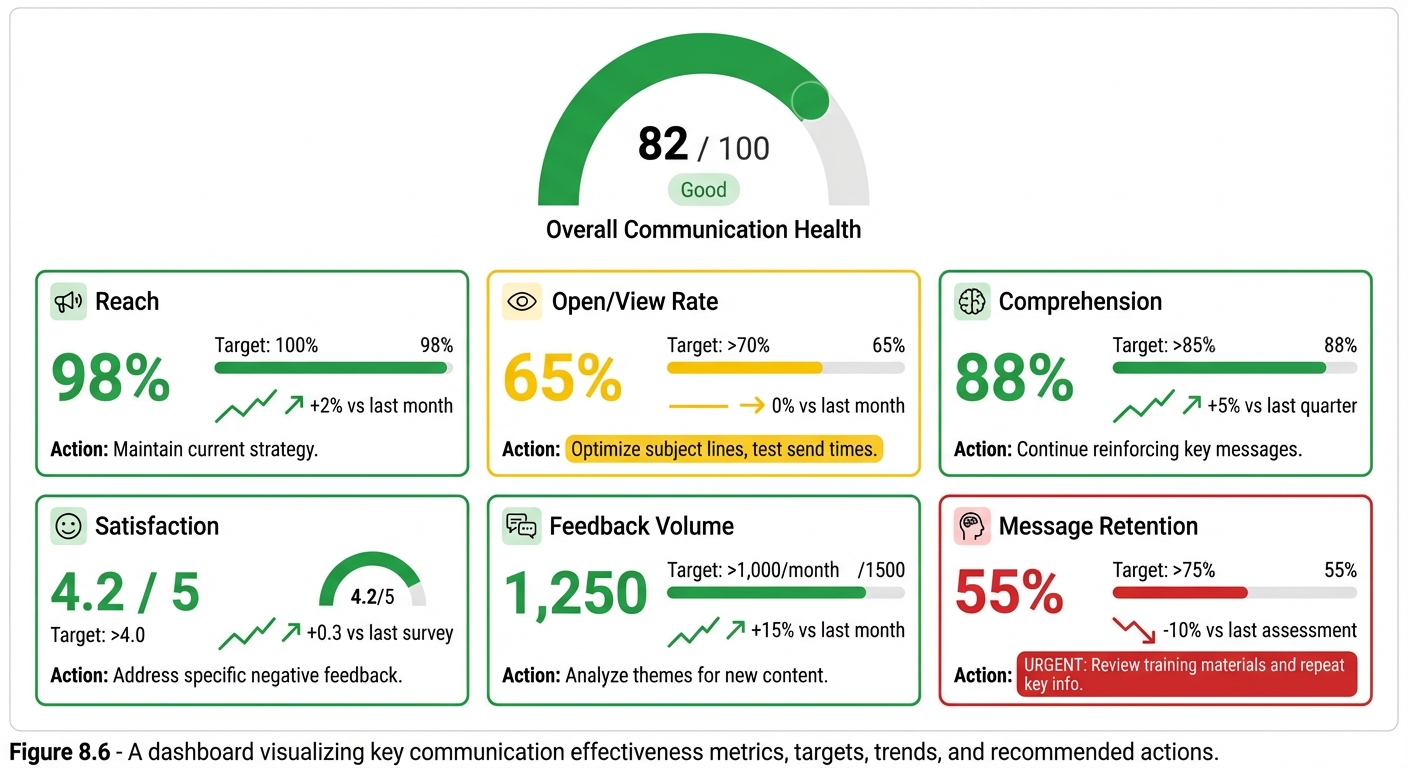
Figure 8.6: Communication effectiveness is measured across six dimensions: Reach (% who received messages), Open/View Rate (engagement), Comprehension (understanding), Satisfaction (quality rating), Feedback Volume (engagement indicator), and Message Retention (recall). Track trends over time and take corrective action when metrics show at-risk or off-track performance.
Using Measurement Data
Communication metrics should drive continuous improvement:
- Low reach: Evaluate channel mix; messages may not be getting through
- Low comprehension: Simplify messages; test with audience representatives
- Low satisfaction: Gather qualitative feedback on what’s missing
- High feedback volume: May indicate anxiety or gaps; analyze themes
- Declining engagement: Refresh approaches; address communication fatigue
Key Takeaways
- Communication is necessary but not sufficient for change success—it must be integrated with other OCM activities
- The 5 Rights framework (message, audience, time, channel, sender) guides effective communication planning
- Two-way communication through feedback mechanisms is essential for surfacing concerns and building engagement
- Consistency across all communications builds credibility and reduces confusion
- Measurement enables continuous improvement of communication effectiveness
- Communication must be sustained throughout the change lifecycle, not just at launch
Summary
Effective change communication is planned, targeted, multi-channel, and two-way. It addresses the information needs of different stakeholder groups through appropriate channels with messages delivered by credible senders at the right times. Beyond broadcasting information, effective communication creates dialogue through feedback mechanisms that surface concerns and enable continuous improvement.
Communication is a foundational OCM activity that supports all other change activities. Without effective communication, stakeholders cannot be aware of change, training cannot be positioned effectively, sponsors cannot demonstrate commitment, and resistance cannot be surfaced and addressed. Investment in communication planning and execution pays dividends throughout the change lifecycle.