Chapter 7: OCM Strategy and Planning
Learning Objectives
After completing this chapter, you will be able to:
- Develop comprehensive OCM strategies aligned with project objectives
- Create integrated OCM plans that coordinate all change activities
- Align OCM activities with project timelines and milestones
- Define resource requirements and governance structures
- Establish success metrics and measurement approaches
The Role of OCM Strategy
OCM strategy defines the overall approach to managing the people side of change. It translates assessment findings into a coherent plan of action that guides all OCM activities throughout the change lifecycle.
Without a clear strategy, OCM activities become reactive and fragmented. Communication happens in response to problems rather than proactively building awareness. Training is designed without understanding the full scope of skill gaps. Resistance is addressed only after it emerges rather than anticipated and prevented. Resources are allocated ad hoc rather than planned for peak demand periods.
A well-developed OCM strategy provides several critical benefits:
Alignment: Ensures OCM activities support project objectives and business outcomes
Coordination: Integrates multiple OCM workstreams (communication, training, engagement) into a cohesive approach
Resource Optimization: Enables proactive resource planning and allocation
Risk Management: Identifies and addresses people-related risks before they materialize
Accountability: Establishes clear ownership and expectations for OCM outcomes
Measurement: Defines how success will be measured and tracked
Strategy Development Process
Step 1: Synthesize Assessment Findings
OCM strategy must be grounded in assessment findings. Before developing strategy, consolidate insights from:
- Readiness Assessment: Organizational capacity, leadership support, manager capability, individual preparedness
- Stakeholder Analysis: Key stakeholders, their concerns, engagement requirements
- Impact Assessment: Scope of change, severity of impacts, mitigation needs
Key Questions to Answer:
- What are the critical readiness gaps that must be addressed?
- Which stakeholder groups require the most intensive engagement?
- What are the highest-severity impacts requiring robust support?
- What are the major risks to successful adoption?
Step 2: Define OCM Objectives
Clearly articulate what OCM must accomplish. Objectives should be:
Specific: Clear about what will be achieved Measurable: Quantifiable indicators of success Aligned: Connected to project and business objectives Realistic: Achievable given resources and constraints Time-bound: Associated with target dates
Example OCM Objectives:
- Achieve 90% awareness of change rationale among all impacted employees by Week 8
- Build manager capability to support teams, with 100% of managers completing preparation by Week 10
- Achieve 85% user proficiency within 30 days of go-live
- Maintain resistance below 15% throughout implementation
- Sustain 90%+ adoption at 6 months post-implementation
Step 3: Determine OCM Approach
Based on assessment findings and objectives, determine the overall OCM approach:
Approach Intensity
| Factor | Light OCM | Standard OCM | Intensive OCM |
|---|---|---|---|
| Impact severity | Low | Medium | High |
| Stakeholder complexity | Simple | Moderate | Complex |
| Change history | Positive | Mixed | Negative |
| Organizational readiness | High | Medium | Low |
| Timeline pressure | Relaxed | Normal | Compressed |
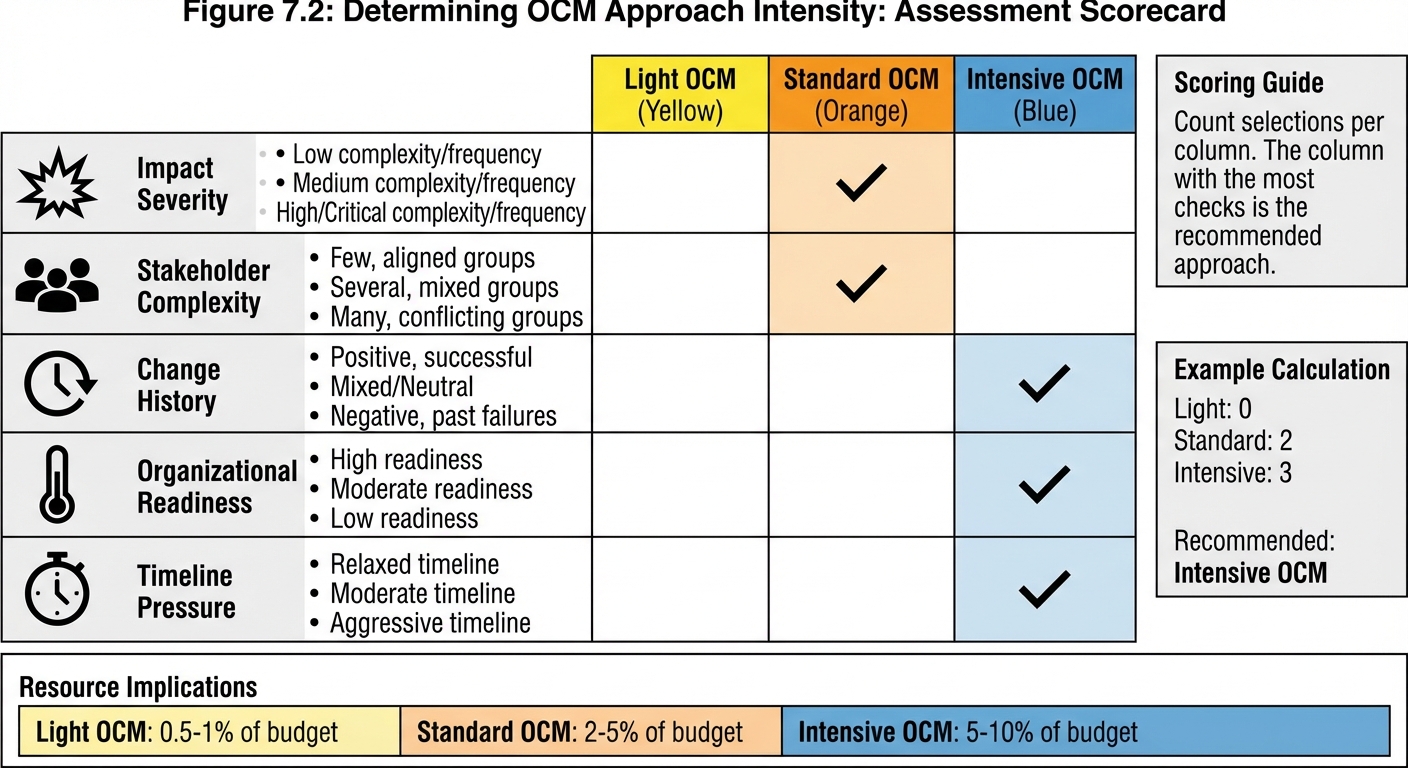
Figure 7.2: Use this scorecard to determine appropriate OCM approach intensity. Assess each factor (impact severity, stakeholder complexity, history, readiness, timeline) and select the matching intensity level. Most scores in one column indicates recommended approach and corresponding resource investment.
Methodology Selection
Select or adapt a methodology that fits the change:
- ADKAR-based: Individual change focus, good for technology implementations
- Kotter-based: Organizational change focus, good for transformations
- Hybrid: Combine elements based on specific needs
Step 4: Design OCM Workstreams
Structure OCM activities into coordinated workstreams:
Communication Workstream
- Key messages and message platform
- Communication channels and cadence
- Feedback mechanisms
- Metrics and measurement
Training Workstream
- Learning strategy and approach
- Curriculum design
- Delivery logistics
- Proficiency assessment
Sponsorship Workstream
- Sponsor engagement plan
- Sponsor activities and commitments
- Coalition building
- Sponsor effectiveness measurement
Change Network Workstream
- Change agent selection and onboarding
- Change agent activities and support
- Network coordination
- Network effectiveness measurement
Resistance Management Workstream
- Resistance anticipation and monitoring
- Intervention strategies
- Escalation processes
- Resolution tracking
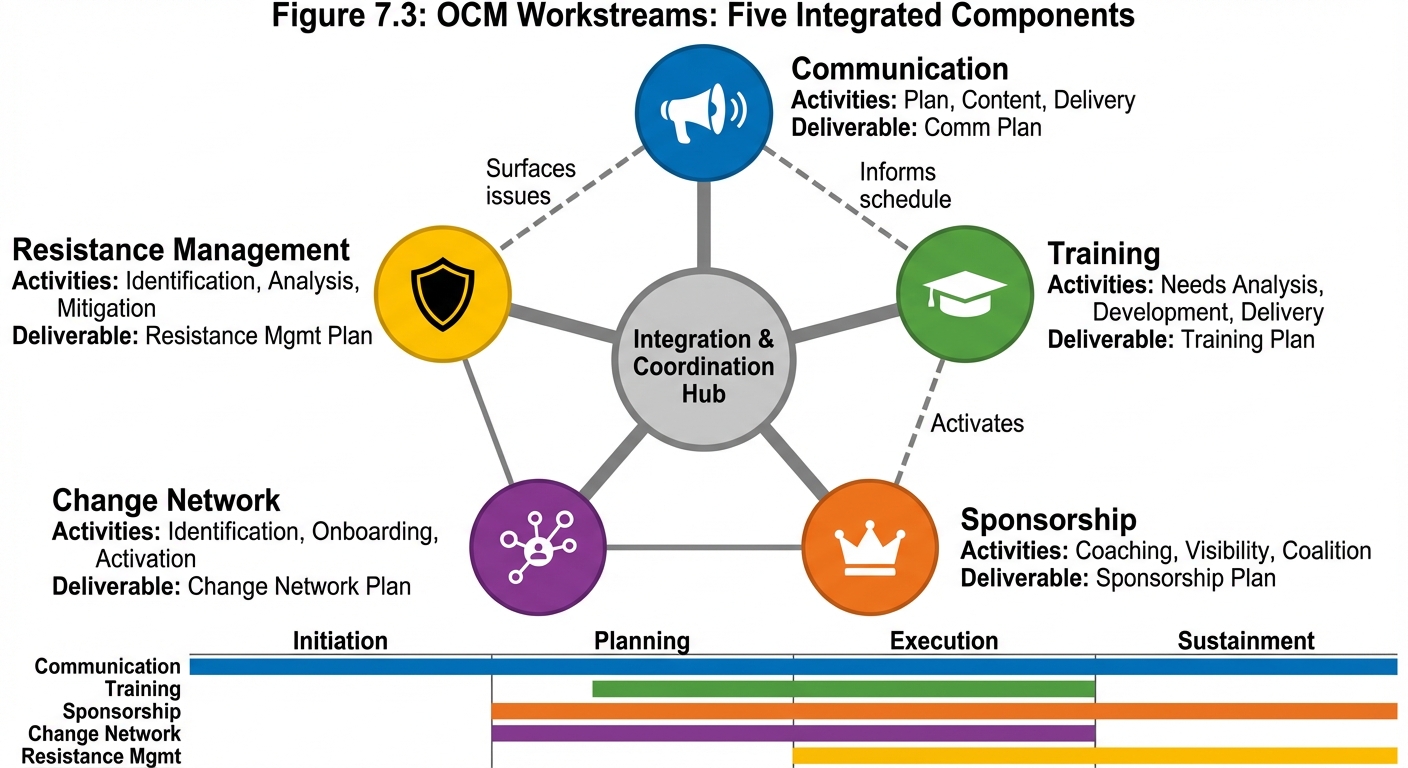
Figure 7.3: Five OCM workstreams operate in concert throughout the change lifecycle: Communication builds awareness, Training builds capability, Sponsorship provides leadership support, Change Networks extend reach, and Resistance Management addresses barriers. Coordination is managed centrally to ensure integration.
Step 5: Integrate with Project Plan
OCM activities must align with project milestones. Map OCM activities to the project timeline:
| Project Phase | Project Activities | OCM Activities |
|---|---|---|
| Initiation | Charter, stakeholder ID | OCM assessment, strategy development |
| Planning | Requirements, design | Impact assessment, detailed OCM planning |
| Build | Development, configuration | Training development, communication preparation |
| Test | UAT, integration testing | Pilot training, readiness verification |
| Deploy | Go-live, cutover | Intensive communication, training delivery, support |
| Stabilize | Hypercare, optimization | Reinforcement, adoption monitoring, sustainment |
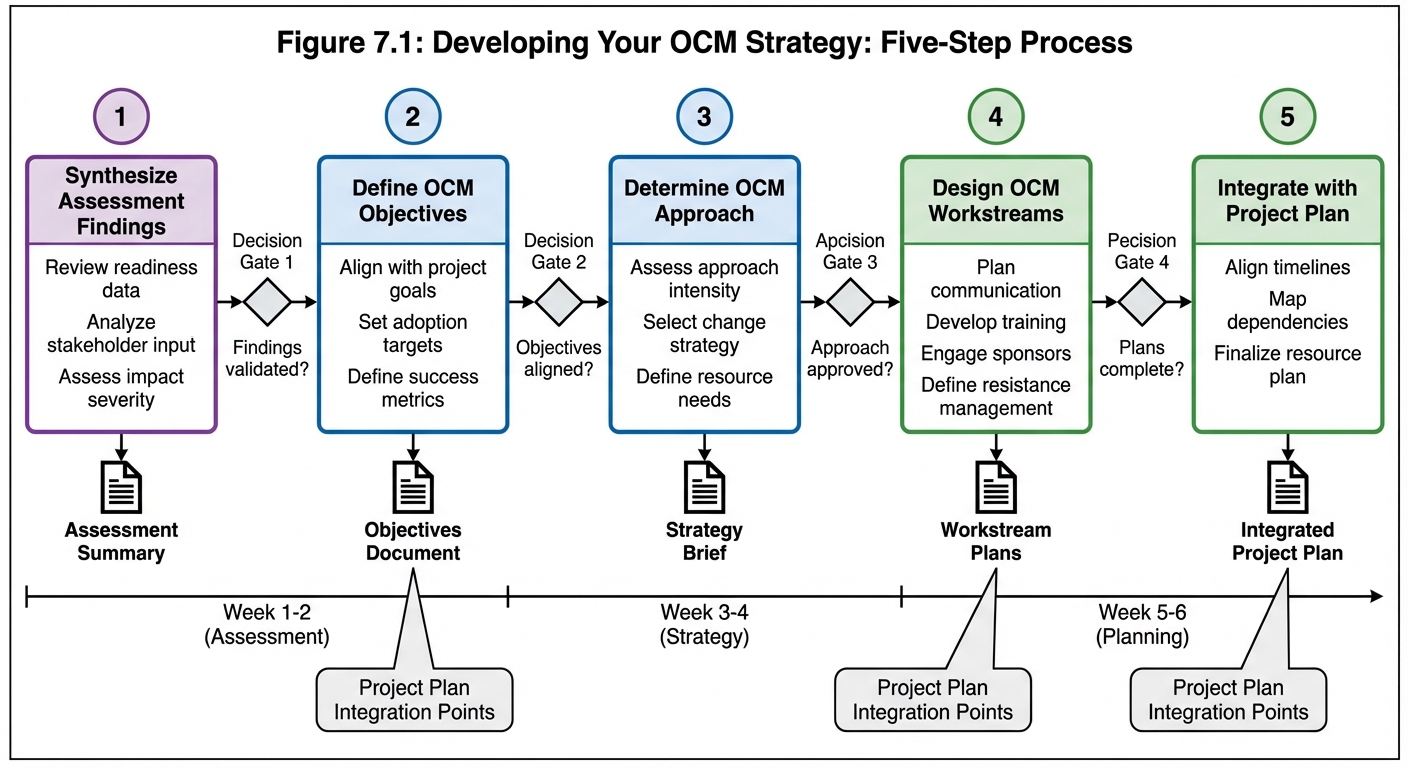
Figure 7.1: OCM strategy development follows five steps: synthesize assessments, define objectives, determine approach intensity, design workstreams, and integrate with the project plan. The process typically takes 4-6 weeks and produces comprehensive OCM strategy and detailed plans.
OCM Planning Components
Communication Plan
The communication plan operationalizes the communication strategy into specific activities:
Elements:
- Target audiences and segmentation
- Key messages by audience and phase
- Communication channels and tools
- Communication calendar/timeline
- Roles and responsibilities
- Feedback mechanisms
- Measurement approach
Sample Communication Calendar:
| Week | Audience | Message | Channel | Sender |
|---|---|---|---|---|
| 1 | All employees | Change announcement | Town hall | Executive Sponsor |
| 2 | Managers | Manager preparation | Workshop | OCM Lead |
| 3 | Impacted users | What’s changing | Team meetings | Managers |
| 4 | All employees | Progress update | Email/intranet | Project Lead |
| 5 | Impacted users | Training preview | Demo sessions | Training Lead |
Training Plan
The training plan defines how stakeholders will build required skills:
Elements:
- Training needs by role/group
- Learning objectives
- Curriculum and content outline
- Delivery approach (classroom, e-learning, blended)
- Training schedule and logistics
- Trainer/facilitator requirements
- Materials and resources
- Proficiency assessment approach
- Post-training support
Training Matrix Example:
| Role | Training Modules | Duration | Delivery | Timing |
|---|---|---|---|---|
| All Users | System Overview | 1 hour | E-learning | Week -4 |
| Power Users | Advanced Functions | 4 hours | Classroom | Week -2 |
| Managers | Reporting & Analytics | 2 hours | Virtual | Week -2 |
| Support Staff | Troubleshooting | 3 hours | Classroom | Week -1 |
Sponsorship Plan
The sponsorship plan defines how sponsors will be engaged and activated:
Elements:
- Sponsor identification and roles
- Sponsor commitments and activities
- Sponsor preparation and support
- Sponsor communication requirements
- Coalition building activities
- Sponsor effectiveness measurement
Sponsor Activity Plan Example:
| Activity | Frequency | Sponsor Role | Support Needed |
|---|---|---|---|
| Steering committee updates | Bi-weekly | Present progress, decisions | Briefing materials |
| All-hands presentations | Monthly | Deliver key messages | Talking points, slides |
| Department visits | Weekly during rollout | Visible presence, Q&A | Scheduling, FAQ prep |
| Manager meetings | As needed | Remove barriers, reinforce | Issue escalation |
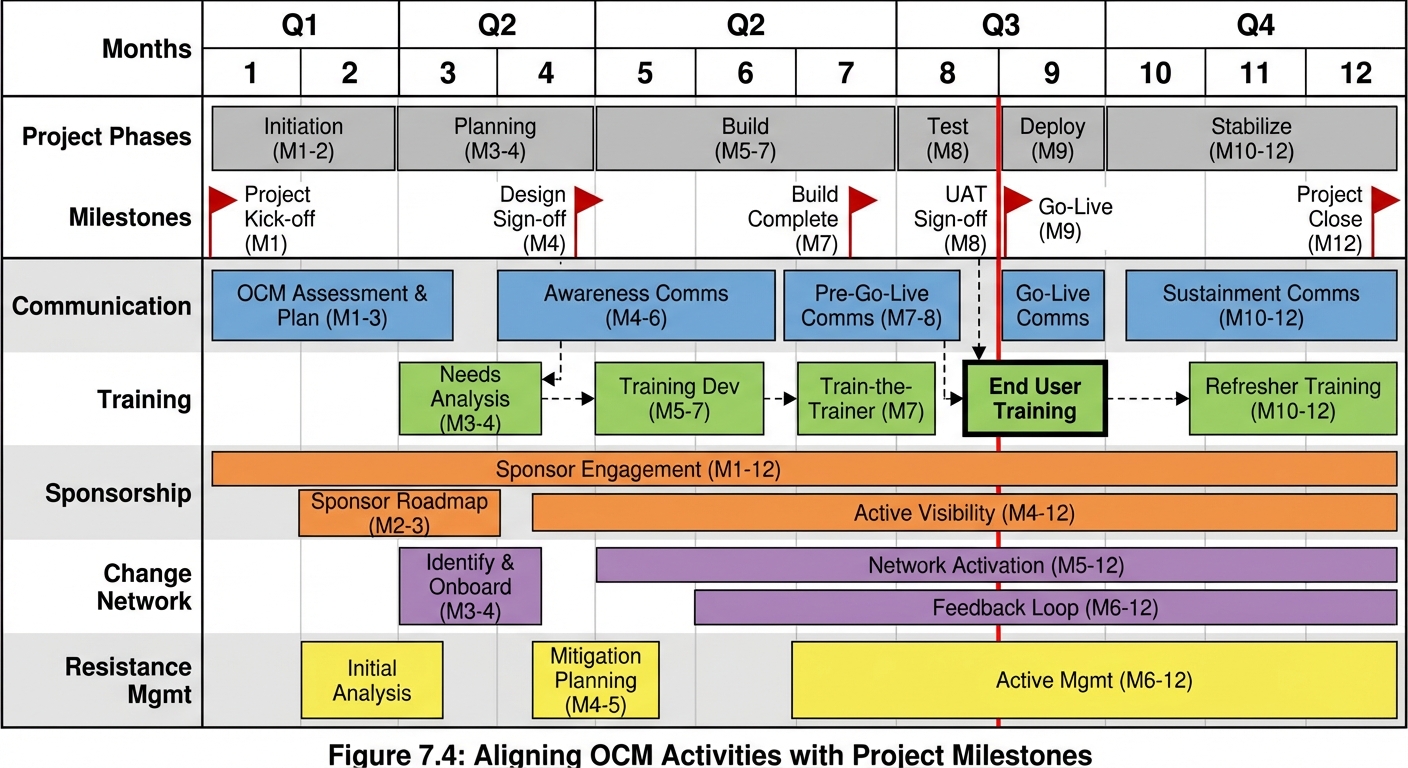
Figure 7.4: Effective OCM integration aligns activities with project phases and milestones. OCM assessment begins during Initiation, planning during Planning, intensive activities during Deploy, and sustainment during Stabilize phase. Dependencies ensure OCM activities are sequenced appropriately.
Resistance Management Plan
The resistance management plan prepares for and addresses resistance:
Elements:
- Anticipated resistance sources and causes
- Early warning indicators
- Monitoring mechanisms
- Intervention strategies by resistance type
- Escalation procedures
- Resolution tracking
Resistance Response Matrix:
| Resistance Type | Indicators | Initial Response | Escalation |
|---|---|---|---|
| Awareness gap | Questions about why | Targeted communication | Manager engagement |
| Skill concern | Training anxiety | Additional support, practice | Coaching |
| Workload concern | Capacity complaints | Workload analysis, adjustment | Leadership review |
| Philosophical objection | Disagreement with approach | One-on-one dialogue | Sponsor involvement |
Reinforcement Plan
The reinforcement plan ensures change is sustained beyond initial adoption:
Elements:
- Recognition and reward mechanisms
- Performance management integration
- Compliance monitoring
- Continuous improvement processes
- Sustainment metrics and tracking
- Transition to business-as-usual
Resource Planning
OCM Team Structure
Define the OCM team structure and roles:
| Role | Responsibilities | Allocation |
|---|---|---|
| OCM Lead | Strategy, coordination, stakeholder management | 100% |
| Communication Specialist | Communication planning and execution | 50-100% |
| Training Specialist | Training design and delivery | 50-100% |
| Change Analysts | Assessment, monitoring, support | As needed |
| Change Agents | Local support and feedback | Part-time (distributed) |
Resource Estimation
Estimate resources based on change scope and intensity:
Factors Affecting Resource Needs:
- Number of impacted stakeholders
- Geographic distribution
- Impact severity
- Organizational readiness
- Timeline constraints
- Change complexity
Rule of Thumb Guidelines:
- Light OCM: 0.5-1% of project budget
- Standard OCM: 2-5% of project budget
- Intensive OCM: 5-10% of project budget
Budget Components
| Category | Components |
|---|---|
| Personnel | OCM team, trainers, facilitators |
| Communication | Materials, events, tools |
| Training | Development, delivery, facilities |
| Tools | Survey tools, collaboration platforms |
| Travel | Site visits, workshops |
| Contingency | Unplanned activities, extended support |
Governance and Decision-Making
OCM Governance Structure
Establish clear governance for OCM decisions:
Steering Level
- Strategic direction and priorities
- Resource allocation decisions
- Major risk and issue resolution
- Success criteria and measurement
Management Level
- Tactical planning and coordination
- Progress monitoring and reporting
- Issue identification and escalation
- Stakeholder relationship management
Execution Level
- Activity planning and delivery
- Day-to-day coordination
- Feedback gathering and reporting
- Continuous improvement
Decision Rights
Clarify who decides what:
| Decision Type | Decision Maker | Input From |
|---|---|---|
| OCM strategy | Project Sponsor | OCM Lead, Stakeholders |
| Communication content | OCM Lead | Communications, Legal |
| Training approach | Training Lead | OCM Lead, SMEs |
| Resistance interventions | OCM Lead | Managers, HR |
| Resource allocation | Project Manager | OCM Lead |
| Go/no-go readiness | Sponsor | OCM Lead, Project Team |
Success Metrics
Defining Success
Establish clear metrics for OCM success:
Leading Indicators (predict outcomes):
- Communication reach and comprehension
- Training completion and proficiency
- Sponsor engagement levels
- Stakeholder sentiment trends
- Resistance levels
Lagging Indicators (measure outcomes):
- Adoption rates
- Proficiency achievement
- Business benefits realization
- Sustainment rates
Measurement Framework
| Metric | Target | Measurement Method | Frequency |
|---|---|---|---|
| Awareness level | 100% | Pulse survey | Weekly |
| Training completion | 100% | LMS reports | Weekly |
| Proficiency score | >85% | Assessment | At training, +30 days |
| Adoption rate | >90% | System usage | Daily, then weekly |
| Resistance level | <10% | Survey, feedback | Bi-weekly |
| Sponsor engagement | 4.5/5 | Activity tracking | Monthly |
| Sustainment rate | >90% | Usage at 6 months | Monthly post-go-live |
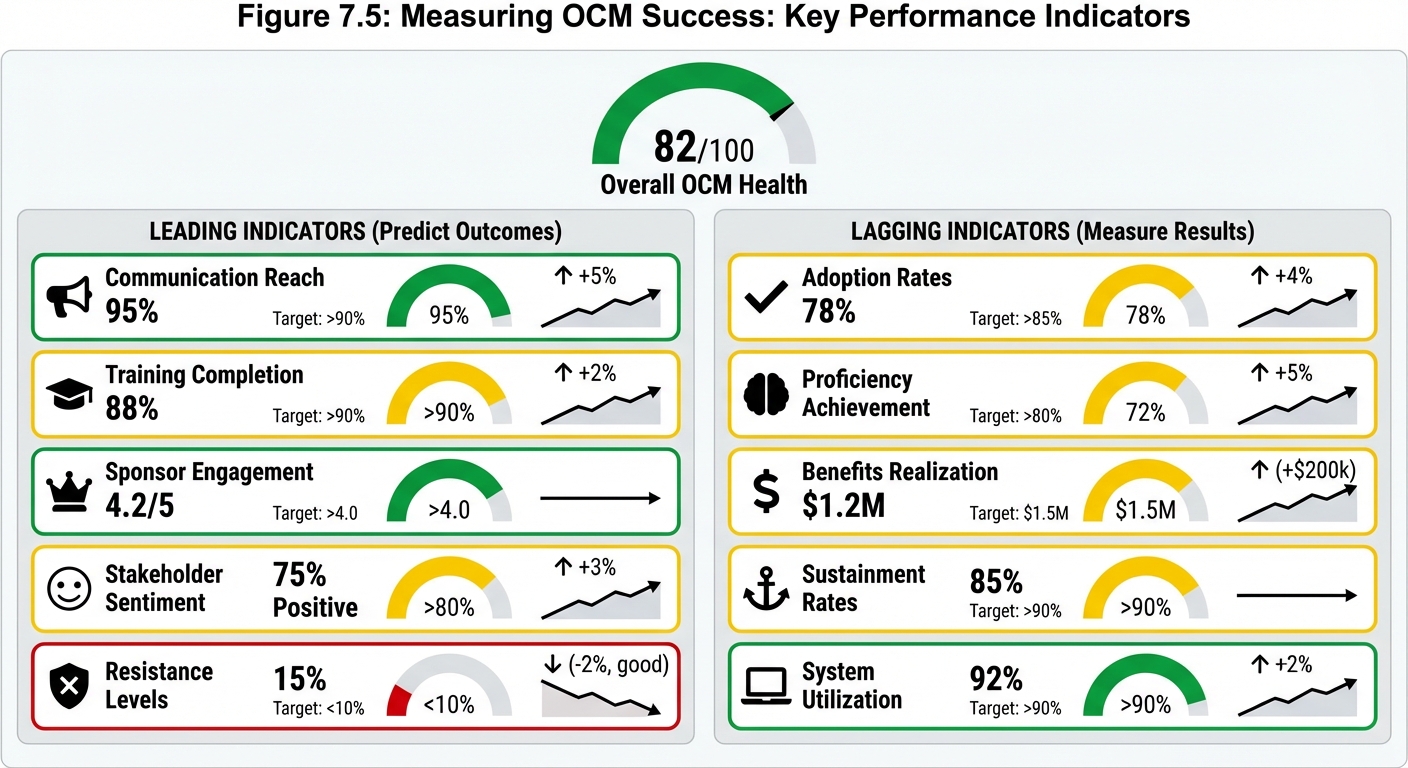
Figure 7.5: OCM success is measured through leading indicators (communication reach, training completion, sponsor engagement, sentiment, resistance) that predict outcomes, and lagging indicators (adoption rates, proficiency, benefits realization, sustainment) that measure results. Track all metrics regularly and take corrective action when indicators show at-risk or off-track status.
Key Takeaways
- OCM strategy translates assessment findings into a coherent plan of action
- Strategy must align with project objectives and integrate with project timelines
- Multiple workstreams must be coordinated: communication, training, sponsorship, resistance management, reinforcement
- Resource planning ensures adequate capacity for OCM activities
- Clear governance enables effective decision-making throughout the change
- Success metrics provide accountability and enable course correction
Summary
OCM strategy and planning transforms the insights from assessment into actionable plans that guide change activities throughout the project lifecycle. A well-developed strategy ensures that OCM activities are proactive rather than reactive, coordinated rather than fragmented, and aligned with project objectives rather than operating in isolation.
The strategy provides the foundation; the detailed plans operationalize it. Communication plans, training plans, sponsorship plans, and resistance management plans each address a critical dimension of change adoption. Together, they create a comprehensive approach to helping people successfully transition to new ways of working.
Investment in thorough strategy and planning pays dividends through more effective execution, better resource utilization, and ultimately higher adoption rates and sustained benefits realization.