Chapter 5: Stakeholder Analysis and Engagement
Learning Objectives
After completing this chapter, you will be able to:
- Systematically identify and categorize stakeholders
- Create stakeholder maps and influence diagrams
- Assess stakeholder attitudes and readiness
- Develop targeted engagement strategies for different stakeholder groups
- Manage stakeholder relationships throughout the change lifecycle
The Importance of Stakeholder Management
Stakeholder management is one of the most critical disciplines in organizational change management. The fundamental principle is simple: change happens through people, and stakeholders are the people who will determine whether change succeeds or fails. Understanding who your stakeholders are, what they care about, and how to engage them effectively is essential for change success.
Poor stakeholder management manifests in predictable ways. Critical stakeholders are overlooked until they become obstacles. Influential skeptics are ignored until their resistance spreads. Supportive stakeholders are taken for granted until their enthusiasm wanes. Resources are spread too thin trying to engage everyone equally. Messages miss the mark because they don’t address what stakeholders actually care about.
Effective stakeholder management, by contrast, identifies and prioritizes stakeholders based on their impact and influence. It develops differentiated engagement strategies that address specific stakeholder needs and concerns. It builds coalitions of supporters who advocate for change. It anticipates and addresses resistance before it solidifies. And it maintains engagement throughout the change lifecycle, not just at the beginning.
Stakeholder Identification
The first step in stakeholder management is comprehensive identification. Missing critical stakeholders early creates problems that are difficult to remedy later. Cast a wide net initially; you can always refine and prioritize later.
Stakeholder Categories
| Category | Definition | Examples |
|---|---|---|
| Sponsors | Those who authorize, fund, and champion the change | Executive sponsors, steering committee members, business owners |
| Impacted | Those whose daily work will be affected | End users, process owners, team members, customers |
| Influencers | Those who shape opinions and decisions | Managers, informal leaders, union representatives, industry experts |
| Enablers | Those who provide support and resources | IT, HR, Training, Legal, Finance, Communications |
| Interested | Those with a stake in outcomes but not directly impacted | Shareholders, partners, regulators, community |
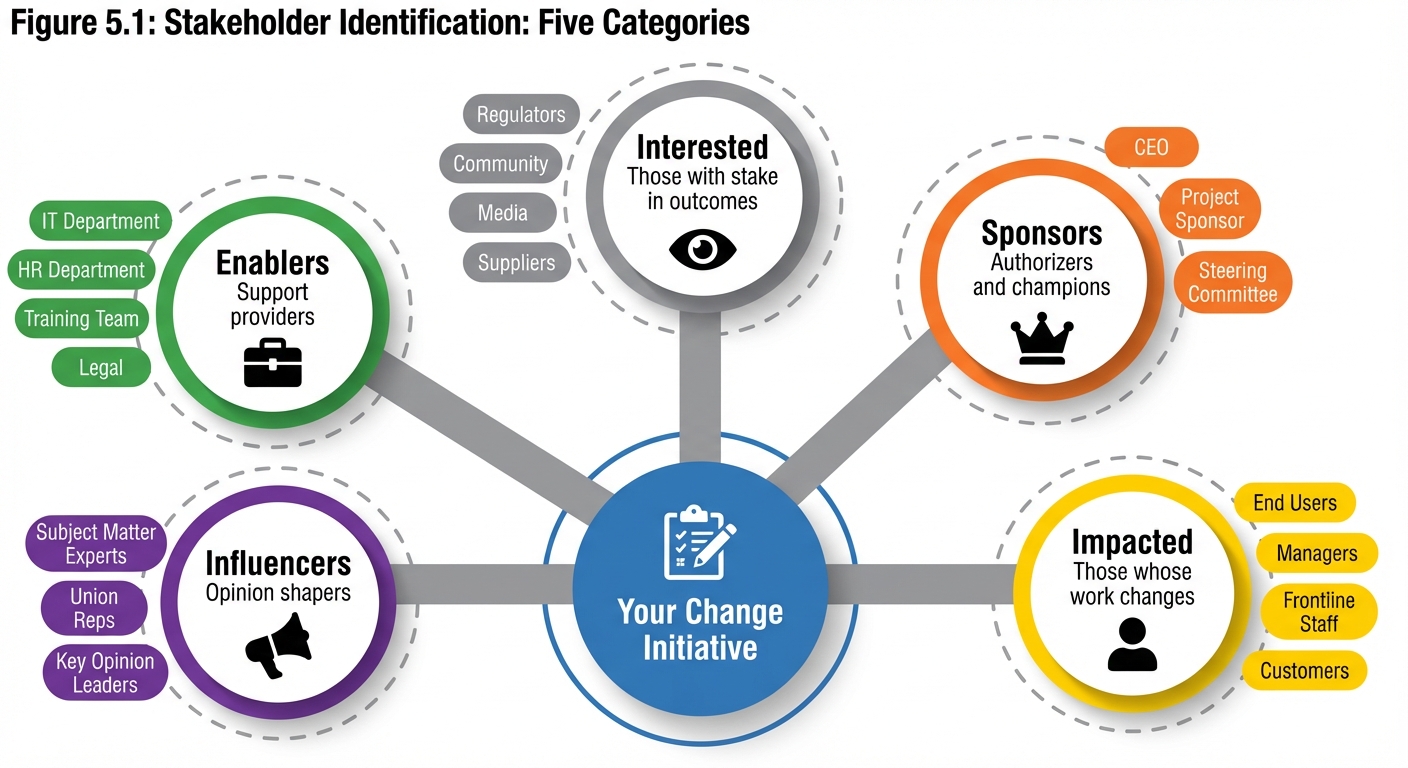
Figure 5.1: Comprehensive stakeholder identification covers five categories: Sponsors (authorizers and champions), Impacted (those whose work changes), Influencers (opinion shapers), Enablers (support providers), and Interested parties (those with stake in outcomes). Cast a wide net initially across all categories.
Identification Techniques
Organizational Analysis: Review organization charts to identify groups and individuals. Don’t stop at formal structures; consider matrix relationships, project teams, and cross-functional dependencies.
Process Mapping: Trace the processes affected by change to identify everyone who touches those processes. Include upstream and downstream dependencies.
Impact Assessment: Work from the change impact assessment to identify who will experience each impact.
Snowball Sampling: Ask identified stakeholders who else should be included. Stakeholders often know who else cares about or will be affected by the change.
Historical Review: Look at similar past changes to see who was involved or should have been involved.
Stakeholder Register
Document identified stakeholders in a stakeholder register:
| Stakeholder/Group | Category | Department | Impact Level | Influence Level | Current Attitude | Engagement Lead |
|---|---|---|---|---|---|---|
| CFO | Sponsor | Finance | Medium | Very High | Supportive | Project Lead |
| Finance Analysts | Impacted | Finance | High | Medium | Unknown | OCM Lead |
| IT Support Team | Enabler | IT | Medium | Medium | Neutral | IT Manager |
| Operations Managers | Influencer | Operations | High | High | Concerned | Sponsor |
Stakeholder Analysis
Once stakeholders are identified, analyze them to understand their position and develop appropriate engagement strategies.
Power/Interest Grid
The Power/Interest Grid is a foundational tool for stakeholder prioritization. It plots stakeholders on two dimensions: their power (ability to influence change outcomes) and their interest (degree to which they care about the change).
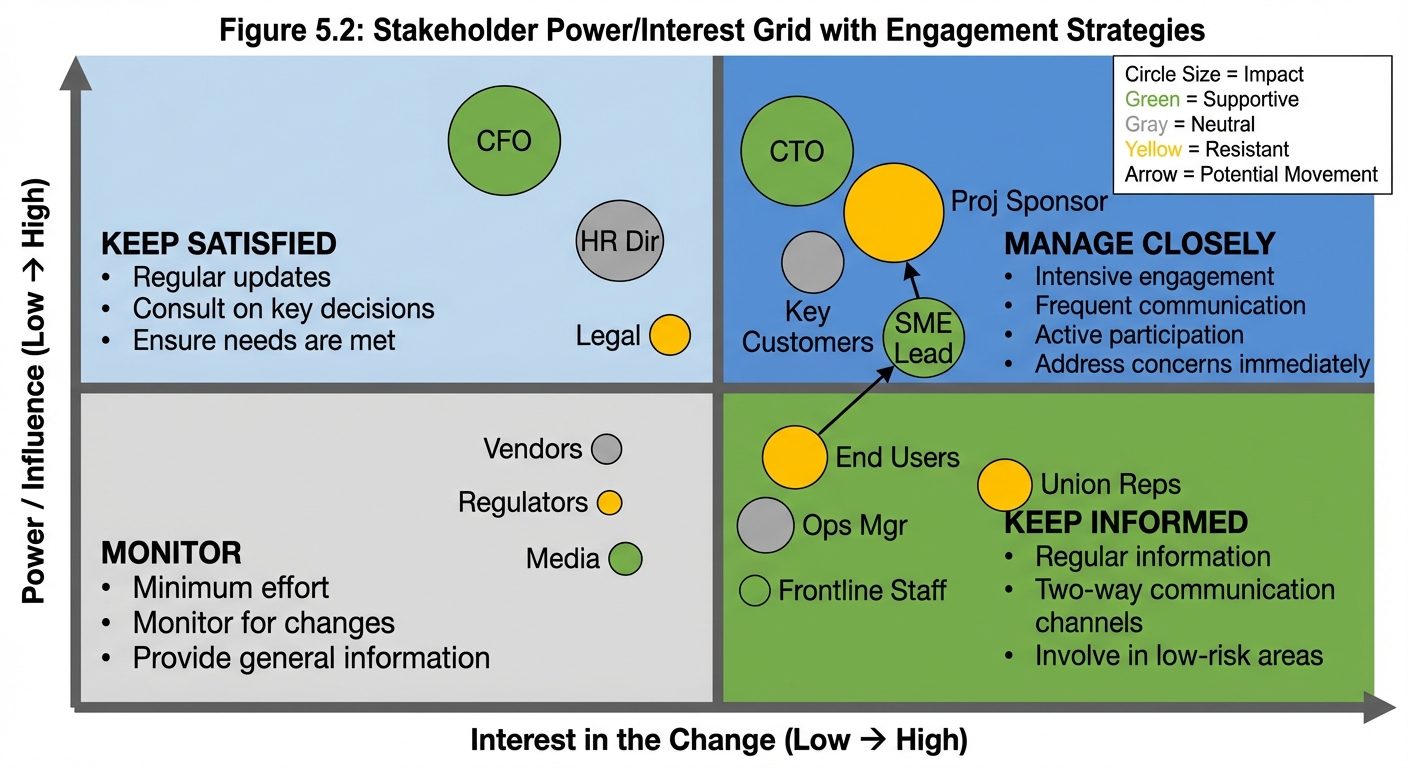
Figure 5.2: Plot stakeholders on the Power/Interest Grid to determine engagement priority. Those in “Manage Closely” (high power, high interest) require intensive engagement. Circle size indicates relative impact; color shows current attitude (green=supportive, gray=neutral, yellow=resistant).
Manage Closely (High Power, High Interest): These stakeholders can make or break your change. Invest significant time in understanding their concerns, involving them in decisions, and building strong relationships. Never surprise them.
Keep Satisfied (High Power, Low Interest): These stakeholders have power but aren’t currently focused on your change. Keep them satisfied with periodic updates and be responsive when they do engage. Monitor for increasing interest.
Keep Informed (Low Power, High Interest): These stakeholders care deeply but have limited direct influence. Keep them informed with regular communication, address their concerns, and look for ways to leverage their enthusiasm.
Monitor (Low Power, Low Interest): These stakeholders have limited impact and interest. Maintain awareness but don’t over-invest. Watch for changes in their position.
Stakeholder Assessment Matrix
Go deeper than power/interest to understand stakeholder positions:
| Stakeholder | Impact on Them | Their Influence | Current State | Desired State | Gap | Priority |
|---|---|---|---|---|---|---|
| Finance Team | High - New processes | Medium - Can slow adoption | Resistant | Supportive | Large | High |
| IT Support | Medium - Support load | Medium - User experience | Neutral | Engaged | Medium | Medium |
| End Users | High - Daily workflow | Low - Must adopt | Unaware | Proficient | Large | High |
| Operations Mgr | High - Team disruption | High - Can block | Skeptical | Advocate | Large | Critical |
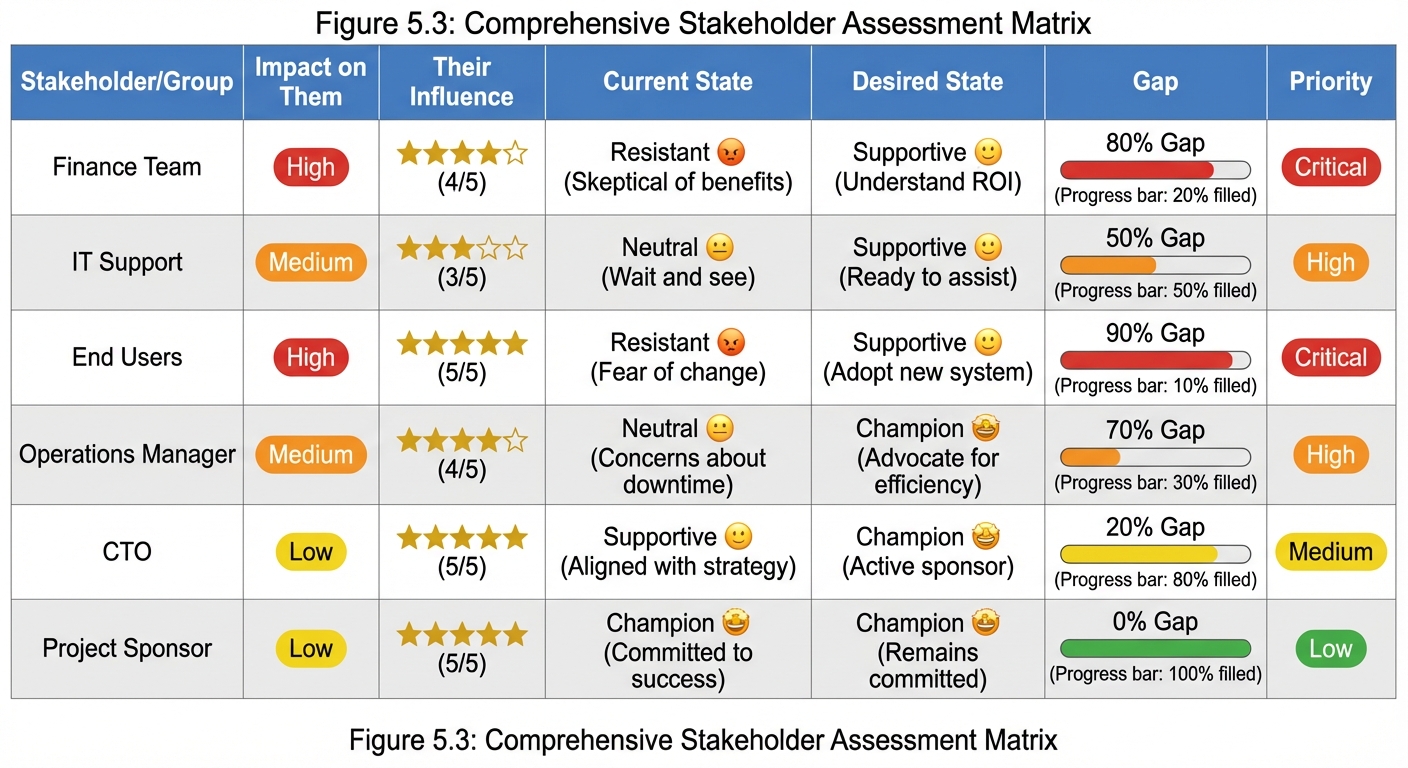
Figure 5.3: The Stakeholder Assessment Matrix provides comprehensive analysis of key stakeholders, tracking their impact, influence, current attitude, desired state, gap to close, and engagement priority. Use this to plan targeted engagement strategies for each stakeholder or group.
Understanding Stakeholder Concerns
For key stakeholders, develop deep understanding of their concerns:
WIIFM (What’s In It For Me): What benefits does this stakeholder potentially gain? What losses might they experience? Benefits must outweigh losses for willing adoption.
Fears and Concerns: What are they worried about? Job security? Competence? Workload? Status? Political position? Addressing unspoken concerns is often more important than promoting stated benefits.
Past Experiences: What has their history with change been? Past negative experiences create resistance that must be acknowledged and addressed.
Information Needs: What do they need to know? When? From whom? Match communication to specific stakeholder needs.
Decision Criteria: What factors will determine their support or resistance? Understanding decision criteria enables targeted influence.
Engagement Strategies
Different stakeholders require different engagement approaches. The engagement spectrum ranges from passive information sharing to active partnership in decision-making.
Engagement Levels
| Level | Description | Activities | When to Use |
|---|---|---|---|
| Inform | One-way communication | Newsletters, emails, announcements | Low impact, low influence stakeholders |
| Consult | Gather input and feedback | Surveys, focus groups, interviews | Need input, medium influence |
| Involve | Active participation | Workshops, working groups, pilots | High impact, need ownership |
| Collaborate | Partnership in decisions | Co-design, shared governance | High impact, high influence |
| Empower | Delegate decision authority | Delegated ownership, autonomy | Build capability, trusted stakeholders |
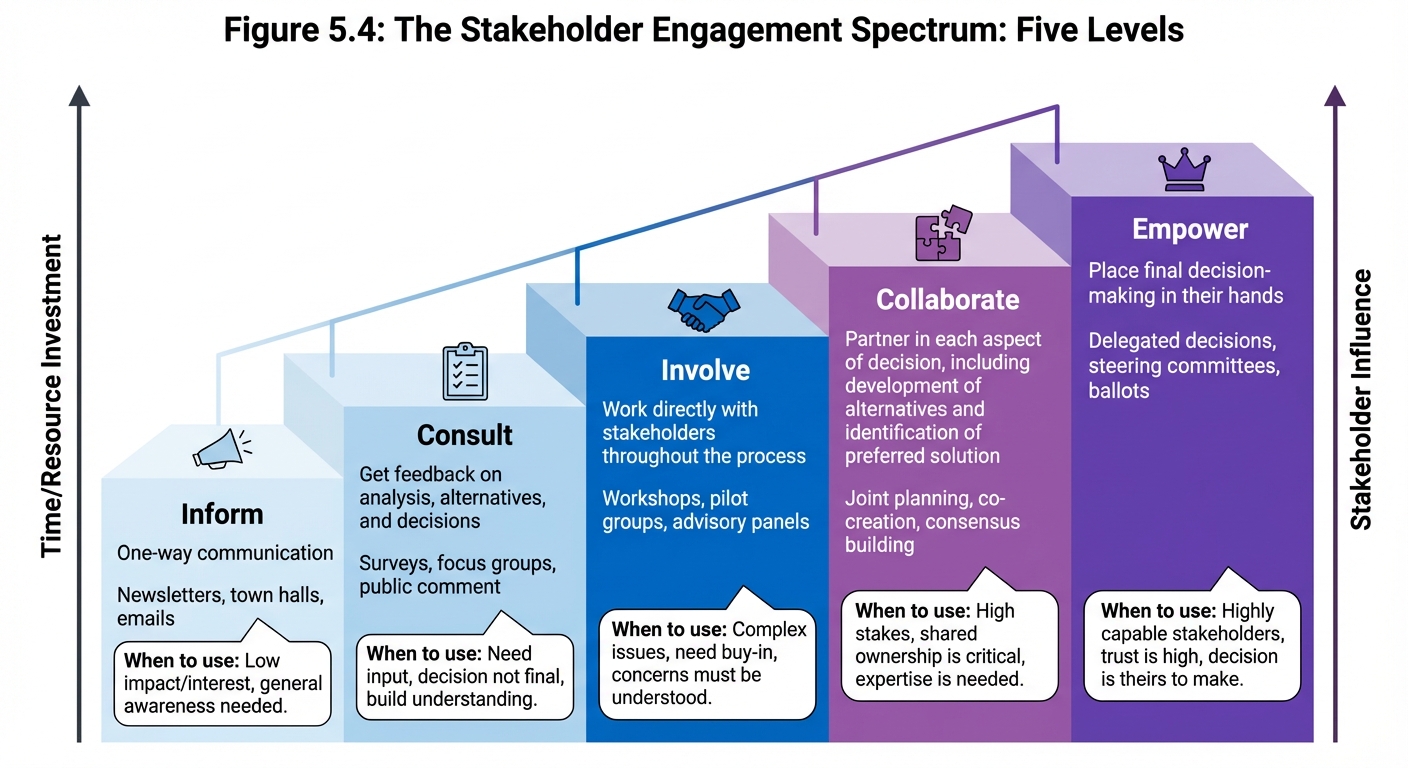
Figure 5.4: The Engagement Spectrum shows five levels of stakeholder involvement from one-way information (Inform) to delegated decision-making (Empower). Higher levels require greater time and resource investment but yield increased stakeholder influence, ownership, and commitment.
Developing Engagement Plans
For each key stakeholder or stakeholder group, develop an engagement plan:
Stakeholder: Operations Director Current Position: Skeptical - concerned about team capacity and disruption Desired Position: Active advocate who champions change with teams Engagement Strategy:
- Weekly 1:1 meetings with sponsor to address concerns
- Involve in design decisions affecting operations
- Provide early access to pilots
- Recognize as change champion once converted
Key Messages:
- This change reduces long-term workload after transition
- Operations input is essential to design success
- Additional support resources during transition
- Recognition for operations leadership
Engagement Lead: Executive Sponsor Timeline: Convert from skeptical to supportive within 4 weeks
Engaging Resistant Stakeholders
Resistance from influential stakeholders requires special attention. Strategies include:
Understand Before Influencing: Seek to understand their concerns deeply before trying to change their position. Premature influence attempts entrench resistance.
Find Common Ground: Identify shared goals and values. Frame the change in terms of what they care about.
Address Legitimate Concerns: If their concerns are valid, address them. Acknowledging problems and demonstrating responsiveness builds credibility.
Involve in Solutions: Invite them to help solve problems they’ve identified. People support what they help create.
Leverage Relationships: Identify who they trust and respect. Influence through trusted peers is often more effective than direct persuasion.
Accept Partial Support: Not every skeptic will become an advocate. Neutral cooperation may be sufficient if outright support isn’t achievable.
Stakeholder Coalition Building
Successful change requires building coalitions of supporters who can influence others. Individual stakeholder engagement matters, but collective momentum multiplies impact.
Identifying Coalition Members
Look for stakeholders who:
- Support the change and are willing to advocate
- Have credibility and influence with other stakeholders
- Represent diverse constituencies and perspectives
- Can commit time and energy to coalition activities
Coalition Activities
Coordinated Messaging: Coalition members deliver consistent messages through their networks, extending reach far beyond what the project team alone could achieve.
Peer Influence: Coalition members influence their peers through informal conversations and relationships that carry more weight than formal communications.
Problem-Solving: Coalition members identify issues early and help develop solutions that are credible to their constituencies.
Visible Support: Coalition members demonstrate visible support through their actions, signaling to others that adoption is expected and valued.
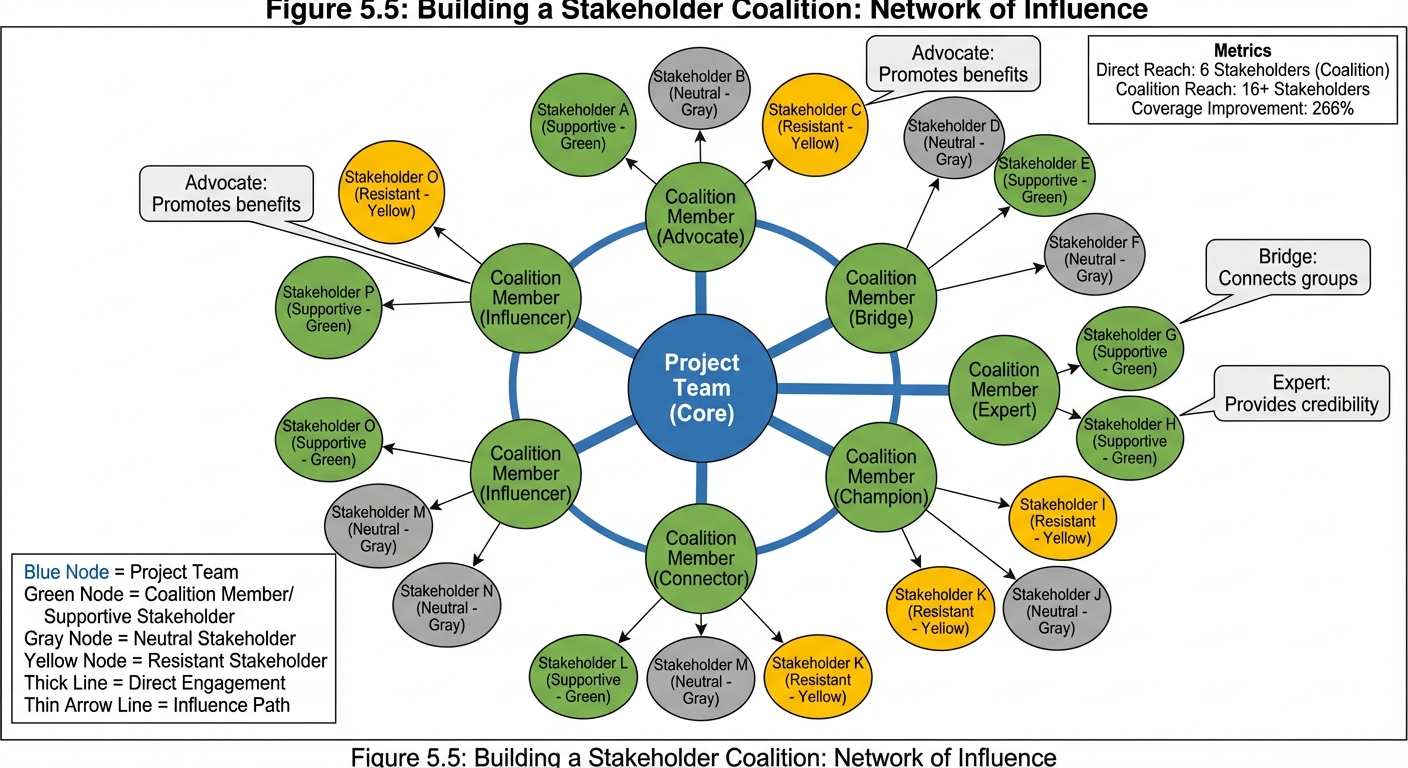
Figure 5.5: A stakeholder coalition extends project team influence through a network of supporters who can reach and influence their peers. Coalition members serve as advocates, bridges, and experts, multiplying the reach and effectiveness of change messaging.
Maintaining Coalition Energy
Coalitions require ongoing attention to remain effective:
- Regular coalition meetings to share information and coordinate
- Recognition and appreciation for coalition contributions
- Clear roles and expectations for coalition members
- Feedback on how coalition efforts are making a difference
- Addressing coalition member concerns promptly
Ongoing Stakeholder Management
Stakeholder engagement is not a one-time activity but an ongoing process throughout the change lifecycle.
Monitoring Stakeholder Positions
Stakeholder positions shift over time. Monitor through:
- Regular pulse surveys assessing sentiment
- Feedback from change agents and managers
- Participation levels in change activities
- Questions and concerns being raised
- Informal observations and conversations
Adapting Engagement
As stakeholder positions change, adapt engagement strategies:
- Increase engagement with stakeholders becoming more resistant
- Leverage newly supportive stakeholders as advocates
- Adjust messaging based on emerging concerns
- Reallocate resources to highest-priority stakeholders
Stakeholder Reporting
Track and report on stakeholder engagement:
| Metric | Current | Target | Trend |
|---|---|---|---|
| % Key stakeholders engaged | 85% | 100% | ↑ |
| % Supportive/Advocates | 45% | 70% | ↑ |
| % Resistant | 20% | <10% | ↓ |
| Sponsor engagement score | 4.2/5 | 4.5/5 | → |
Key Takeaways
- Comprehensive stakeholder identification is essential; missing key stakeholders early creates problems later
- Stakeholder analysis using tools like the Power/Interest Grid enables prioritization and targeted engagement
- Different stakeholders require different engagement approaches based on their impact, influence, and concerns
- Coalition building multiplies the reach and effectiveness of change advocacy
- Ongoing monitoring and adaptation is required as stakeholder positions evolve throughout the change
- Understanding stakeholder concerns at a deep level enables effective engagement strategies
Summary
Stakeholder analysis and engagement is a foundational OCM discipline that determines who the people are that will make or break your change, what they care about, and how to engage them effectively. Systematic identification ensures no critical stakeholders are overlooked. Analysis using frameworks like the Power/Interest Grid enables prioritization and strategy development. Differentiated engagement approaches address specific stakeholder needs and concerns. Coalition building extends influence beyond what the project team alone could achieve. And ongoing monitoring and adaptation ensures engagement remains effective as stakeholder positions evolve.
The investment in stakeholder management pays dividends throughout the change lifecycle. Organizations that excel at stakeholder engagement build support faster, identify and address resistance earlier, and achieve higher sustained adoption rates.