Chapter 4: Change Readiness Assessment
Learning Objectives
After completing this chapter, you will be able to:
- Conduct comprehensive organizational readiness assessments
- Evaluate change capacity and identify saturation risks
- Assess leadership and manager readiness for change
- Identify readiness gaps and develop targeted action plans
- Use assessment tools and templates effectively
What is Change Readiness Assessment?
Change Readiness Assessment is a systematic evaluation of an organization’s capacity, willingness, and preparation to adopt a specific change. Unlike a general organizational assessment, change readiness evaluation focuses specifically on the factors that will enable or inhibit successful adoption of a particular initiative.
The fundamental premise of readiness assessment is straightforward: organizations that are better prepared for change achieve better outcomes. Research consistently demonstrates that change initiatives launched into unprepared organizations face significantly higher failure rates. By identifying readiness gaps early, OCM practitioners can develop targeted interventions that increase the probability of success.
Readiness assessment serves multiple purposes within the OCM lifecycle. First, it provides baseline data against which progress can be measured throughout the change. Second, it identifies specific areas requiring attention before and during implementation. Third, it helps calibrate the intensity and focus of OCM activities. Fourth, it surfaces potential risks that might otherwise remain hidden until they derail the initiative.
When to Conduct Readiness Assessment
Readiness assessment should begin early in the change lifecycle, ideally during project initiation or planning phases. However, assessment is not a one-time activity. Organizations should conduct:
- Initial Assessment: During project planning to inform OCM strategy
- Pre-Implementation Assessment: Before major milestones to verify readiness
- Ongoing Monitoring: Throughout implementation to track progress
- Post-Implementation Assessment: To evaluate sustained readiness for benefits realization
Assessment Dimensions
Effective readiness assessment examines multiple dimensions, recognizing that organizational readiness is a complex, multifaceted construct. Weakness in any dimension can undermine change success, even when other dimensions are strong.
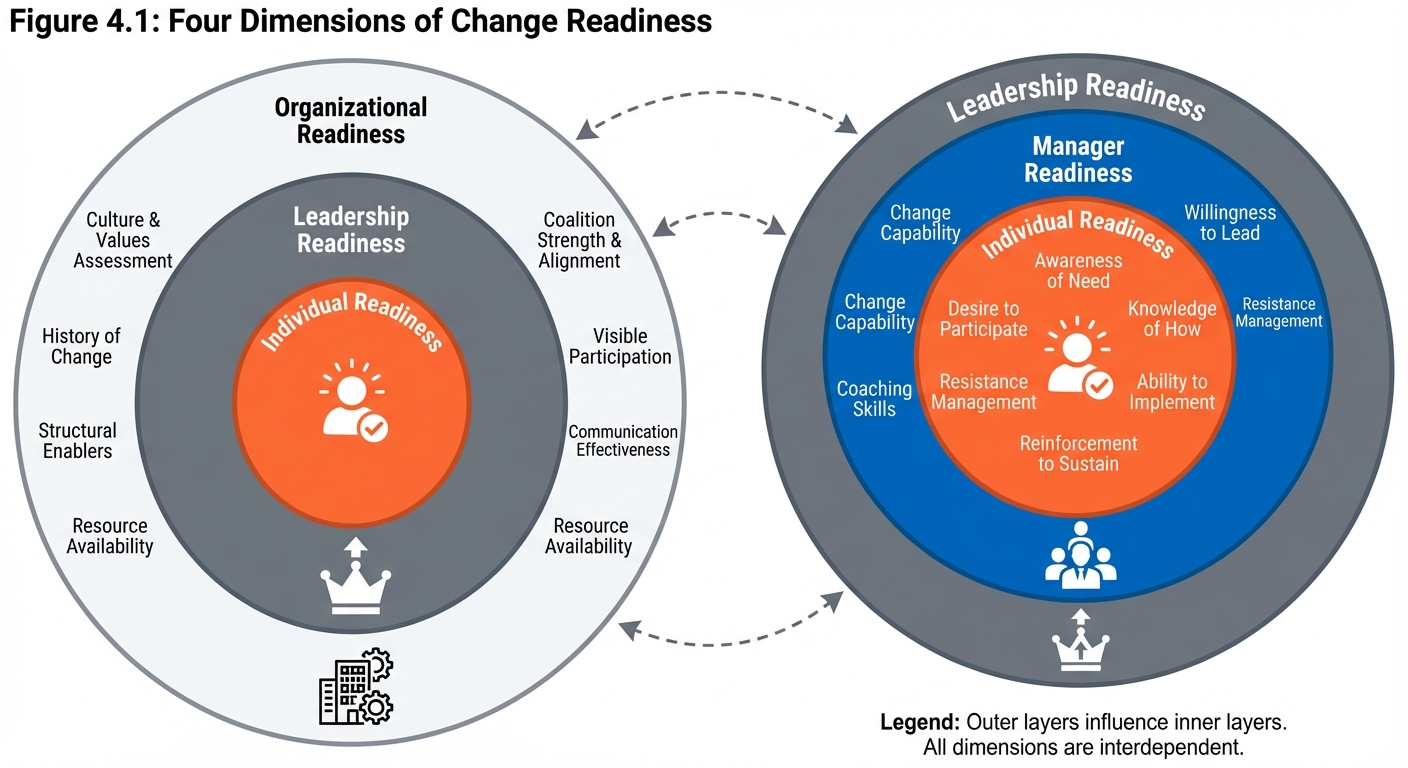
Figure 4.1: Change readiness must be assessed across four dimensions: organizational (systemic factors), leadership (sponsor support), manager (middle-management capability), and individual (personal preparedness). Each dimension influences and depends on the others.
Organizational Readiness
Organizational readiness refers to the systemic factors that affect an organization’s ability to absorb and sustain change. These factors exist at the enterprise level and influence all change initiatives, not just the current one.
Culture and Values Assessment
Organizational culture profoundly influences change readiness. Cultures that embrace innovation, value continuous improvement, and tolerate appropriate risk-taking are inherently more change-ready than those that prize stability, consistency, and risk avoidance. Key cultural factors to assess include:
| Factor | High Readiness Indicators | Low Readiness Indicators |
|---|---|---|
| Change Orientation | Change viewed as opportunity | Change viewed as threat |
| Risk Tolerance | Mistakes are learning opportunities | Mistakes are punished |
| Collaboration | Cross-functional cooperation | Strong silos and boundaries |
| Innovation | New ideas welcomed and explored | “Not invented here” syndrome |
| Trust | High trust in leadership | Skepticism about intentions |
| Communication | Open, transparent dialogue | Information hoarding |
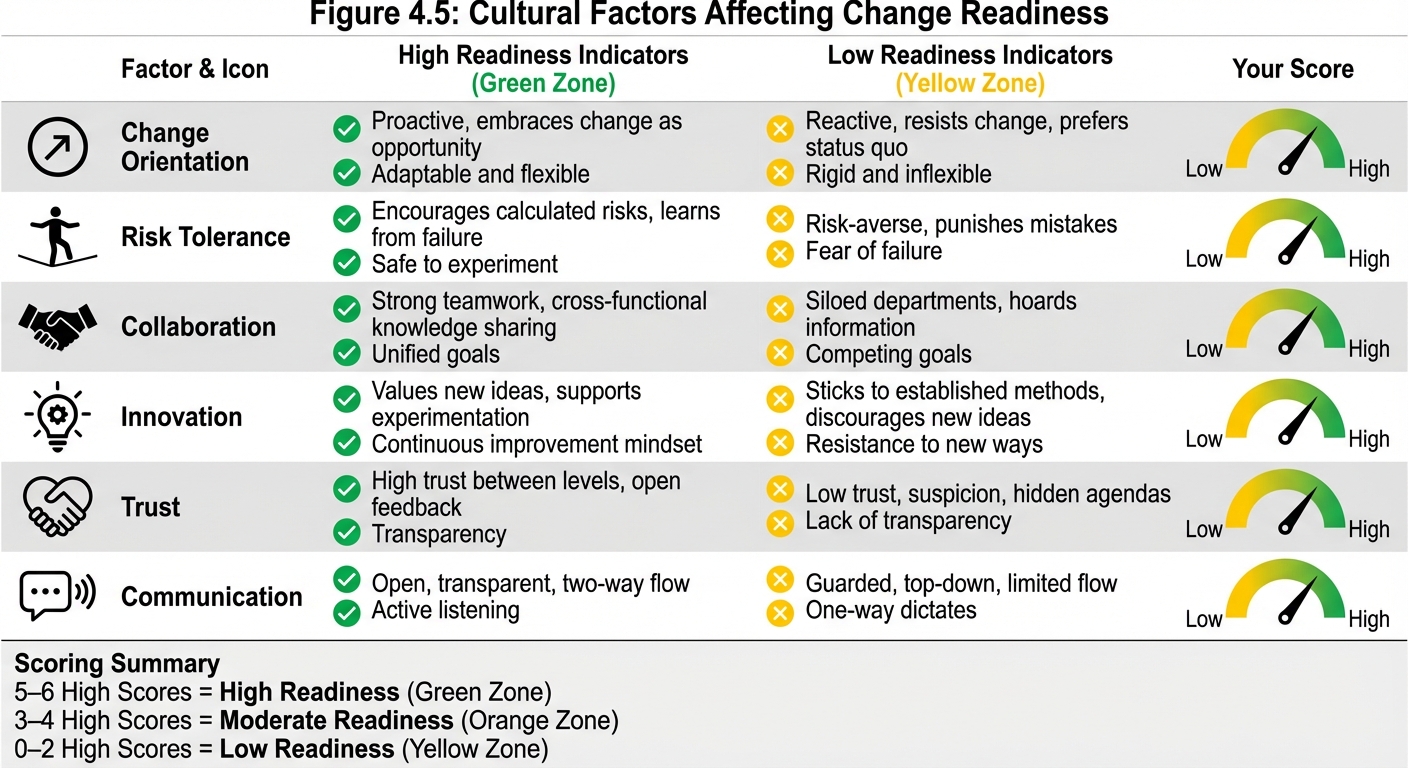
Figure 4.5: Cultural factors significantly influence change readiness. Assess your organization on six dimensions from change orientation to communication openness. Organizations scoring high (green zone) on most factors demonstrate greater change capacity than those scoring low (yellow zone).
Historical Change Performance
An organization’s history with change significantly predicts future success. Organizations that have successfully navigated previous changes have developed change muscle memory and confidence. Conversely, organizations with histories of failed changes carry baggage that manifests as cynicism, skepticism, and preemptive resistance.
When assessing historical performance, consider:
- Success rate of recent change initiatives
- How previous changes were managed (well or poorly)
- Whether promises made during previous changes were kept
- How employees who resisted were treated
- Whether benefits of previous changes were realized
Structural Factors
Organizational structure affects how change flows through the enterprise. Factors to evaluate include:
- Decision-making speed and authority distribution
- Communication pathways and effectiveness
- Resource allocation mechanisms
- Performance management alignment
- Governance structures and processes
Leadership Readiness
Leadership readiness assesses whether executives and senior leaders are prepared to actively sponsor and support the change. This dimension is critically important because sponsorship is consistently identified as the number one predictor of change success.
Sponsorship Commitment Assessment
Effective sponsors demonstrate commitment through actions, not just words. Assess sponsors on:
| Commitment Indicator | Questions to Ask |
|---|---|
| Time Investment | Will the sponsor dedicate personal time to change activities? |
| Resource Allocation | Is the sponsor willing to allocate budget and staff? |
| Political Capital | Will the sponsor spend political capital advocating for change? |
| Visibility | Is the sponsor willing to be publicly associated with the change? |
| Persistence | Will the sponsor maintain support through difficulties? |
Leadership Coalition Strength
No single sponsor can drive enterprise-wide change alone. Assess the strength of the sponsorship coalition:
- Are all necessary sponsors identified and engaged?
- Is there alignment among sponsors on vision and approach?
- Are sponsors prepared to present a unified front?
- Do sponsors have sufficient authority for their roles?
- Are succession plans in place if sponsors change?
Manager Readiness
Middle managers are the critical link between executive sponsorship and frontline adoption. Their readiness often determines whether change succeeds or fails at the implementation level.
Manager Capability Assessment
Assess whether managers have the skills to lead their teams through change:
- Understanding of the change and its rationale
- Ability to communicate change messages effectively
- Skills to coach and support employees through transition
- Capacity to identify and address resistance
- Willingness to model desired behaviors
Manager Willingness Assessment
Capability without willingness is insufficient. Assess:
- Personal support for the change
- Competing priorities and time availability
- Concerns about personal impact
- Historical relationship with change initiatives
- Trust in executive leadership
Individual Readiness
Individual readiness examines the extent to which employees are prepared to adopt new ways of working. This dimension aligns directly with the ADKAR model.
| ADKAR Element | Assessment Questions |
|---|---|
| Awareness | Do employees know change is coming? Do they understand why? |
| Desire | Are employees motivated to change? What concerns do they have? |
| Knowledge | Do employees know what to do differently? Have they been trained? |
| Ability | Can employees perform new behaviors? Are barriers removed? |
| Reinforcement | Are systems aligned? Will adoption be recognized and rewarded? |
Change Saturation Analysis
Change saturation occurs when the cumulative demands of concurrent change initiatives exceed an organization’s capacity to absorb them. Saturation is a common but frequently overlooked cause of change failure.
Recognizing Saturation
Organizations experiencing change saturation exhibit characteristic symptoms:
- Declining engagement: Participation in change activities decreases
- Increased resistance: Pushback intensifies across multiple initiatives
- Quality degradation: Adoption becomes superficial rather than genuine
- Burnout indicators: Stress, absenteeism, and turnover increase
- Competing priorities: Employees struggle to prioritize among changes
- Initiative fatigue: “Not another change” sentiment becomes pervasive
Assessing Saturation Risk
To assess saturation risk, inventory all concurrent changes affecting the same stakeholder groups:
| Change Initiative | Stakeholder Groups | Impact Level | Timeline | Status |
|---|---|---|---|---|
| ERP Implementation | Finance, Operations | High | Q1-Q4 | Active |
| Office Relocation | All departments | Medium | Q2 | Planned |
| New Performance System | All employees | Medium | Q3 | Active |
| Process Automation | Operations | High | Q2-Q3 | Active |
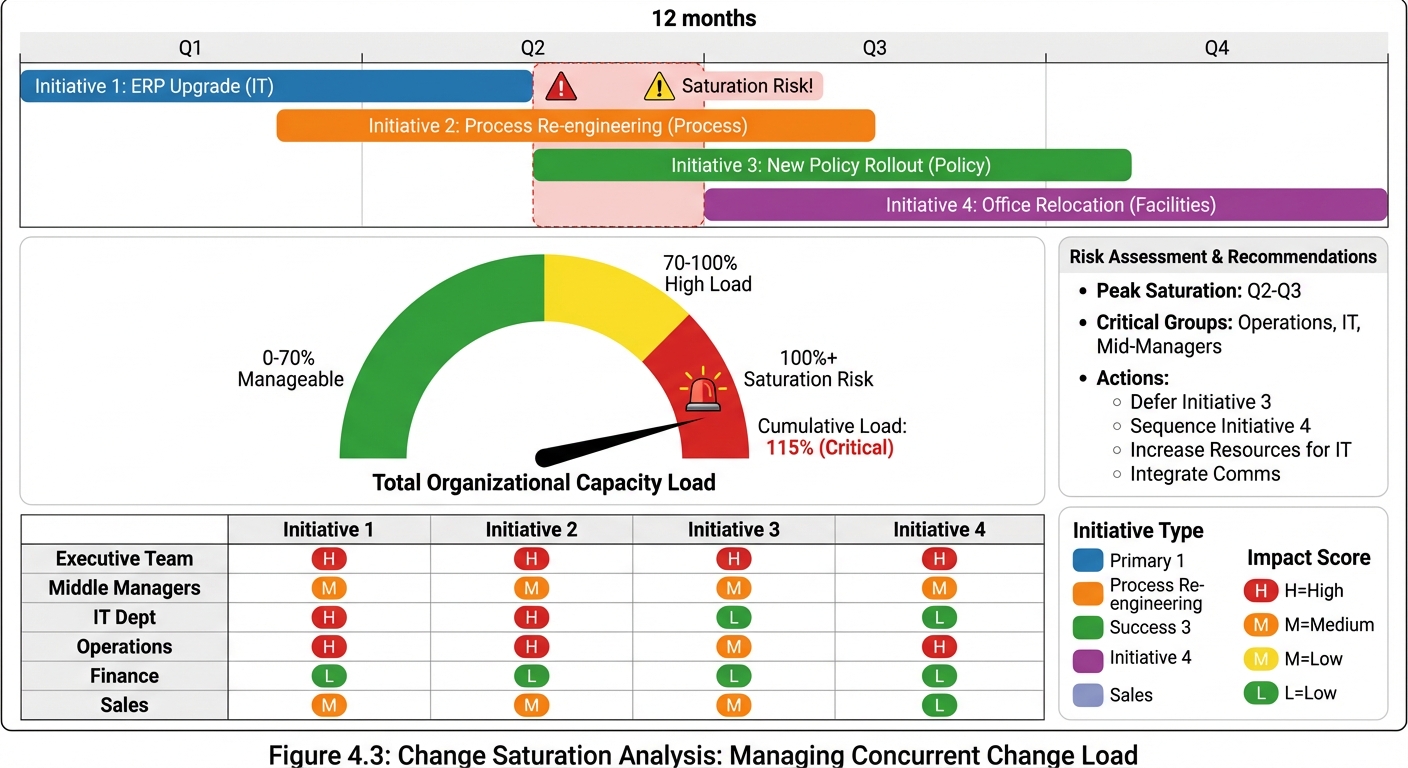
Figure 4.3: Change saturation analysis tracks concurrent change initiatives, their overlap, and cumulative impact on organizational capacity. When load exceeds 100% capacity (red zone), saturation risk requires intervention through deferral, sequencing, integration, or increased resources.
Responding to Saturation
When saturation risk is identified, several response strategies are available:
Defer or Cancel: Remove lower-priority initiatives from the portfolio Sequence: Stagger initiatives to avoid overlapping peak demands Integrate: Combine related changes into unified initiatives Reduce Scope: Scale back change scope to reduce demands Increase Capacity: Add resources to expand absorption capacity Prioritize Stakeholders: Focus limited capacity on highest-impact groups
Readiness Assessment Process
Step 1: Define Assessment Scope
Before beginning assessment, clearly define what will be assessed:
- Change Initiative: What specific change is being assessed?
- Stakeholder Groups: Which groups will be included?
- Assessment Dimensions: Which dimensions are most relevant?
- Timing: When will assessment occur relative to project milestones?
- Resources: What resources are available for assessment activities?
Step 2: Select Assessment Methods
Multiple methods should be used to ensure comprehensive understanding:
Surveys and Questionnaires
- Efficient for large populations
- Enable quantitative analysis
- Provide anonymity for honest responses
- Limited depth of insight
Interviews
- Rich qualitative data
- Ability to probe and clarify
- Build relationships with stakeholders
- Time-intensive for large groups
Focus Groups
- Group dynamics surface issues
- Efficient use of time
- Generate ideas and solutions
- May suppress minority views
Document Review
- Objective historical data
- No stakeholder burden
- Identify structural factors
- Limited to documented information
Observation
- Direct behavioral data
- Unfiltered by self-reporting
- Contextual understanding
- Observer effect concerns
Step 3: Gather Data
Execute the assessment plan with attention to:
- Consistent administration: Ensure comparable data across groups
- Confidentiality: Protect individual responses to encourage honesty
- Representation: Include diverse perspectives within stakeholder groups
- Documentation: Record findings systematically for analysis
Step 4: Analyze Results
Analysis should identify patterns, themes, and specific findings:
Quantitative Analysis
- Calculate readiness scores by dimension and group
- Compare scores against benchmarks or targets
- Identify statistically significant differences
- Track trends over time
Qualitative Analysis
- Code responses for themes
- Identify root causes behind symptoms
- Note quotes that capture key insights
- Map stakeholder concerns and questions
Gap Analysis
- Compare current state to required readiness
- Prioritize gaps by impact and urgency
- Identify root causes of gaps
- Assess difficulty of closing gaps
Step 5: Develop Action Plans
Assessment findings must translate into action:
| Gap Identified | Root Cause | Action | Owner | Timeline |
|---|---|---|---|---|
| Low awareness among end users | Communication not reaching frontline | Cascade communication through managers | OCM Lead | Week 2 |
| Manager resistance in Operations | Concern about team capacity | Meet with Operations Director to address | Sponsor | Week 1 |
| Training infrastructure gaps | No LMS access for contractors | Extend LMS access to contractor population | IT/HR | Week 3 |
Step 6: Monitor and Reassess
Readiness is dynamic and requires ongoing monitoring:
- Track progress on action plans
- Conduct pulse surveys at key milestones
- Adjust interventions based on progress
- Escalate persistent gaps that threaten success
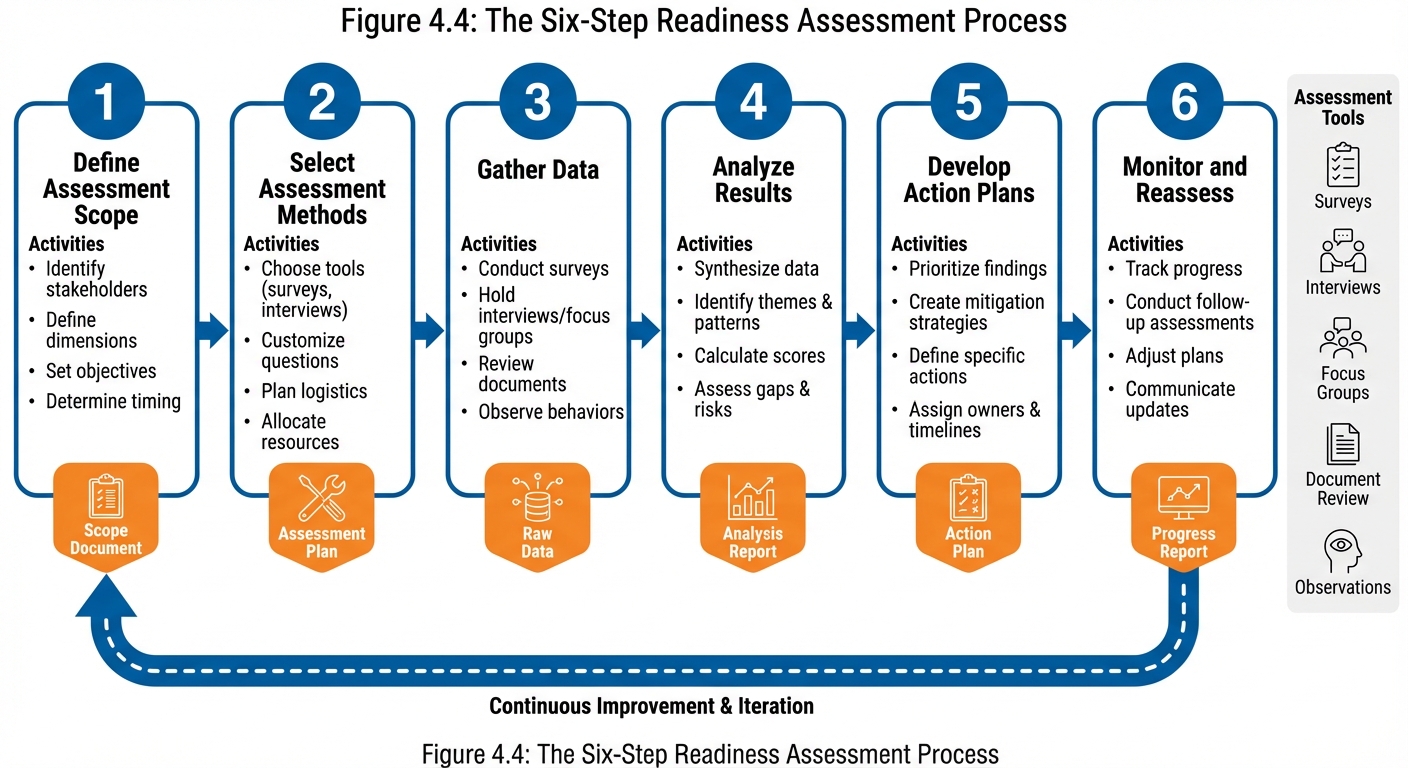
Figure 4.4: The readiness assessment process follows six steps: define scope, select methods, gather data, analyze results, develop action plans, and monitor/reassess. The process is iterative, with ongoing monitoring informing continuous assessment and adjustment.
Readiness Assessment Tools
Organizational Readiness Survey Template
A comprehensive readiness survey should cover all dimensions. Sample questions include:
Organizational Culture (1-5 scale)
- Our organization adapts well to change
- We learn from both successes and failures
- Different departments collaborate effectively
- Leadership communicates openly and honestly
- Employees feel safe raising concerns
Leadership Support (1-5 scale)
- Senior leaders are visibly supporting this change
- Adequate resources have been allocated
- Leadership has clearly explained why this change is necessary
- I trust that leaders have the organization’s best interests in mind
- Leaders are following through on commitments
Manager Readiness (1-5 scale)
- My manager understands this change
- My manager supports this change
- My manager has time to help our team through this change
- My manager can answer my questions about this change
- My manager models the behaviors this change requires
Individual Readiness (1-5 scale)
- I understand why this change is happening
- I believe this change is necessary
- I know what I need to do differently
- I have the skills to succeed with this change
- I will be recognized for adopting this change
Readiness Heatmap
Visual representation of readiness findings helps communicate results:
                    LOW         MEDIUM        HIGH
                  (1-2.5)     (2.5-3.5)     (3.5-5)
                ┌───────────┬───────────┬───────────┐
Organizational  │           │     █     │           │
Culture         │           │           │           │
                ├───────────┼───────────┼───────────┤
Leadership      │           │           │     █     │
Support         │           │           │           │
                ├───────────┼───────────┼───────────┤
Manager         │     █     │           │           │
Readiness       │           │           │           │
                ├───────────┼───────────┼───────────┤
Individual      │           │     █     │           │
Readiness       │           │           │           │
                └───────────┴───────────┴───────────┘
Key Takeaways
- Readiness assessment should occur early and continue throughout the change - it is not a one-time activity but an ongoing monitoring process
- Multiple dimensions must be evaluated - organizational, leadership, manager, and individual readiness all contribute to success
- Assessment findings must drive action - assessment without action planning is wasted effort
- Change saturation is a critical risk factor that can derail otherwise well-planned initiatives
- Multiple assessment methods provide more complete and reliable findings than any single method alone
- Readiness gaps can be closed with targeted interventions when identified early enough
Summary
Change Readiness Assessment is a foundational OCM activity that determines whether an organization is prepared to successfully adopt a change. By systematically evaluating organizational culture, leadership support, manager capability, and individual preparedness, OCM practitioners can identify gaps that threaten success and develop targeted interventions to close them.
Assessment is not a one-time checkpoint but an ongoing process of monitoring and adjustment. Organizations that invest in thorough readiness assessment and respond proactively to findings achieve significantly better change outcomes than those that proceed without this critical preparation.
The next chapter explores stakeholder analysis and engagement, building on readiness assessment to develop targeted strategies for engaging different stakeholder groups throughout the change lifecycle.