Chapter 3: Strategic Framework and Critical Success Factors
Learning Objectives
After completing this chapter, you will be able to:
- Explain the OCM strategic framework and its components
- Define and apply the 8 Critical Success Factors (CSFs)
- Understand how CSFs interconnect and support each other
- Assess organizational OCM capability against CSFs
- Develop strategies to strengthen weak CSFs
The OCM Strategic Framework
The OCM Strategic Framework provides a structured approach to managing the people side of change. It integrates proven methodologies including Prosci ADKAR, Kotter’s 8-Step Process, and ITIL 4 practices.
Framework Components
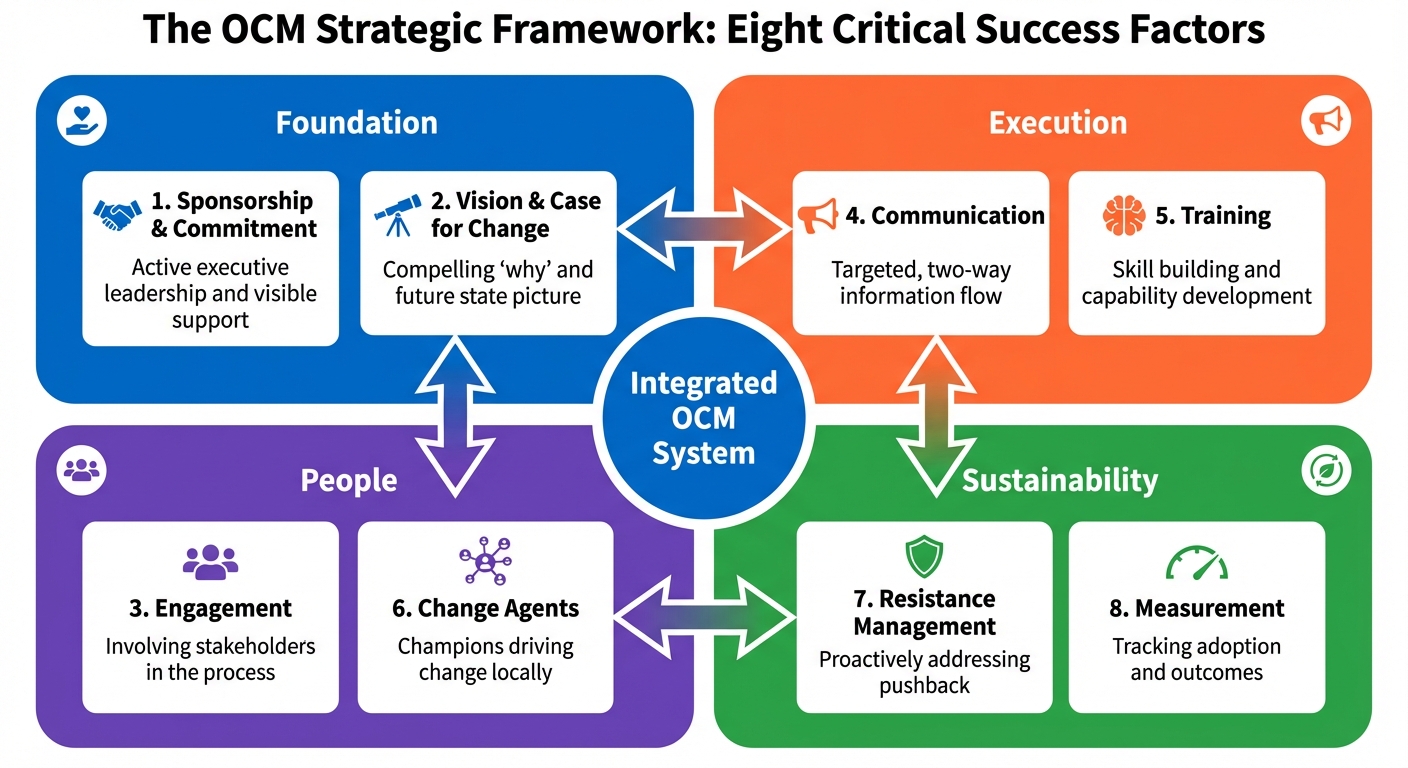
Figure 3.1: The OCM Strategic Framework organizes eight Critical Success Factors into four categories: Foundation (sponsorship and vision), People (engagement and change agents), Execution (communication and training), and Sustainability (resistance management and measurement).
The 8 Critical Success Factors
CSF 1: Executive Sponsorship and Commitment
Definition: Active and visible executive support for the change, including resource allocation, barrier removal, and consistent messaging.
Why It Matters:
- Sponsorship is the #1 predictor of change success (Prosci research)
- Executives signal organizational priority
- Resources and authority flow from sponsorship
- Resistance decreases when leadership is visibly committed
Key Indicators:
| Strong Sponsorship | Weak Sponsorship |
|---|---|
| Active participation in communications | Delegated to others |
| Visible presence at key events | Absent from change activities |
| Resources allocated and protected | Resources diverted or cut |
| Barriers actively removed | Issues escalated but unresolved |
| Consistent messaging | Mixed or contradictory messages |
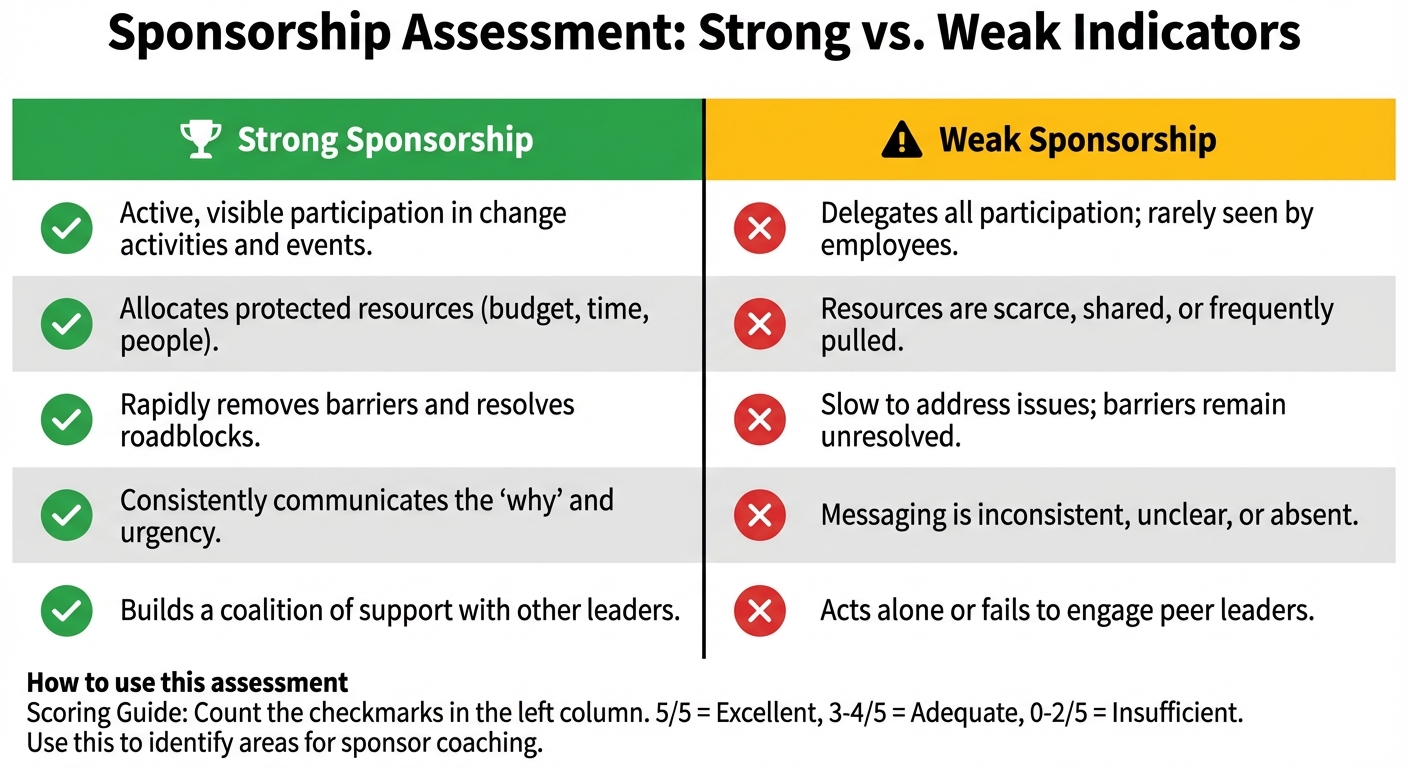
Figure 3.2: Use this assessment to evaluate sponsor effectiveness. Strong sponsorship shows active participation, visible presence, protected resources, rapid barrier removal, and consistent messaging. Count checkmarks in the left column for a quick effectiveness score.
Success Metrics:
- Sponsor engagement score (participation in planned activities)
- Resource commitment maintained (% of planned resources)
- Barrier removal time (days from escalation to resolution)
CSF 2: Clear Vision and Case for Change
Definition: A compelling narrative that explains why change is necessary, what the future state looks like, and why the chosen approach is right.
Why It Matters:
- Creates shared understanding and alignment
- Addresses “Why should I care?”
- Provides foundation for all communications
- Reduces uncertainty and speculation
Vision Components:
| Component | Description | Example |
|---|---|---|
| Current State | Where we are today | “Manual processes causing 40% of incidents” |
| Case for Change | Why we must change | “Customer satisfaction declining, costs rising” |
| Future State | Where we’re going | “Automated, efficient service management” |
| Benefits | Value to be realized | “50% faster resolution, 30% cost reduction” |
| Journey | How we’ll get there | “Phased implementation over 12 months” |
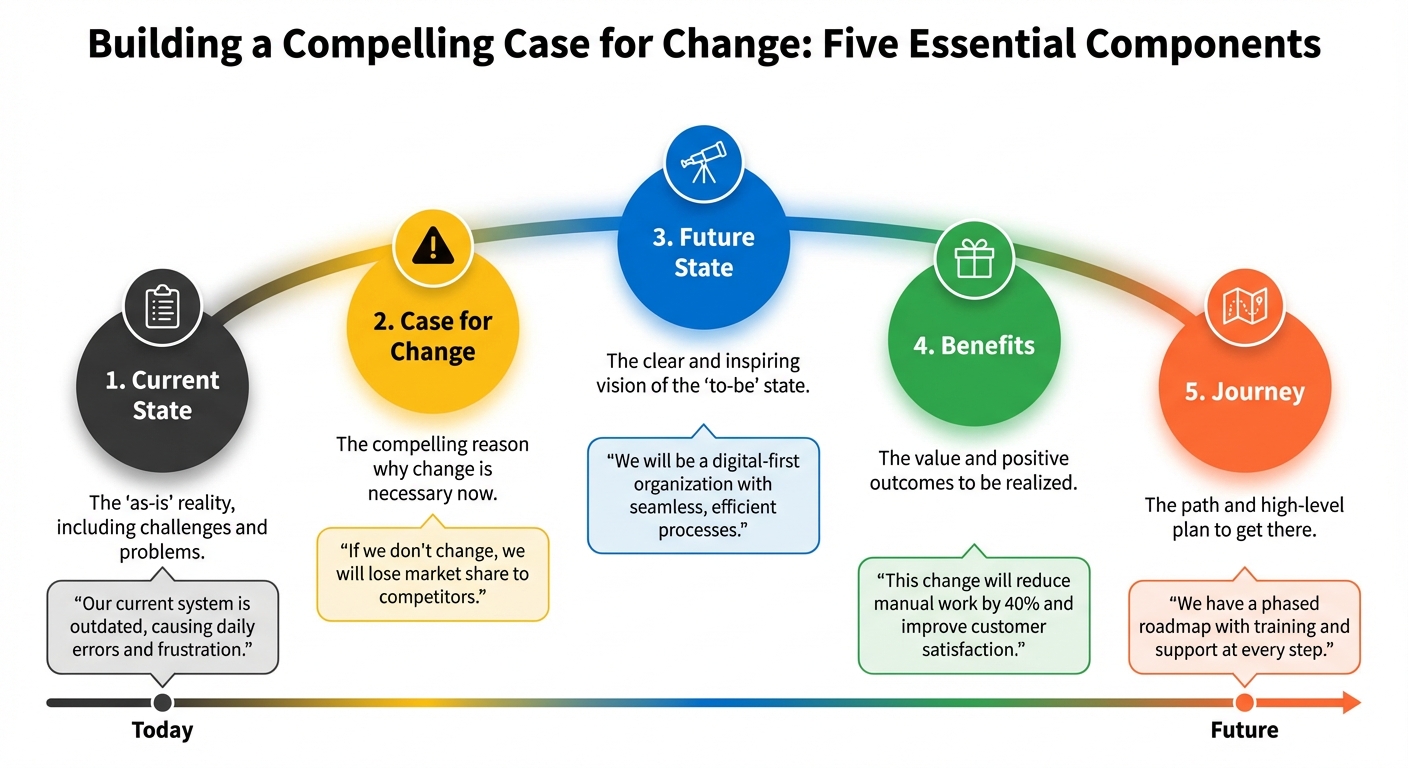
Figure 3.3: A compelling case for change articulates five essential components: the current state reality, why change is necessary, the future state vision, the benefits to be realized, and the journey to get there. Together these create a complete narrative that builds both awareness and desire.
Success Metrics:
- Awareness level (% who can articulate why change is happening)
- Message consistency (alignment of understanding across groups)
- Vision clarity score (stakeholder survey)
CSF 3: Stakeholder Engagement and Involvement
Definition: Systematic identification, analysis, and engagement of stakeholders throughout the change lifecycle.
Why It Matters:
- People support what they help create
- Early involvement identifies issues and improves solutions
- Engagement builds ownership and reduces resistance
- Stakeholders become advocates when meaningfully involved
Engagement Levels:
| Level | Description | Activities |
|---|---|---|
| Inform | One-way communication | Newsletters, emails, announcements |
| Consult | Gather input and feedback | Surveys, focus groups, interviews |
| Involve | Active participation in decisions | Workshops, working groups |
| Collaborate | Partnership in design | Co-creation sessions, pilots |
| Empower | Decision-making authority | Delegated ownership |
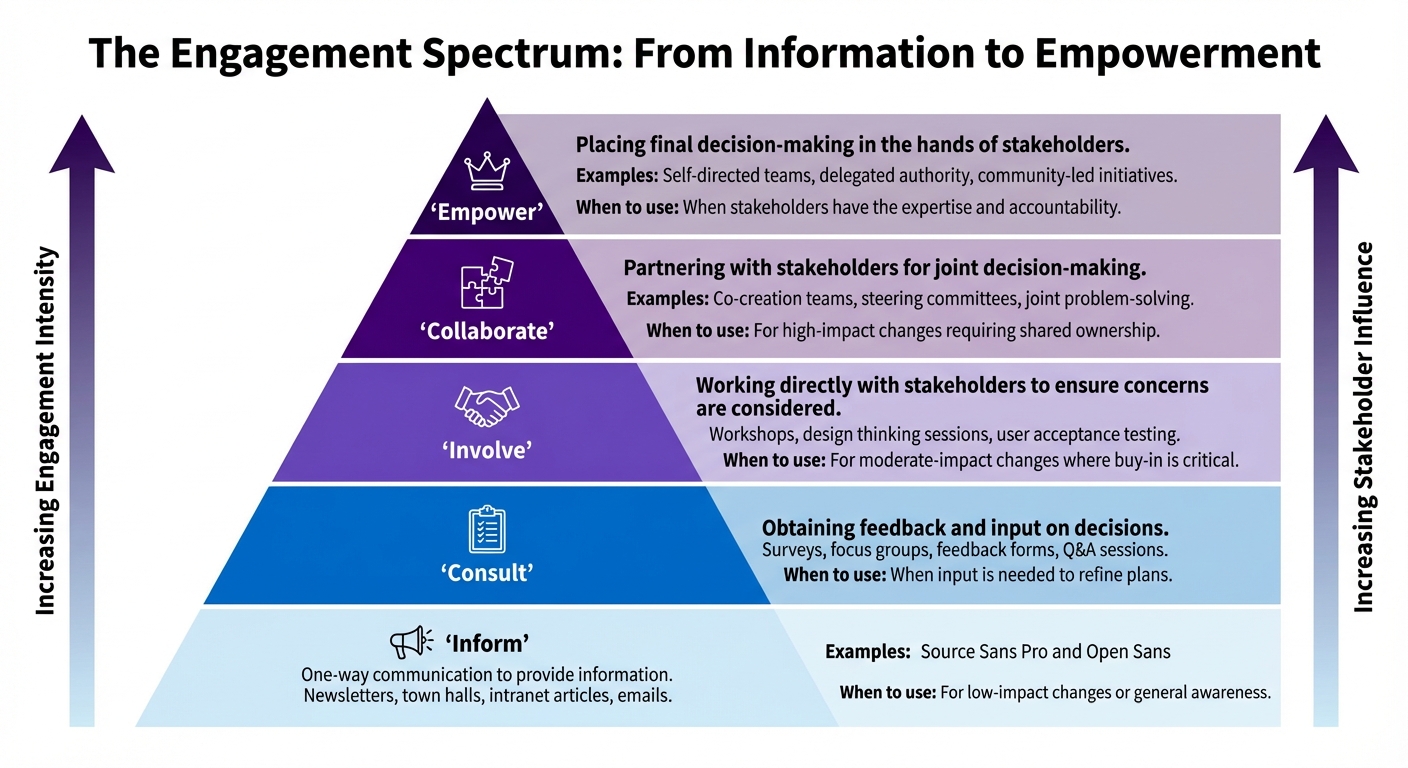
Figure 3.4: Stakeholder engagement exists on a spectrum from one-way information (Inform) to delegated decision-making (Empower). Higher levels of engagement increase stakeholder influence and commitment but require more time and resources.
Success Metrics:
- Stakeholder coverage (% engaged by group)
- Engagement quality score (stakeholder satisfaction with involvement)
- Feedback implementation rate (% of input acted upon)
CSF 4: Effective Communication
Definition: Timely, relevant, and appropriately targeted communication that addresses stakeholder information needs throughout the change.
Why It Matters:
- Communication builds awareness and understanding
- Reduces rumors and misinformation
- Demonstrates transparency and respect
- Reinforces key messages consistently
Communication Principles:
- Right Message: Content relevant to audience
- Right Audience: Targeted by stakeholder group
- Right Time: Appropriate timing in change lifecycle
- Right Channel: Medium suited to message and audience
- Right Sender: Credible source for that message
- Two-Way: Mechanisms for feedback and questions
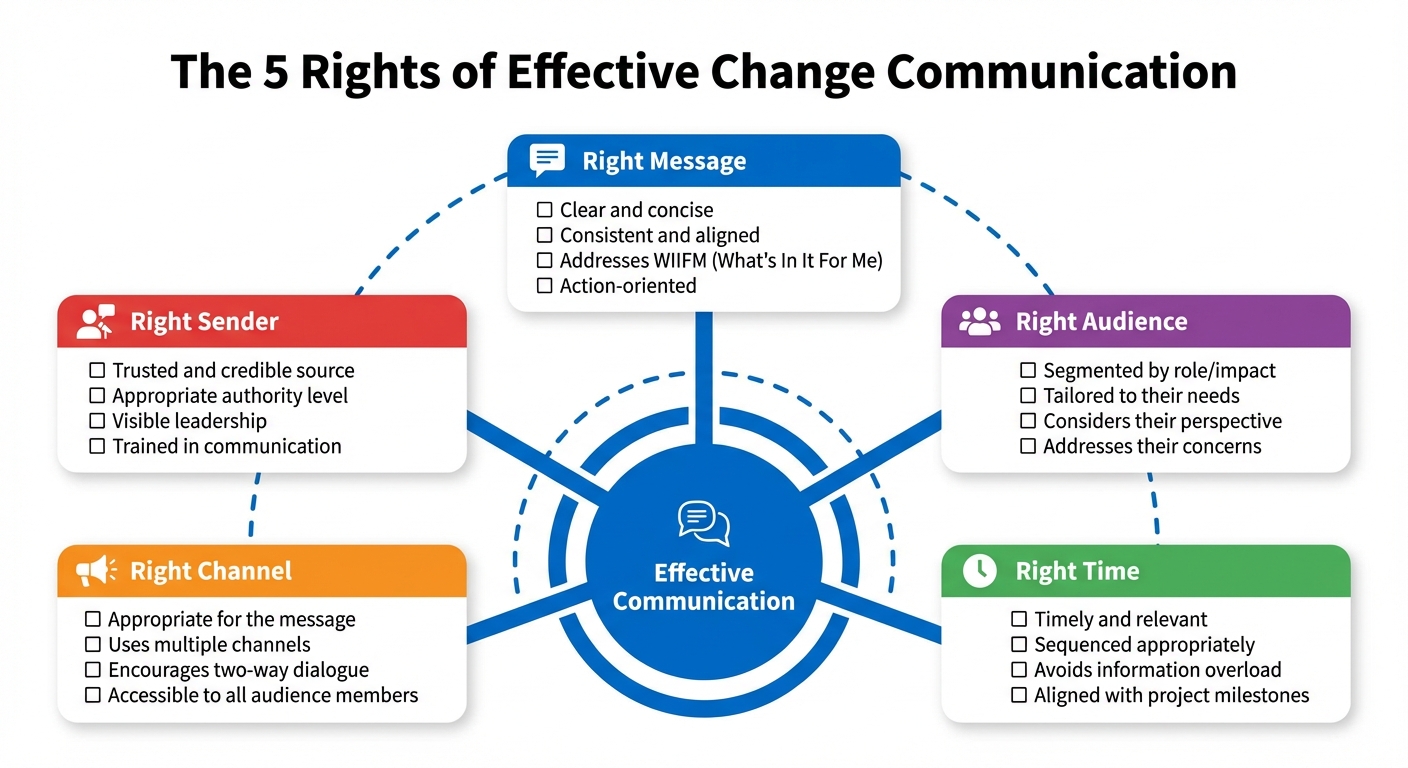
Figure 3.5: Effective change communication applies the 5 Rights framework: deliver the Right Message to the Right Audience at the Right Time through the Right Channel from the Right Sender. All five elements must align for maximum impact.
Communication Matrix:
| Audience | Key Messages | Channels | Frequency | Sender |
|---|---|---|---|---|
| Executives | Progress, risks, decisions needed | Steering committee, email | Weekly | Project Lead |
| Managers | Team impacts, how to support | Team meetings, toolkit | Bi-weekly | Sponsor |
| End Users | What’s changing, how to prepare | Town halls, intranet | Monthly | Manager |
Success Metrics:
- Communication reach (% who received key messages)
- Message comprehension (understanding checks)
- Communication satisfaction score
CSF 5: Training and Capability Building
Definition: Structured learning experiences that build the knowledge, skills, and abilities needed to succeed in the future state.
Why It Matters:
- Knowledge is prerequisite for ability
- Reduces anxiety by building confidence
- Prevents errors and rework
- Accelerates time to proficiency
Training Design Principles:
| Principle | Application |
|---|---|
| Role-based | Tailored to specific job needs |
| Just-in-time | Delivered close to when needed |
| Blended | Mix of methods (classroom, e-learning, coaching) |
| Practice-oriented | Hands-on application opportunities |
| Reinforced | Followed up with support and refreshers |
Training Effectiveness Levels (Kirkpatrick):
| Level | Measure | Methods |
|---|---|---|
| 1. Reaction | Satisfaction with training | Surveys, feedback |
| 2. Learning | Knowledge/skill acquisition | Tests, demonstrations |
| 3. Behavior | Application on the job | Observation, metrics |
| 4. Results | Business impact | KPIs, ROI |
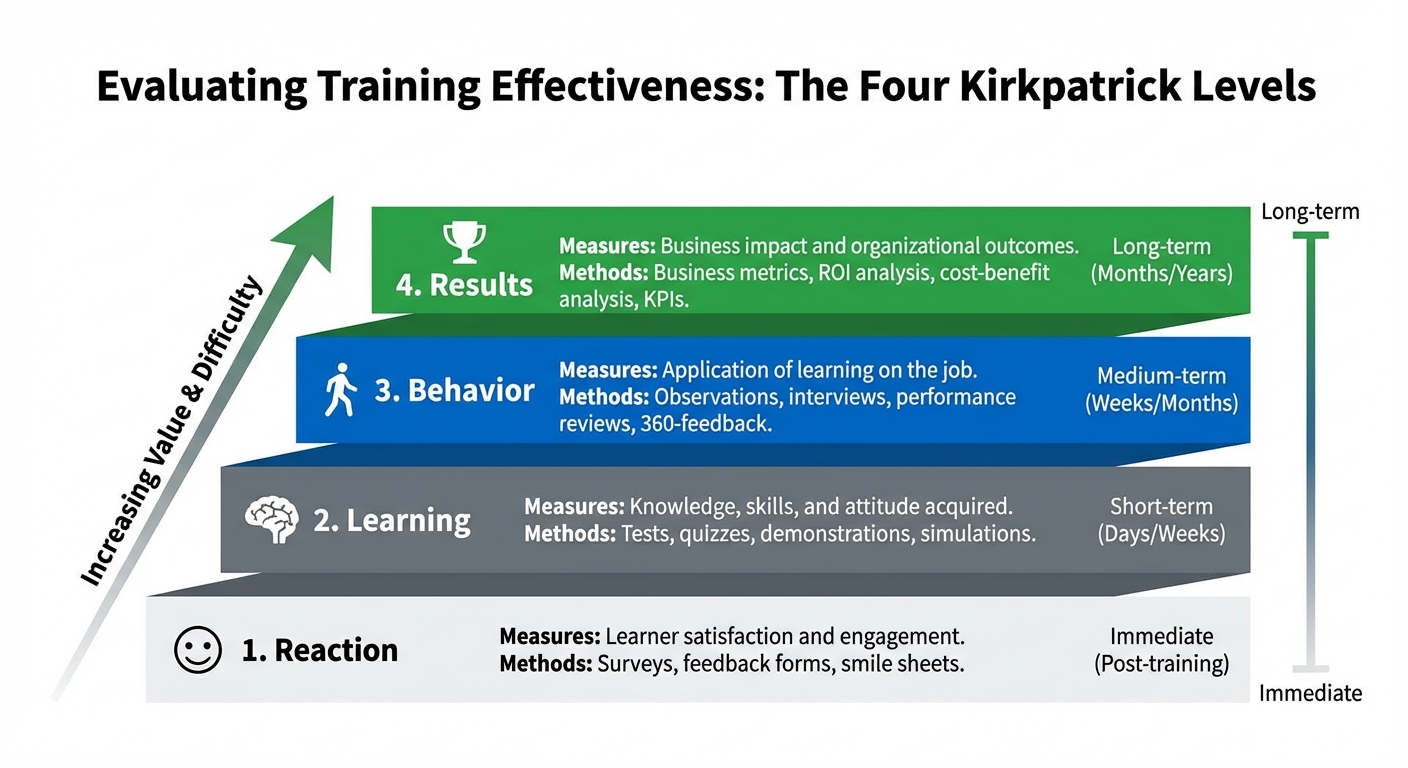
Figure 3.7: The Kirkpatrick Four-Level Model evaluates training effectiveness from immediate reaction through learning, behavior change, and ultimately business results. Higher levels require longer timeframes to measure but provide greater insight into training impact.
Success Metrics:
- Training completion rate
- Proficiency assessment scores
- Time to competency
CSF 6: Change Agent Network
Definition: A distributed network of individuals who advocate for, support, and enable change at all levels of the organization.
Why It Matters:
- Extends reach beyond project team
- Provides local, peer-level support
- Gathers ground-level feedback
- Sustains change after project ends
Network Structure:
Executive Sponsor (1)
       │
       └── Senior Change Champions (5-10)
                │
                └── Change Agents (20-50)
                         │
                         └── Peer Supporters (As needed)
Change Agent Responsibilities:
- Communicate change messages locally
- Support colleagues through transition
- Gather and escalate feedback
- Identify and report resistance
- Model desired behaviors
- Celebrate successes
Success Metrics:
- Network coverage (ratio of agents to impacted population)
- Agent engagement score
- Feedback volume and quality
CSF 7: Resistance Management
Definition: Proactive identification, analysis, and management of resistance to change throughout the lifecycle.
Why It Matters:
- Unmanaged resistance derails projects
- Early intervention is more effective
- Resistance often indicates legitimate concerns
- Addressing resistance builds trust
Resistance Management Process:
- Anticipate: Identify likely sources based on impact analysis
- Listen: Create channels for concerns to surface
- Diagnose: Understand root causes (ADKAR gaps)
- Address: Develop targeted interventions
- Monitor: Track resistance levels over time
Resistance Response Strategies:
| Root Cause | Response Strategy |
|---|---|
| Lack of awareness | Enhanced communication |
| Low desire | Sponsor engagement, WIIFM |
| Knowledge gaps | Training, demonstrations |
| Ability barriers | Coaching, support, barrier removal |
| Reinforcement issues | Recognition, accountability |
Success Metrics:
- Resistance level (% showing active resistance)
- Issue resolution time
- Resistance trend (improving/stable/worsening)
CSF 8: Measurement and Reinforcement
Definition: Systematic tracking of adoption progress and reinforcement mechanisms that sustain change over time.
Why It Matters:
- What gets measured gets managed
- Data enables course correction
- Recognition reinforces desired behaviors
- Accountability prevents backsliding
Measurement Framework:
| Category | Metrics | Target |
|---|---|---|
| Adoption | Usage rates, proficiency levels | 85%+ adoption |
| Speed | Time to proficiency | Within 60 days |
| Quality | Error rates, compliance | <5% errors |
| Satisfaction | User sentiment | 4.0+ score |
| Business | Benefits realization | 100% of projected |
Reinforcement Mechanisms:
- Recognition programs and celebrations
- Performance management alignment
- Success stories and case studies
- Compliance monitoring
- Continuous improvement actions
Success Metrics:
- Sustainment rate (adoption maintained at 6+ months)
- Benefits realization percentage
- Continuous improvement actions implemented
CSF Interdependencies
The 8 CSFs work together as a system. Note: Figure 3.6 is not available.
Key Takeaways
- 8 CSFs provide a comprehensive framework for OCM success
- Executive sponsorship is foundational - the #1 predictor of success
- CSFs work as a system - weakness in one affects others
- Each CSF has measurable indicators for tracking effectiveness
- Regular assessment against CSFs enables proactive improvement
Summary
The 8 Critical Success Factors provide a comprehensive framework for planning and executing organizational change management. Executive sponsorship forms the foundation; clear vision provides direction; stakeholder engagement builds ownership; communication creates understanding; training builds capability; change agents extend reach; resistance management addresses barriers; and measurement ensures sustainability. Together, these CSFs create the conditions for successful change adoption.