Chapter 2: Core Concepts and Definitions
Learning Objectives
After completing this chapter, you will be able to:
- Define key OCM terminology and concepts
- Explain the ADKAR model for individual change
- Understand stakeholder categories and their significance
- Describe change readiness dimensions
- Identify sources and types of change resistance
Key Definitions and Terminology
Organizational Change
An Organizational Change is any transformation that significantly affects how people work, the skills they need, organizational structures, business processes, or organizational culture.
Characteristics of Organizational Change:
- Impacts people, processes, and/or culture
- Requires behavior modification and new skill development
- Affects stakeholder experience and daily work
- Creates uncertainty and potential resistance
- Requires sustained adoption to realize benefits
Types of Organizational Change
| Type | Description | Examples |
|---|---|---|
| Structural | Changes to organizational hierarchy, reporting lines, or team composition | Reorganization, merger integration |
| Process | Changes to how work is performed | New ITSM workflows, automation |
| Technology | New systems, tools, or platforms | ERP implementation, cloud migration |
| Cultural | Changes to values, norms, and behaviors | Agile transformation, DevOps adoption |
| Strategic | Changes to business direction or model | Digital transformation, new service offerings |
The ADKAR Model
The ADKAR Model (Prosci) is the foundational framework for understanding individual change. Each letter represents a building block that must be achieved in sequence:
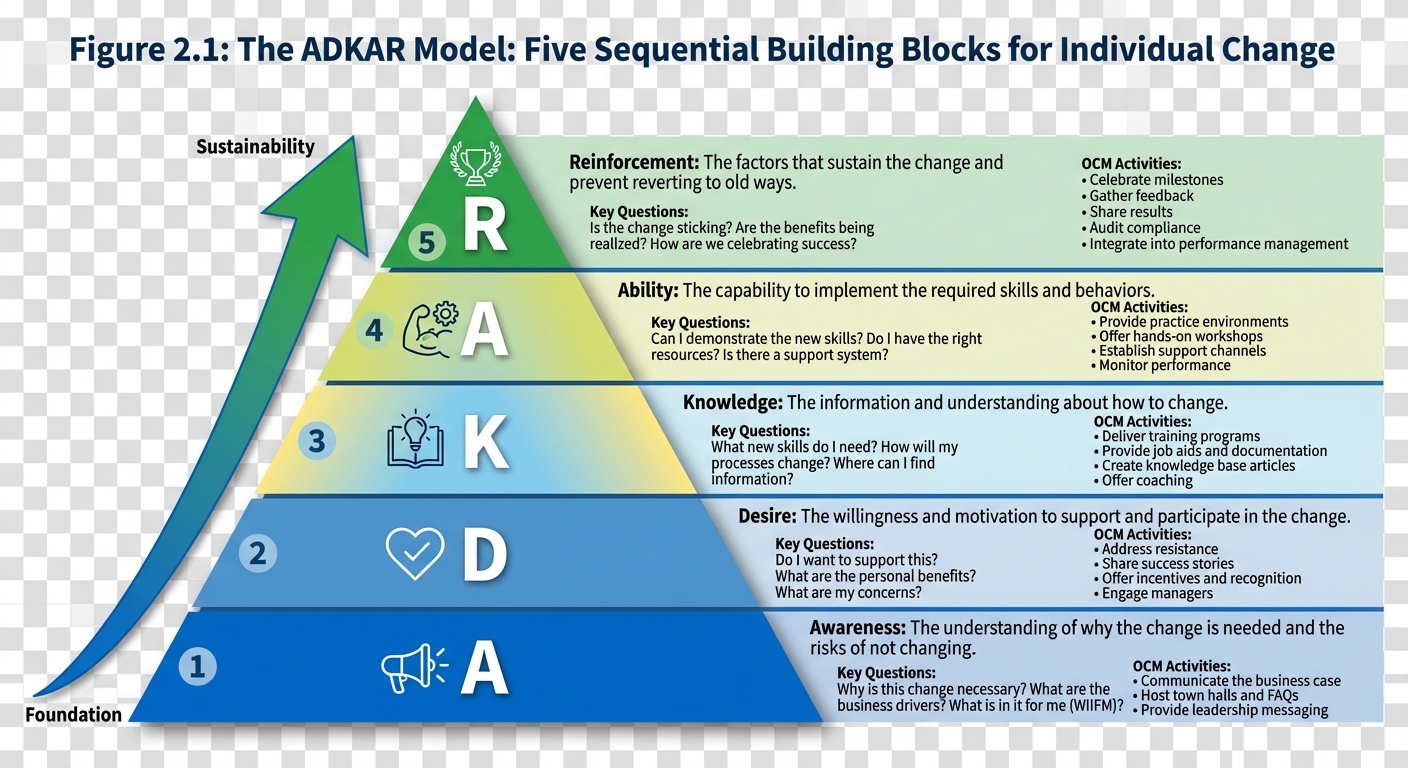
Figure 2.1: The ADKAR Model shows five sequential building blocks for individual change. Each element must be achieved before moving to the next, with Awareness and Desire as the foundation, and Reinforcement ensuring sustainability.
A - Awareness
Definition: Understanding why change is needed and the risk of not changing.
Key Questions:
- Why is this change happening?
- What is wrong with the current state?
- What are the consequences of not changing?
OCM Activities:
- Executive communications
- Business case presentations
- FAQ documents
- Town halls and information sessions
D - Desire
Definition: Personal motivation and choice to support and participate in the change.
Key Questions:
- What’s in it for me (WIIFM)?
- How does this align with my goals?
- Do I trust leadership’s intentions?
OCM Activities:
- Stakeholder engagement
- Addressing personal concerns
- Sponsor visibility
- Change agent conversations
K - Knowledge
Definition: Understanding how to change, including new skills, processes, and behaviors required.
Key Questions:
- What do I need to learn?
- How will I perform my job differently?
- Where do I get help?
OCM Activities:
- Training programs
- Job aids and documentation
- Demonstrations and pilots
- Knowledge base content
A - Ability
Definition: Demonstrated capability to implement required skills and behaviors.
Key Questions:
- Can I actually do this?
- Do I have the time and resources?
- Is the environment supportive?
OCM Activities:
- Hands-on practice
- Coaching and mentoring
- Performance support
- Removing barriers
R - Reinforcement
Definition: Actions that sustain the change and prevent regression to old behaviors.
Key Questions:
- Is this still the expected way of working?
- Am I recognized for adopting the change?
- What happens if I revert to old ways?
OCM Activities:
- Recognition programs
- Metrics and accountability
- Celebrating successes
- Corrective actions
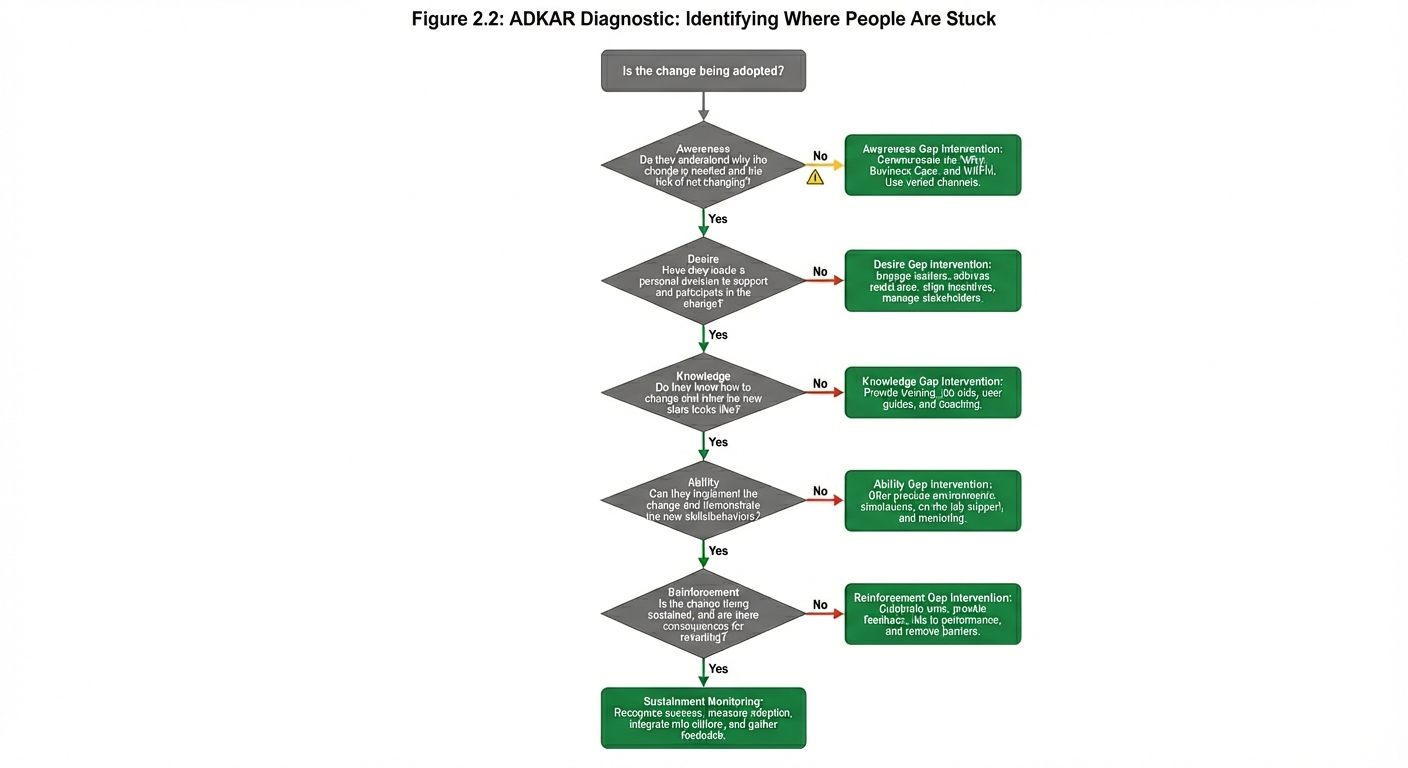
Figure 2.2: Use this ADKAR diagnostic framework to identify where individuals or groups are experiencing barriers to adoption. Each “No” response indicates a gap requiring specific interventions.
Stakeholder Categories
A Stakeholder is any individual or group that is affected by, can influence, or has an interest in a change initiative.
Primary Stakeholders
Directly impacted by the change on a daily basis.
Examples: End users, process owners, team members Focus: Training, support, adoption
Secondary Stakeholders
Indirectly affected or have influence on success.
Examples: Managers, support staff, IT teams Focus: Engagement, communication, enablement
Key Stakeholders
Critical decision-makers and influencers.
Examples: Executives, sponsors, steering committee Focus: Alignment, sponsorship, resource commitment
Affected Stakeholders
Experience operational impact from the change.
Examples: Customers, partners, vendors Focus: Communication, expectation management
Stakeholder Analysis Matrix
| Stakeholder Group | Impact Level | Influence Level | Engagement Approach |
|---|---|---|---|
| Executive Sponsors | Medium | Very High | Active sponsorship |
| Middle Managers | High | High | Change agents |
| End Users | Very High | Medium | Training & support |
| IT Support | High | Medium | Technical enablement |
| Customers | Medium | Low | Communication |
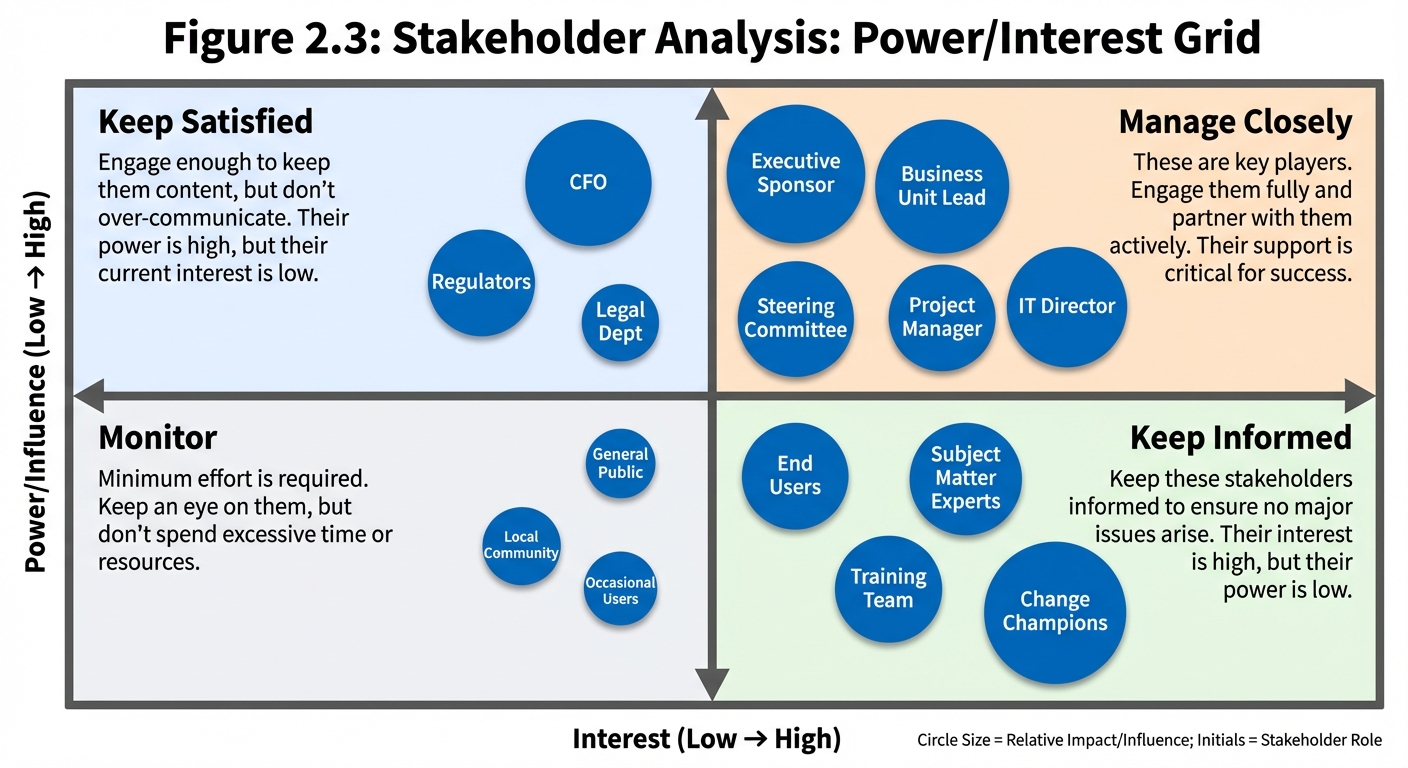
Figure 2.3: The Power/Interest Grid helps prioritize stakeholder engagement efforts. Those in the “Manage Closely” quadrant require the most intensive engagement, while those in “Monitor” require lighter touch.
Change Readiness
Change Readiness is the organizational and individual capacity and willingness to adopt a change.
Readiness Dimensions
Organizational Readiness
- Culture and values alignment
- Historical change success
- Available resources and capacity
- Organizational stability
Leadership Readiness
- Sponsorship commitment
- Active and visible support
- Coalition building
- Resource allocation
Manager Readiness
- Understanding of change
- Skills to lead teams through change
- Willingness to coach
- Personal adoption
Individual Readiness
- Awareness and understanding
- Personal motivation
- Required skills and knowledge
- Capacity to change
Readiness Assessment Questions
| Dimension | Assessment Questions |
|---|---|
| Awareness | Do people know change is coming? Do they understand why? |
| Desire | Are people motivated to change? Is resistance high? |
| Knowledge | Do people know what to do differently? |
| Ability | Can people perform new behaviors? Are barriers removed? |
| Reinforcement | Are systems aligned? Is adoption recognized? |
Change Resistance
Change Resistance is opposition, pushback, or hesitation to adopt new ways of working. Resistance is natural and should be expected.
Types of Resistance
| Type | Characteristics | Examples |
|---|---|---|
| Active | Visible, vocal opposition | Complaints, arguments, refusal |
| Passive | Subtle, non-confrontational | Ignoring, workarounds, minimal compliance |
| Covert | Hidden, undermining | Negative influence, sabotage |
Common Sources of Resistance
- Fear of the Unknown
- Uncertainty about future state
- Concern about ability to succeed
- Worry about job security
- Loss of Control
- Reduced autonomy or authority
- Changed reporting relationships
- Different processes imposed
- Past Experiences
- Previous failed changes
- Broken promises
- Change fatigue
- Lack of Trust
- Skepticism about leadership intentions
- Poor communication history
- Perceived hidden agendas
- Competence Concerns
- Fear of appearing incompetent
- Steep learning curve
- Inadequate training time
- Change Saturation
- Too many concurrent changes
- Insufficient time to adapt
- Competing priorities
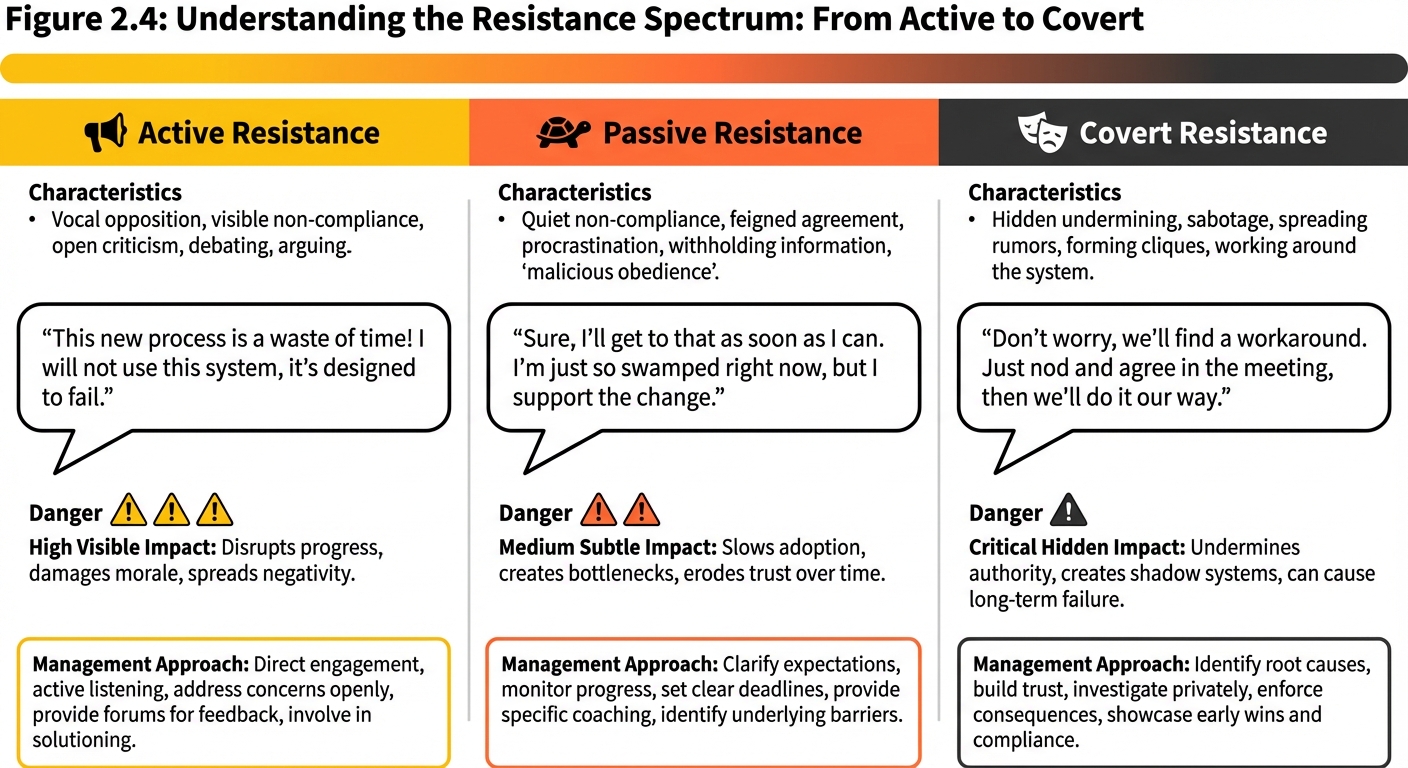
Figure 2.4: Resistance manifests in three primary forms—active (vocal and visible), passive (subtle non-compliance), and covert (hidden undermining). Understanding the type helps determine appropriate intervention strategies.
Resistance as Feedback
Important: Resistance is not inherently negative. It often provides valuable information:
- Identifies gaps in communication
- Highlights legitimate concerns
- Reveals implementation barriers
- Indicates where additional support is needed
Change Agents and Champions
Change Agent
A Change Agent is an individual who actively supports and enables change by helping others transition.
Roles:
- Communicate change messages
- Provide peer support
- Gather feedback
- Identify and escalate issues
- Model new behaviors
Change Champion
A Change Champion is a senior advocate who actively promotes and sponsors the change.
Roles:
- Visible support and advocacy
- Resource allocation
- Barrier removal
- Recognition and reinforcement
- Executive communication
Change Agent Network Structure

Figure 2.5: An effective Change Agent Network extends from executive sponsors through champions and agents to peer supporters, creating a distributed support structure that reaches all impacted employees. Typical ratio: 1 sponsor : 5 champions : 25 agents : 100+ employees.
Key Takeaways
- ADKAR provides a framework for understanding individual change: Awareness, Desire, Knowledge, Ability, Reinforcement
- Stakeholders must be categorized by impact and influence to determine engagement approaches
- Change readiness exists at multiple levels: organizational, leadership, manager, and individual
- Resistance is natural and provides valuable feedback when properly managed
- Change agents and champions are critical for cascading change throughout the organization
Summary
Understanding core OCM concepts is essential for effective change management. The ADKAR model provides a framework for diagnosing where individuals are stuck and what interventions are needed. Stakeholder analysis ensures the right engagement approaches for different groups. Change readiness assessment identifies gaps that must be addressed before and during implementation. Finally, understanding resistance as natural and informative enables proactive management rather than reactive firefighting.