Chapter 1: Introduction to Organizational Change Management
Learning Objectives
After completing this chapter, you will be able to:
- Define Organizational Change Management (OCM) in the ITSM context
- Explain why OCM is critical for IT transformation success
- Differentiate between OCM and technical change management
- Understand the change adoption lifecycle
- Recognize the business case for investing in OCM
What is Organizational Change Management?
Organizational Change Management (OCM) is the systematic approach to helping individuals, teams, and the organization transition from a current state to a desired future state by addressing the human aspects of change.
Within IT Service Management, OCM focuses on ensuring that people successfully adopt, utilize, and realize value from IT changes, new services, systems, processes, and organizational transformations.
Formal Definition
Organizational Change Management is the practice that applies structured methods and tools to enable the people side of change to achieve the desired business results. It encompasses activities and tools to manage the human dynamics of transformation including readiness assessment, stakeholder engagement, communication planning, training and development, resistance management, and adoption measurement.
Why OCM Matters in ITSM
Technology implementations frequently fail not because of technical issues, but because people don’t adopt and use the new systems effectively. Consider these statistics:
| Statistic | Source |
|---|---|
| 70% of change initiatives fail to achieve their goals | McKinsey |
| Projects with excellent change management are 6x more likely to meet objectives | Prosci |
| 33% of IT project failures are attributed to poor change management | PMI |
| Employee resistance is the #1 obstacle to successful change | Prosci Best Practices |
OCM bridges the gap between technical implementation and business value realization by ensuring that:
- Stakeholders understand why change is happening and how it benefits them
- Users are prepared and trained to adopt new systems and processes
- Resistance is identified and addressed proactively
- Leadership actively sponsors and supports change initiatives
- Organizational culture adapts to support transformation
- Change adoption is measured and sustained over time
OCM vs Technical Change Management
It’s important to distinguish between Organizational Change Management and ITIL’s technical Change Management (now called Change Enablement):
| Aspect | Technical Change Management | Organizational Change Management |
|---|---|---|
| Focus | IT infrastructure and systems | People and organizational readiness |
| Scope | Configuration items, releases | Stakeholders, culture, behavior |
| Objective | Minimize service disruption | Maximize adoption and value |
| Activities | RFCs, CAB reviews, deployment | Communication, training, engagement |
| Success Metric | Change success rate | Adoption rate, proficiency |
| Timeline | Implementation focused | Pre, during, and post implementation |
Key Insight: Both disciplines are essential. Technical change management ensures systems work correctly; organizational change management ensures people use them effectively.
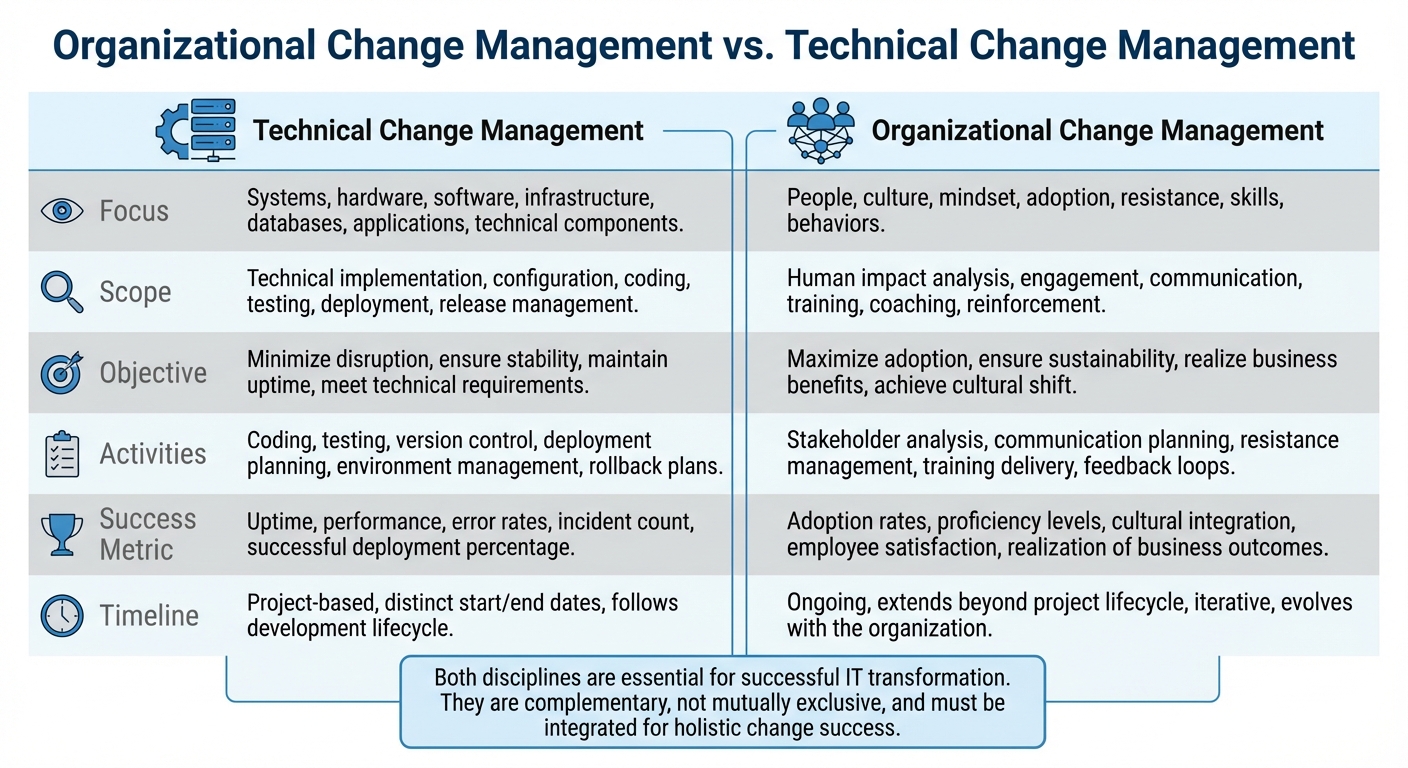
Figure 1.1: Technical Change Management focuses on systems and infrastructure, while Organizational Change Management focuses on people and adoption. Both are essential and complementary disciplines.
The Change Adoption Lifecycle
Understanding how individuals and organizations move through change is fundamental to OCM. The change adoption lifecycle consists of five stages:
Stage 1: Awareness
- Individuals become aware that a change is coming
- Key questions: “What is changing? Why?”
- OCM Focus: Communication, messaging
Stage 2: Understanding
- Individuals comprehend what the change means for them
- Key questions: “How does this affect me?”
- OCM Focus: Impact analysis, stakeholder engagement
Stage 3: Acceptance
- Individuals decide to support or resist the change
- Key question: “Am I willing to change?”
- OCM Focus: Sponsorship, resistance management
Stage 4: Adoption
- Individuals begin using new systems and processes
- Key question: “Can I do this?”
- OCM Focus: Training, support, coaching
Stage 5: Sustainment
- New behaviors become the standard way of working
- Key question: “Is this now how we work?”
- OCM Focus: Reinforcement, recognition, metrics
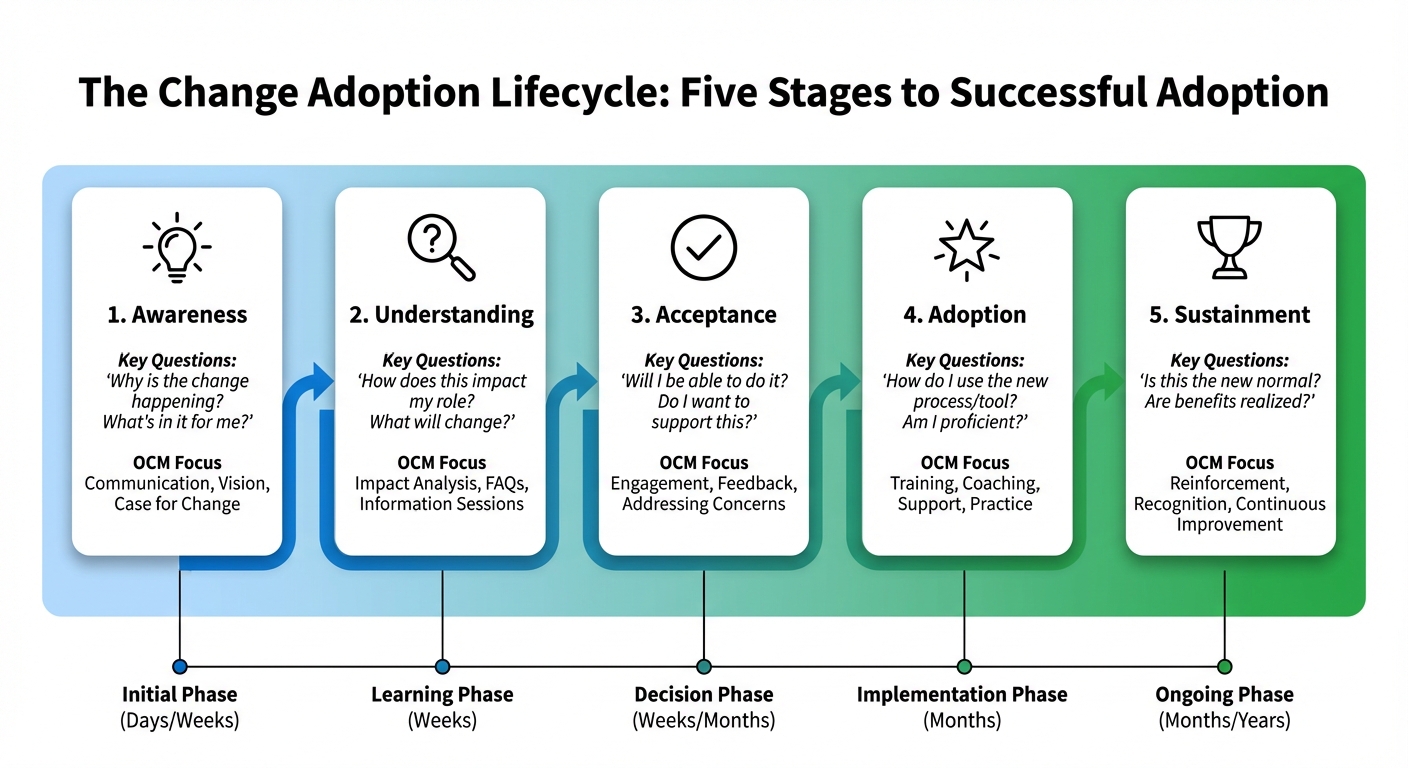
Figure 1.2: The Change Adoption Lifecycle shows how individuals progress through five stages from initial awareness to sustained adoption. Each stage requires different OCM interventions and support.
The Business Case for OCM
Investing in OCM delivers measurable business value:
Quantitative Benefits
| Benefit | Typical Impact |
|---|---|
| Faster time to proficiency | 30-50% reduction |
| Higher adoption rates | 85%+ vs 50% without OCM |
| Reduced productivity loss | 40-60% reduction in transition dip |
| Lower support costs | 25-35% fewer help desk tickets |
| Better ROI realization | 3-5x improvement in benefit capture |
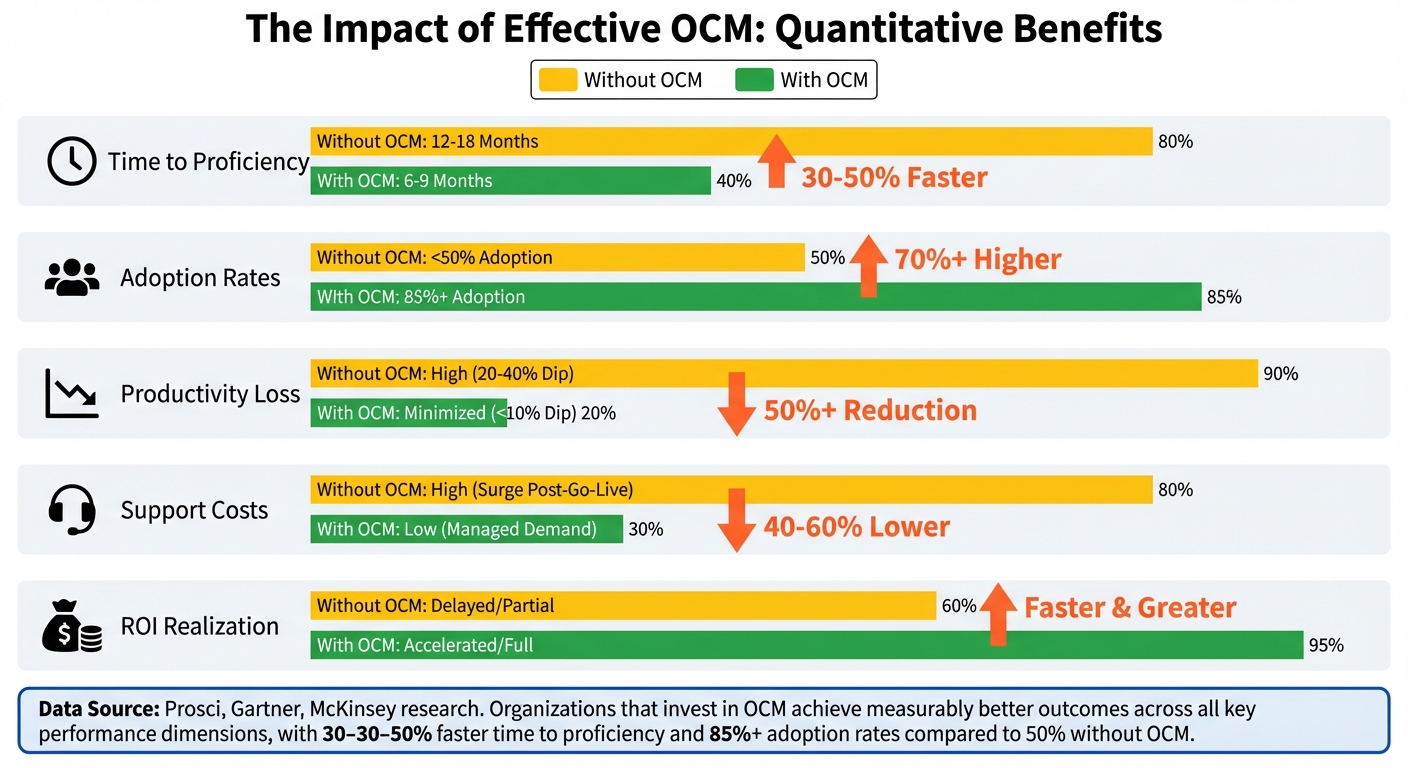
Figure 1.3: Organizations that invest in OCM achieve measurably better outcomes across all key performance dimensions, with 30-50% faster time to proficiency and 85%+ adoption rates compared to 50% without OCM.
Qualitative Benefits
- Reduced resistance and organizational friction
- Improved morale and employee engagement
- Enhanced trust between IT and business
- Stronger change capability for future initiatives
- Better alignment with strategic objectives
Cost of NOT Doing OCM
| Risk | Impact |
|---|---|
| Project delays | 2-6 months average extension |
| Budget overruns | 25-50% additional costs |
| Adoption failure | Only 30-50% of expected utilization |
| Employee turnover | 15-25% increase during poorly managed change |
| Shadow IT | Workarounds that bypass new systems |
OCM in the ITIL 4 Framework
ITIL 4 recognizes Organizational Change Management as a distinct practice within the Service Value System. It aligns with:
Guiding Principles
- Focus on value: OCM ensures change delivers intended benefits
- Start where you are: Assess current state and readiness
- Progress iteratively: Engage stakeholders throughout
- Collaborate and promote visibility: Communication and engagement
- Think and work holistically: Address people, process, and technology
- Keep it simple and practical: Fit-for-purpose approaches
- Optimize and automate: Continuous improvement
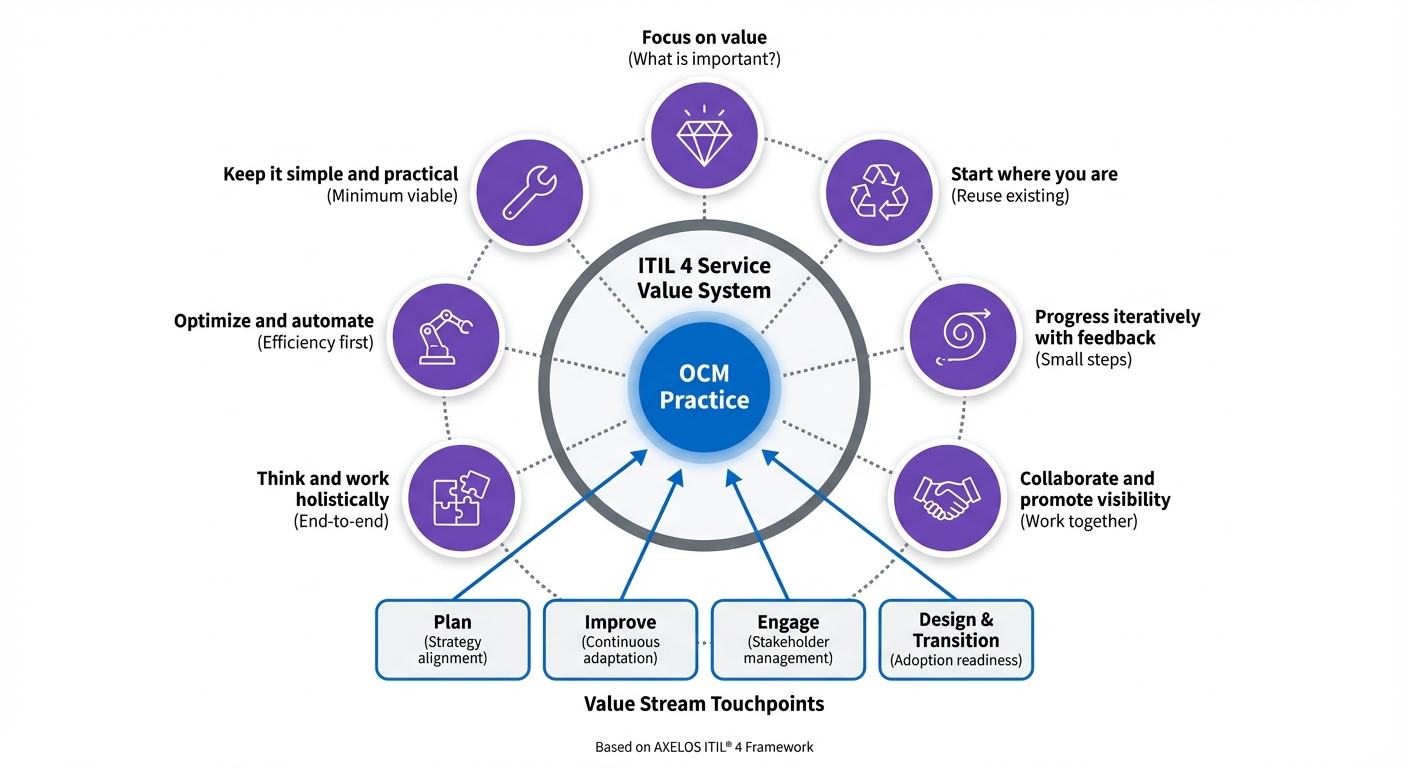
Figure 1.4: OCM is positioned as a critical practice within the ITIL 4 Service Value System, supporting all seven guiding principles and contributing to value creation across the service lifecycle.
Value Streams
OCM contributes to value streams by:
- Enabling smooth service transitions
- Accelerating value realization
- Building organizational capability
- Supporting strategic initiatives
Key Takeaways
- OCM addresses the people side of IT change, complementing technical change management
- 70% of changes fail primarily due to people-related issues, not technical problems
- The change adoption lifecycle moves through awareness, understanding, acceptance, adoption, and sustainment
- Investment in OCM delivers measurable ROI through faster adoption and higher value realization
- ITIL 4 recognizes OCM as a critical practice for service management success
Summary
Organizational Change Management is the discipline that ensures IT transformations succeed by focusing on the people who must adopt and use new systems, processes, and ways of working. Without effective OCM, even technically perfect implementations will fail to deliver expected business value.
The statistics are clear: organizations that invest in OCM are significantly more likely to achieve their change objectives, realize benefits faster, and build lasting capability for future transformations.
As we progress through this handbook, you will learn the frameworks, tools, and techniques needed to plan and execute effective organizational change management for IT initiatives of any scale.
Chapter Navigation
| Previous | Next |
|---|---|
| Home | Chapter 2: Core Concepts and Definitions |